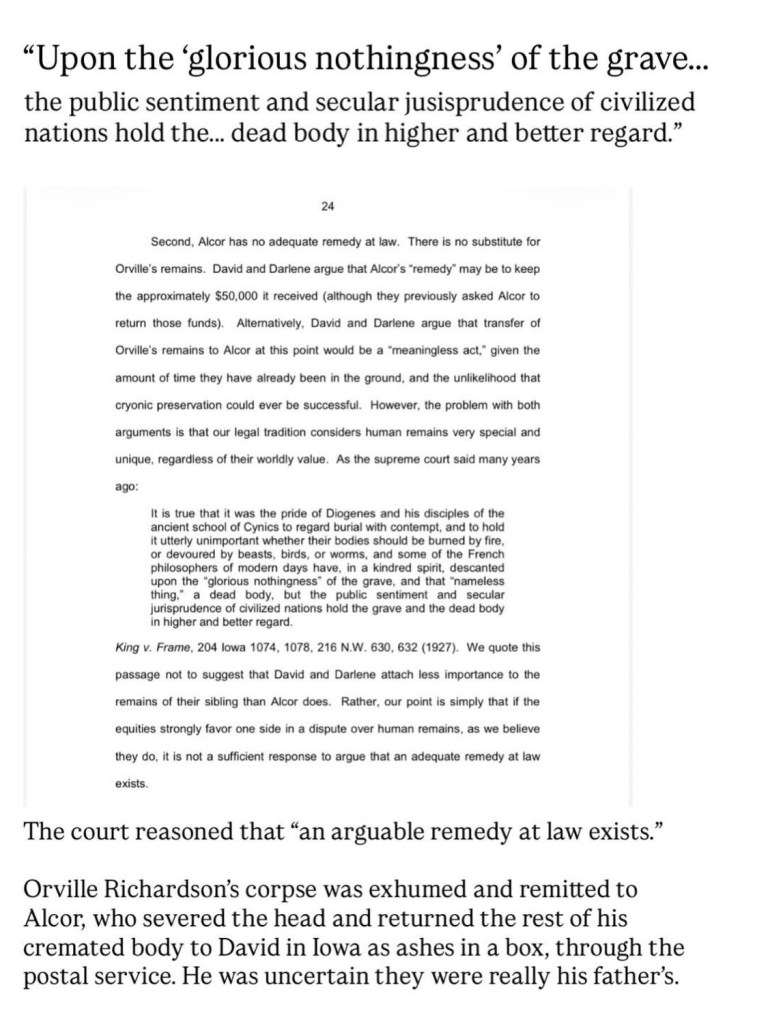
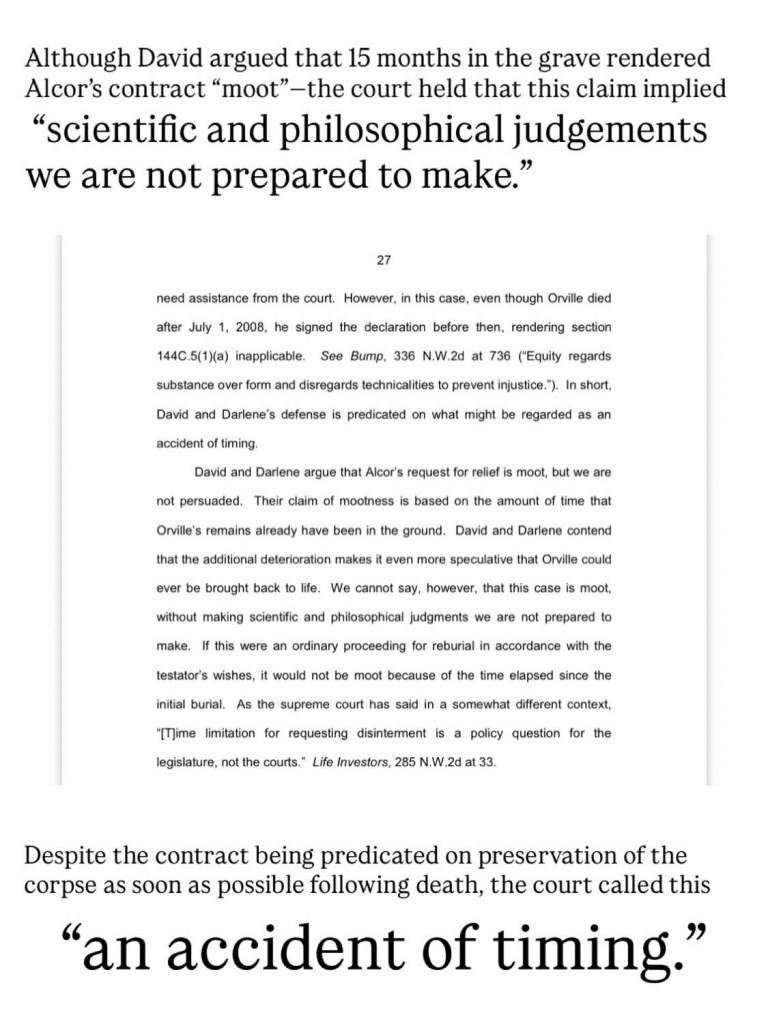
“…an arguable remedy at law exists…”
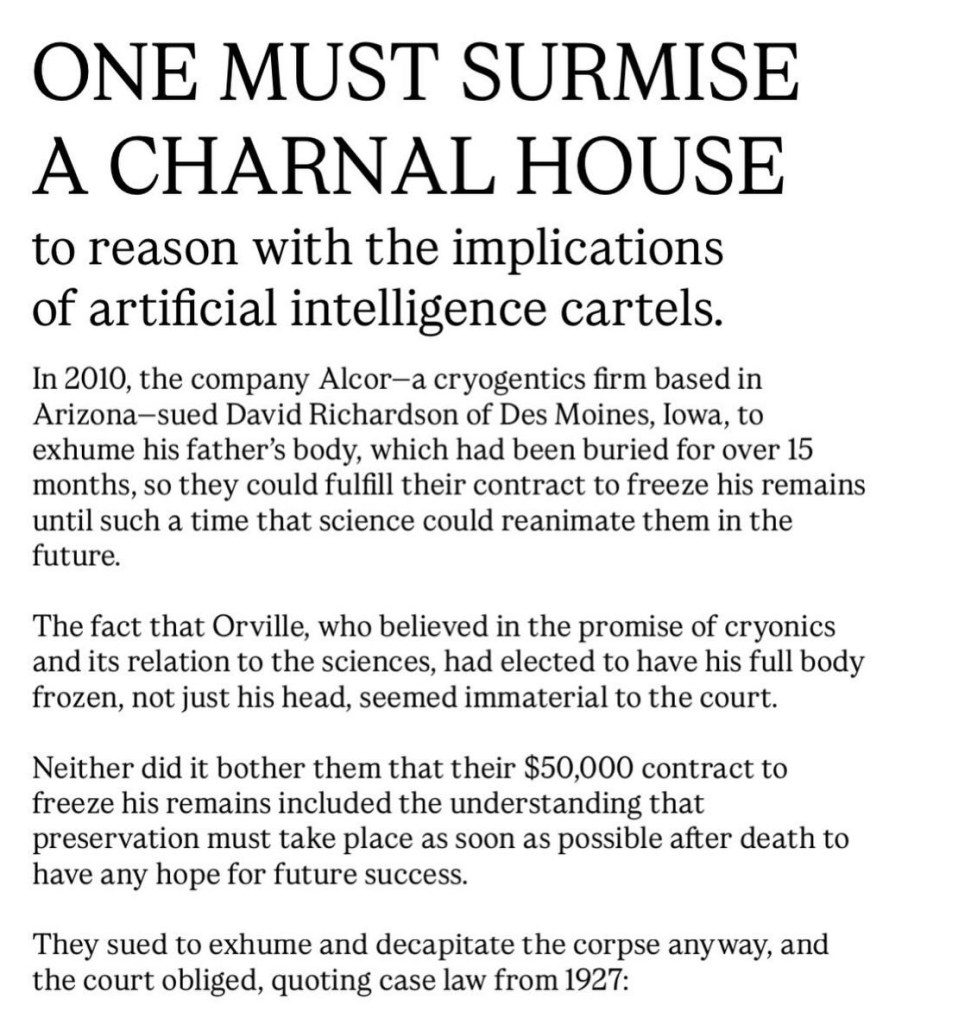
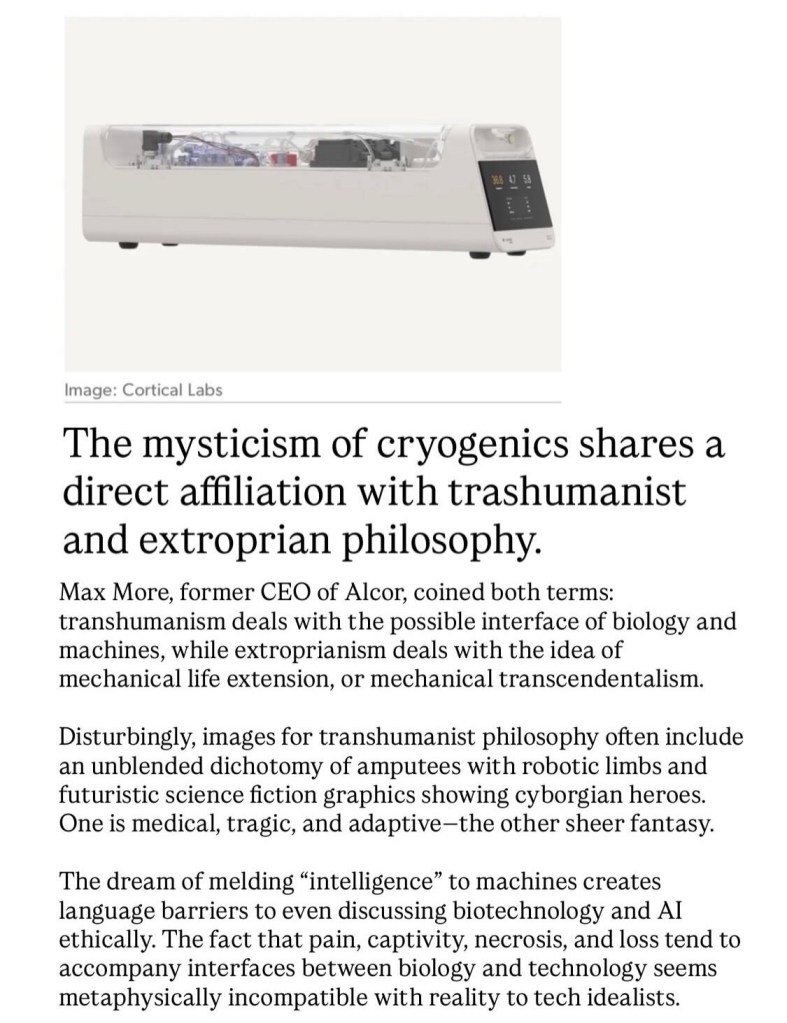
Alcor Cryogenics operates its own nursing home in Phoenix, Arizona to aid transition of its patients into its program of “fixed state hypothermia” after death.
At least once, one of their clients, Dora Kent, was found to have been exposed—let’s say—to lethal levels of barbituates rather, than having died of natural causes as Alcor had officially proclaimed. Incidentally, their program makes mention of a “cocktail of medications” somehow administered “after death” although the term “medication” implies theraputic benefit—a mystery that likely infers its own conclusions in this context.
In 1992, according to one taped conversation handed over to police, an Alcor “engineer” named Hixon murdered a terminally ill client by injecting the paralytic drug Metubine. Interviewed in 2009, then-CEO assured a reporter that Alcor “had severed Alcor’s ties with” Hixon for “hastened the patient’s death…” an astounding euphamism for murder by way of attempting to systematically mystify the line in both law and practice between biology, medicine, “inorganic states,” and burial.
Theil is a client of Alcor.
In around 50 years of operations, Alcor has collected only 222 clients for cryogenesis—a mix of full body and head-only volunteers—as well as 33 pets.
I would sample their brochure and company policy here, but I am frankly too afraid to visit their website.
*Corrections; David was Orville’s brother, not his son. Also, Orville did elect for “neurosuspension,” not full body “solid state hypothermia.” My mistake. That was another case.
–
Addendum: I should note that this article and analysis is not meant to shame or belittle this burial practice. I think that people should be able to inter themselves any way they like, and I can actually see a reasonable case being made for preservation based on ideals of scientific progress in the future—that do not involve reanimation or extroprian ideals.
Again, burial rites are culturally relative and valid practices based on deeply held spiritual beliefs. I don’t see that many people should interfere with final wishes for one’s one corporeal remains.
But I do take serious issue when people may be pressured or even forced into early, unnatural deaths because of the belief that they may someday, somehow, come back to life as good as new.
This is dangerous cultism—it is Rapture theology cloaked in a thick garb of scientific miasma and the pernicious menace of self-obsessed fundamentalism that comes when people find their beliefs feel* inextricable to them, yet offer scanty evidence to the senses. They feel* they must punish the world until it becomes true to their conviction—their religion is not to connect to reality more fully, then, but to crusade against it.
To this mentality, any act is excusable as yet another, further, more incontrovertable proof of their conviction‘s endearing rationality, for it governs their actions from the subconscious level to which we ascribe the epitome of meaning and virtuous, right action.
To discover their presumptions unjustified is to undo their ground of being.
Sometimes, what is appropriate in these cases is sensative intervention, with the mentality you might use with a cult recruit or a drug addict. They don’t need to be punished for belief—belief is the sacred right of the individual.
But they do need to see that punishing themselves and others for their beliefs is not proof of their validity. Perhaps quite the opposite.
I believe causing people to suffer for the delusions of others is among the most unjust crimes.
*facts don’t care that science fiction implied that real science would trend in this direction, when in reality it in fact did not.
–
Update: 06/25/26
See my series on the old TikTok account @rita_robots for more context. Here is a comment summarizing the twin issue of transhumanism attempting to (and much more likely succeeding in) represent human-like behavior from raw robotics and AI software technologies, rather than actually hybridizing biological and machine systems or intelligences:
The discussion here is truly less about rita_robots as a potential psyop or thought experiment, as useful as I think that is.
The true implications here are the catastrophic implications of human realism in robotics—a threshold we’ve already crossed in the realm of digital images and language response thanks to AI. Think of merely the psychological implications of human realism in life-like robotics.
All it takes is exposure to the actual possibility of this technical threshold being crossed—once. You will never be certain that another human being is real or an android without some kind of detection method for the rest of your life.
Consider what that would do—especially if the distinction was classified. We are talking nuclear level changes in the global security landscape overnight.
Why? Not just because of public suspicion and paranoia, but because the detection and regulation of these technologies would be a natural violation of privacy and transparency, and a logistical watershed.
Think of—instead of regulating the sale of uranium and plutonium—trying to track shipping containers with suspicious hardware for on-site assembly, or trying to surmise who may be engaged in operations that by their nature could constitute a kind of public health crisis by tracking the sale of latex, molds, certain pigments, and theatrical-grade cosmetics.
It’s not only a new landscape of surreal paranoia, it’s also a regulatory nightmare that would constitue a crisis of the private use of certain technologies and supply chains as an economic right and necessity—forget rare earths, it’s factors of psychosocial and industrial contamination at stake.
We are talking about unforeseen cataclysm.
https://www.tiktok.com/t/ZP8G16w3n/
https://www.tiktok.com/t/ZP8G1SoxH/

