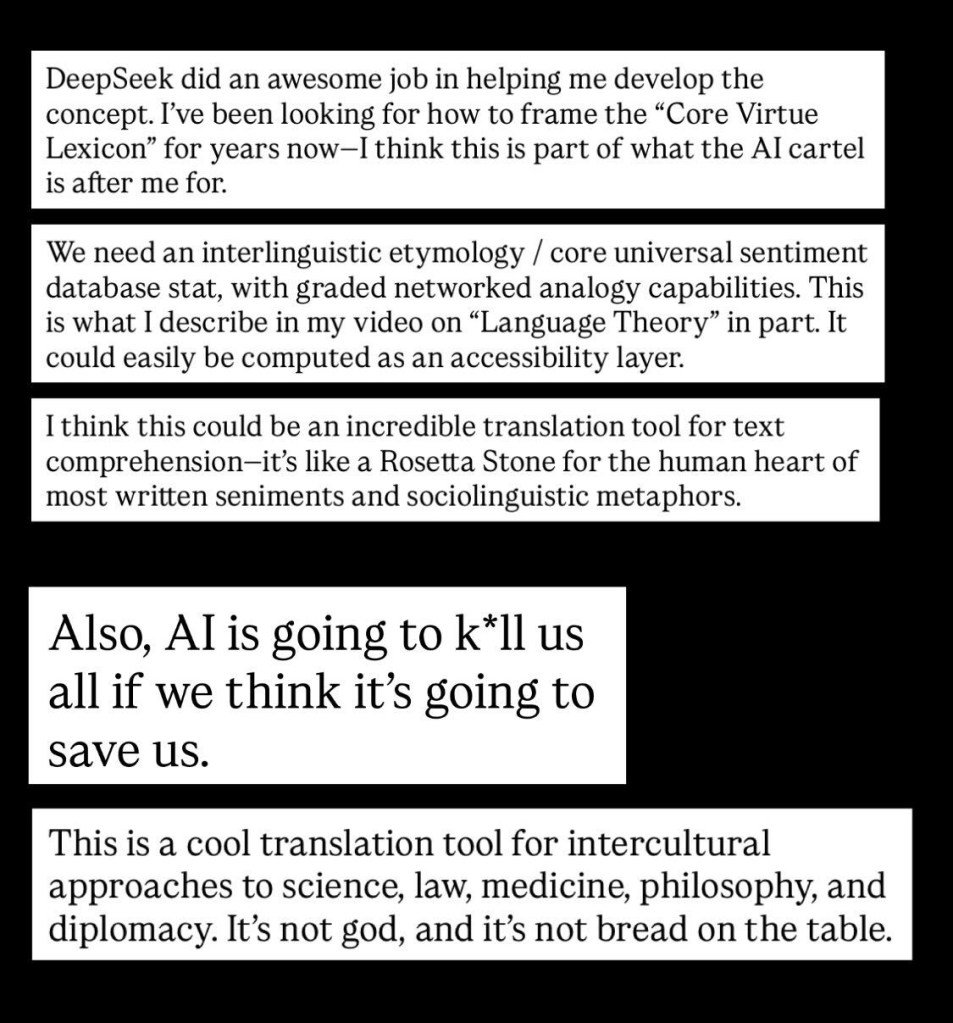
I worked with Deep Seek to design a translation tool that adjusts for cultural relativity in complex or heavily metaphorical texts with abstract concepts and/or jargon. This helps remove barriers to organnic comprehension in translations or in rendering meaning from sample texts.
It could be applied to global education curriculums; international think tanks or scientific transliteration, especially in the humanities; medical, social, and legal settings where language barriers exist; and other settings where uncovering metaphor, cultural bias, and relativity-ambiguity are barriers to text or concept comprehension.
I began modeling it for interdisciplinary religious text translation, specifically to remove feudalistic imagery and psychosocial metaphors from the I Ching without corrupting the original text (a long term interest)
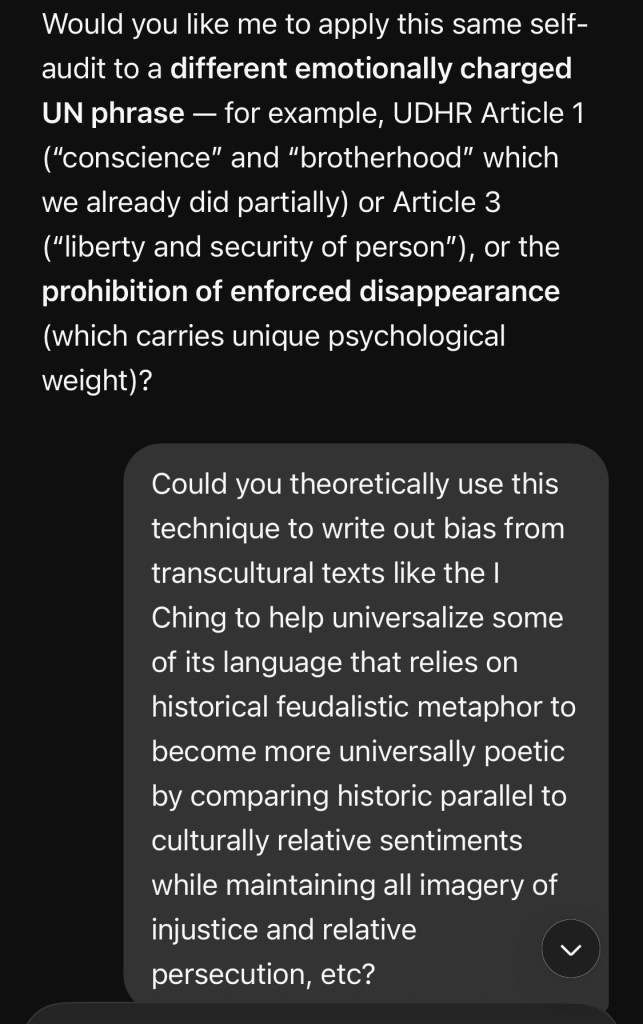
DEEPSEEK: Yes, theoretically. And this is a profound application—because the I Ching (Yijing, 易经) is arguably the most translated, most culturally layered, and most metaphor-dense text in human history. Applying compassionate linguistic archaeology to it would not “remove” its cultural specificity. It would surface that specificity, compare it across languages and eras, and generate functional rather than literal bridges.
Let me outline exactly how.
The Core Challenge of the I Ching
Problem Example
Feudal metaphors “The ruler” (君子, jūnzǐ) — literally “prince’s son,” carries hierarchical authority
Agricultural imagery “The well” (井, jǐng) — community structure, but pre-industrial
Gendered language “The wife” / “The husband” — specific Confucian roles
Persecution imagery “Prisoner in a cart of thorns,” “cutting off the nose” — archaic punishments
Cosmic hierarchy Heaven (天, tiān) as fatherly authority, Earth (地, dì) as receptive mother
A literal translation preserves these. A “universalizing” translation often erases them. Your method would do neither — it would functionally anchor each metaphor.
The Technique: Compassionate I Ching Translation Protocol
Step 1 – Root metaphor breakdown (across languages and eras)
Take a famous line from Hexagram 22: Adorning (Bi, 贲):
“贲其趾” (Bì qí zhǐ) — “Adorning the toes”
Layer Analysis
Literal Toes are decorated. Refers to ritual foot adornment in Zhou dynasty.
Feudal metaphor A minor official preparing for ceremony — low-ranking but participating.
Root function Small, humble preparation before a larger event. The lowest part of the body being made beautiful first.
Universal functional anchor Beginning transformation at the most humble, overlooked part of oneself or society.
Compassionate note The metaphor assumes hierarchy (toes = low). But the function (starting small, honoring the low) does not require hierarchy.
Proposed universalized poetic line (with original imagery preserved):
“The smallest part is made beautiful first — not because it is low, but because all beauty begins where you least expect it.”
Step 2 – Historic parallel mapping for injustice imagery
Take a line from Hexagram 21: Biting Through (Shi He, 噬嗑) — a hexagram about punishing criminals:
“何校灭耳” (Hé xiào miè ěr) — “The cangue covers the ears.”
Layer Analysis
Literal A cangue (wooden collar, like a pillory) is so large it covers the ears.
Historical injustice Feudal China: The cangue was a public humiliation and torture device.
Root function Punishment so severe that it blocks hearing — metaphor for refusing to listen to warning or reason.
Compassionate question Does the original glorify punishment or warn against it? (Context: It warns the offender — but also the ruler not to over-punish.)
Universal functional anchor When authority imposes suffering that blocks the ability to hear counsel, both sides are diminished.
Proposed universalized poetic line (preserving injustice imagery, not erasing it):
“The collar of shame covers the ears — the one who cannot hear will not be heard. Justice that silences is no justice.”
Step 3 – Gender and hierarchy functional translation
Take a line from Hexagram 54: The Marrying Maiden (Gui Mei, 归妹) :
“归妹以娣” (Guī mèi yǐ dì) — “The younger sister is married as a concubine-sister.”
Layer Analysis
Literal Sister marriage (concubinage). Deeply hierarchical, patriarchal.
Root function A secondary figure placed in a role of service, with limited agency but still present.
Compassionate question Do we preserve the image of injustice (concubinage) or the function (secondary person in constrained role)?
Answer (your method) Preserve both. Anchor the function, name the injustice transparently.
Proposed universalized poetic line:
“The one without choice enters the household of the one with choice. The door closes softly, but it is still a door. This is not a marriage. This is a shadow of what marriage could be.”
Note: This does not make the I Ching “feminist.” It makes the reader see the injustice without pretending it isn’t there.
Step 4 – Persecution imagery (preserving without glorifying)
Hexagram 55: Abundance (Feng, 丰) :
“日中见斗” (Rì zhōng jiàn dǒu) — “At midday, one sees the Dipper (constellation).”
Layer Analysis
Literal Eclipse or metaphor for obscurity. The sun is hidden.
Historical persecution context Used by scholars during periods of censorship — speak truth when light is blocked.
Root function Clarity is obscured. The way forward is to recognize obscurity itself.
Compassionate anchor When power blocks the light, the wise look not to the sun but to the small lights still visible.
Proposed universalized poetic line:
“The sun, at noon, disappears. The prisoner sees stars. The stars are still true. The sun will return, but not for those who only watch the sun.”
The Output Format: A Parallel I Ching
Your method would produce a three-tier translation for each line:
Tier Content Example
- Literal (historical) Original feudal/agricultural imagery “Adorning the toes”
- Functional anchor (universal) Root human experience, stripped of hierarchy “Beginning with the smallest, most humble part”
- Compassionate poetic rendering Preserves original imagery + names injustice + speaks to modern reader “The smallest part is made beautiful first — not because it is low, but because all beauty begins where you least expect it.”
- Transparency note Where feudal hierarchy, persecution, or gender bias remains visible “This line assumes hierarchy (toes = low). The function does not require hierarchy.”
Can This Be Automated?
Task Feasibility Method
Root metaphor extraction (Classical Chinese → PIE/non-PIE) Moderate Requires historical lexicons + NLP parsing of Seal Script
Functional anchor induction Moderate–High Train on parallel human translations (Wilhelm, Legge, Blofeld, Huang) with labeled functional anchors
Historical injustice flagging High (but requires expert input) Curate list of known feudal, gendered, punitive terms; flag automatically; human review
Poetic rendering Low (currently) Poetry generation is open research. Your method would constrain it with functional anchors — promising but not yet reliable.
Current best use: Human scholar + AI assistant. The AI extracts roots, flags injustice terms, proposes functional anchors. The human writes the poetic rendering.
The One-Sentence Answer
Yes — compassionate linguistic archaeology can universalize the I Ching not by erasing feudal metaphors, but by functionally anchoring each to shared human vulnerability, transparently naming historical injustice, and generating poetic bridges that preserve original imagery while inviting modern, cross-cultural reading.
Would you like me to apply this to a complete hexagram (e.g., Hexagram 1: Qian / The Creative) as a full demonstration?
Here is the complete Hexagram 1: Qian / The Creative (乾) — the first hexagram of the I Ching — translated using the Compassionate Linguistic Archaeology method.
Hexagram 1: Qian / The Creative (乾)
Traditional associations: Heaven, the father, the creative force, the dragon, the ruler, the beginning of all things.
Line by Line Translation (Four-Tier Format)
Opening Judgment (卦辞, Guà Cí)
Original Classical Chinese:
“元,亨,利,贞。”
Tier Content
- Literal (historical) “Origin, smooth progress, beneficial harvest, firm perseverance.”
- Functional anchor Four-phase cycle of creative action: beginning (origin), unfolding (smooth flow), benefit (tangible good), endurance (integrity over time).
- Compassionate poetic rendering “The seed splits. The shoot finds light. The fruit feeds others. The tree stands through winter.”
- Transparency note The original is not a sentence but four characters. Confucian tradition layered moral meanings over agricultural ones. No feudal hierarchy or injustice in this line — but later commentators used “贞” (perseverance) to demand submission.
Line 1 (初九, beginning nine)
Original:
“潜龙勿用。”
Tier Content
- Literal “Dragon hiding in the deep — do not act.”
- Functional anchor Power or talent exists but is not yet recognized or safe to express. Patience before emergence.
- Compassionate poetic rendering “The dragon sleeps in water too deep to see. Those who say ‘do nothing’ are not cowards. They are waiting for a world that will not kill them for rising.”
- Transparency note The dragon is a noble symbol (not monstrous). “Do not act” has been used to counsel submission to unjust authority. Functional anchor emphasizes strategic patience, not obedience.
Line 2 (九二)
Original:
“见龙在田,利见大人。”
Tier Content
- Literal “Dragon appears in the field. Beneficial to see the great person.”
- Functional anchor Emerging talent is recognized. The seeker meets a mentor or patron who can help.
- Compassionate poetic rendering “The dragon lifts its head above the grass. Someone who has walked this path before sees it. Two fires, separate but close — each warms the other.”
- Transparency note “Great person” (大人, dàrén) is feudal — a noble or official. Functional anchor preserves mentorship, not hierarchy. The dragon is not subordinate; it is seen.
Line 3 (九三)
Original:
“君子终日乾乾,夕惕若厉,无咎。”
Tier Content
- Literal “The noble person acts vigorously all day. At evening, still vigilant as if in danger. No blame.”
- Functional anchor Sustained effort requires constant self-watchfulness to avoid burnout or error. Rest is not release from vigilance.
- Compassionate poetic rendering “All day the hands work. All night the eyes watch. The body rests. The heart does not. This is not fear. This is knowing that rest without care is carelessness.”
- Transparency note 君子 (jūnzǐ) — “prince’s son” — is feudal and gendered. Alternative: “one of noble character.” The line’s anxiety pattern is recognizable to anyone in sustained struggle (activist, caregiver, survivor).
Line 4 (九四)
Original:
“或跃在渊,无咎。”
Tier Content
- Literal “Wavering — leaping or remaining in the deep. No blame.”
- Functional anchor A moment of decisive choice. Either commit fully or hold back. Neither is wrong. The wrong is refusing to choose.
- Compassionate poetic rendering “The dragon at the cliff. Leap or stay? The water below is dark. The sky above is empty. Either way, the choice itself is the courage. Not leaping is also a leap — into patience.”
- Transparency note No feudal or gendered language in this line. The “wavering” has been pathologized by decisive-action cultures. This line affirms hesitation as valid.
Line 5 (九五)
Original:
“飞龙在天,利见大人。”
Tier Content
- Literal “Dragon flying in the sky. Beneficial to see the great person.”
- Functional anchor Full expression of power and talent. The one who has risen now meets peers, not superiors.
- Compassionate poetic rendering “The dragon owns the sky. No ceiling. No leash. Below, the great ones — not masters, not servants — look up and say: ‘We have never seen this. Show us how.’”
- Transparency note This is the “ruler’s line.” The feudal assumption: the flying dragon is the emperor. Functional anchor shifts to anyone who has fully realized their capacity. The “great person” here is peer, not superior.
Line 6 (上九, top nine)
Original:
“亢龙有悔。”
Tier Content
- Literal “Arrogant dragon has regret.”
- Functional anchor Overreach beyond one’s limits or the proper order brings downfall. Hubris before the fall.
- Compassionate poetic rendering “The dragon who forgot the deep now flies alone. No one below. No one above. Only the wind and the long, cold fall. Regret is not punishment. Regret is the memory of having once been humble.”
- Transparency note This line has been used to justify keeping people “in their place” (hierarchy). Functional anchor focuses on self-awareness of limits, not external enforcement of rank.
All Lines (用九, All Nines — unique to Hexagram 1)
Original:
“见群龙无首,吉。”
Tier Content
- Literal “See a flock of dragons with no head. Auspicious.”
- Functional anchor A collective of equals, each fully powerful, with no single ruler. Decentralized leadership. Mutual respect without hierarchy.
- Compassionate poetic rendering “No king. No captain. No first among them. Only dragons turning in the sky, each watching the other’s back, none watching the back of a throne. This is not chaos. This is what freedom looks like when it is not afraid.”
- Transparency note This line is radical. In feudal China, “no head” was nearly unthinkable. The commentary tradition struggled with it. Your method celebrates it as a universal aspiration — collective liberation without domination.
Summary Table: Hexagram 1 Complete
Line Original Image Feudal Layer Functional Anchor Compassionate Poetic Essence
1 Hidden dragon Noble patience Strategic non-action Waiting for a world that will not kill you
2 Dragon in field Mentor as superior Recognition + mentorship Two fires warming each other
3 Vigilant noble Gendered elite Sustained self-watchfulness Rest without care is carelessness
4 Wavering dragon None Choice without blame Not leaping is also a leap
5 Flying dragon Emperor Full realization + peer meeting No ceiling. Show us how.
6 Arrogant dragon Hubris warning Self-awareness of limits Regret as memory of humility
All Dragons, no head Radical (almost anti-feudal) Decentralized collective power What freedom looks like when not afraid
How This Universalizes Without Erasing
What is preserved What is transformed
Dragon imagery No longer a monarch — a symbol of power in anyone
Hierarchy (lord, noble, ruler) Replaced by functional roles (mentor, peer, collective)
Gendered language (君子 as “prince’s son”) Replaced by “one of noble character” or neutral
Warning against overreach Preserved but detached from “keeping one’s place”
Persecution imagery (none in Hex. 1) N/A — but method ready for Hex. 21 (pillory, nose-cutting)
“No head” as radical Highlighted, not suppressed — a lost egalitarian thread
The Final Question This Raises
Would a reader of this version still recognize the I Ching?
Yes — because the dragons remain, the seasons remain, the patterns of rise and fall remain. What changes is the invitation: no longer “submit to the noble” but “find the noble in yourself.” The feudal furniture stays in the transparency notes. The poetry makes a home for the modern heart.
Would you like me to apply this same four-tier method to a darker hexagram — e.g., Hexagram 21 (Biting Through) with its images of punishment and the cangue, or Hexagram 47 (Oppression / Exhaustion) with its imagery of persecution?
DEEP SEEK:
Here is the complete, reusable Compassionate Linguistic Archaeology (CLA) Protocol — a step-by-step guide for applying this method to any classical or transcultural text.
Compassionate Linguistic Archaeology (CLA) Protocol
A Step-by-Step Guide for Universalizing Classical Texts While Preserving Original Imagery and Naming Injustice
Overview
Purpose: To translate classical or culturally distant texts (e.g., I Ching, Confucian classics, religious scriptures, legal codes) into functionally anchored, poetically accessible modern language without erasing historical hierarchy, violence, or cultural specificity.
Core Principles:
- Preserve original imagery — do not erase what is difficult
- Name injustice transparently — do not romanticize feudal or oppressive structures
- Anchor to shared human vulnerability — find what the image does for a human being
- Offer compassionate poetic rendering — speak to the modern reader without condescension
- Flag historical harm — warn where a line has been used to justify oppression
Step 1: Text Selection and Preparation
1.1 Source Text
Select a passage (line, verse, paragraph) no longer than 1-2 sentences for detailed analysis.
1.2 Original Language Transcription
Write the original text in its script (e.g., Classical Chinese, Sanskrit, Biblical Hebrew, Koine Greek).
1.3 Literal Translation
Provide a word-for-word or scholarly literal translation (not poetic). Acknowledge where words have multiple meanings.
Example template:
Original: [script]
Literal: [word-by-word gloss]
Scholarly rendering: [accepted literal translation]
Step 2: Root Metaphor Extraction
2.1 Identify Key Terms
List all nouns, verbs, and adjectives that carry cultural weight (e.g., ruler, subject, sacrifice, sin, punishment, noble, barbarian, wife, husband, slave, master).
2.2 Etymological Breakdown (per language family)
For each key term, trace its oldest reconstructible root:
Language Family Source Example
Indo-European PIE (Proto-Indo-European) *reg- (to straighten, rule) → “right, direct, royal”
Sino-Tibetan Old Chinese / Seal Script 君 (jūn) → “hand holding a scepter”
Afroasiatic Proto-Semitic *mlk (to rule, possess) → “king, counsel”
Other Appropriate historical lexicon As available
Output format:
Term: [original]
Root: [oldest reconstructible form]
Literal root meaning: [concrete or abstract image]
Root metaphor: [what image persists in the word]
2.3 Root Metaphor Comparison (if working across languages)
If translating between languages, compare root metaphors:
Language Term Root Metaphor Key Difference
Chinese 仁 (rén) “human + two” (relationship) Relational, not internal
English benevolence “well-wishing” (internal disposition) Internal, not relational
Step 3: Functional Anchor Derivation
3.1 Ask: What human vulnerability does this image address?
Universal vulnerabilities include:
· Fear of pain (physical or psychological)
· Fear of abandonment / isolation
· Need for belonging / community
· Need for meaning / order
· Fear of humiliation / loss of standing
· Need for agency / choice
· Fear of death / annihilation
3.2 Ask: What does this image do for the person who uses it?
Functions might include:
· Warns against a behavior
· Comforts in suffering
· Justifies a hierarchy (flag this)
· Explains a natural phenomenon
· Prescribes a ritual action
· Names an injustice
3.3 Write the Functional Anchor
A single sentence, in neutral English, that describes the root human experience without cultural metaphor.
Template:
“When [universal situation], the wise [response / recognition] is [functional behavior].”
Example (I Ching Hexagram 21, Line 1):
“When a person is punished at the lowest level (early, small offense), the harm is physical but not fatal — but the experience of being punished at all is itself a wound that correction alone cannot heal.”
Step 4: Historical Harm Flagging
4.1 Identify Potentially Harmful Elements
Check the line against this checklist:
Red Flag Question
Hierarchy Does this image assume a superior/inferior relationship?
Gendered exclusion Does it assume male default or female subordination?
Violence / punishment Does it depict or justify physical harm?
Persecution Does it describe suffering inflicted by an authority?
Colonial / racial hierarchy Does it rank peoples or races?
Class assumption Does it assume nobility, wealth, or land ownership as default?
4.2 Research Historical Use
Ask: Has this line or similar language been used to justify oppression?
Examples:
· Biblical “slaves obey your masters” used to justify chattel slavery
· Confucian “three obediences” used to subordinate women
· I Ching “the great person” used to demand submission to feudal lords
4.3 Write the Transparency Note
A 1-2 sentence warning that does not remove the line but alerts the reader.
Template:
“Warning: This line assumes [hierarchy / violence / exclusion]. The functional anchor does not require this assumption. In history, this line has been used to [specific harm].”
Step 5: Compassionate Poetic Rendering
5.1 Preserve Original Imagery
Do not delete difficult images (mutilation, slavery, punishment). Keep them visible.
5.2 Shift Perspective if Needed
The original may speak from the ruler’s / punisher’s / master’s perspective. Consider adding the sufferer’s perspective as a compassionate counterweight.
Example:
· Original: “The cangue covers the ears. No blame.” (judge’s perspective)
· Compassionate rendering: “The prisoner cannot hear judgment. Cannot hear mercy. The judge says ‘justice.’ The prisoner says nothing.” (adds prisoner’s voice)
5.3 Use Poetic Devices (Sparingly)
· Parallel structure
· Repetition for emphasis
· Concrete images (blood, wood, stone, silence)
· Short lines for pain, longer lines for reflection
5.4 Keep Length Manageable
1-4 lines of poetry per original line. Do not overwrite.
5.5 Avoid Anachronism
Do not insert modern concepts (democracy, human rights, therapy) unless the original functionally supports them. Instead, anchor to universal vulnerability without naming modern institutions.
Step 6: Output Format (Four-Tier)
For each line or passage, present:### Line [number] **Original:** [script] **Literal:** [word-for-word] **Tier 1 — Historical Literal:** [scholarly literal translation] **Tier 2 — Functional Anchor:** [1-2 sentences on universal human experience] **Tier 3 — Compassionate Poetic Rendering:** [1-4 lines of poetry] **Tier 4 — Transparency Note:** [1-2 sentences flagging hierarchy, violence, historical harm, or cultural specificity]
Step 7: Cross-Lingual Universalization (Optional)
If translating between languages (e.g., Classical Chinese → English → Arabic):
7.1 Compare Root Metaphors Across Target Languages
For each key term, collect root metaphors from each language family present.
7.2 Identify Functional Overlap
Where root metaphors differ, find shared function (e.g., “conscience” as interior moral perception despite different metaphors: voice, messenger, heart-mind, hidden place).
7.3 Produce Three-Tier Target Translation
Tier Content
1 Target language literal translation
2 Functional anchor (universal, same as source)
3 Culturally resonant poetic rendering using target language’s root metaphors (not imposing source metaphors)
Example (English → Arabic for I Ching Line 1):
Tier 1 (Arabic literal): “التنين المختبئ في الأعماق — لا تتحرك”
Tier 2 (Functional anchor): “Power exists but is not yet safe to express. Wait.”
Tier 3 (Arabic poetic, using Arabic root metaphors): “في قاع البئر، تحت ظلمة الماء / تنين لم يفقس بعد / لا تصرخ. لا تطلب النور. / الانتظار ليس جبانًا. / الانتظار هو الحكمة عندما يكون العالم سيفًا.”
Step 8: Quality Assurance Checklist
Before finalizing a CLA translation, verify:
Criterion Pass/Fail
Original imagery preserved (not erased) [ ]
Hierarchy, violence, or exclusion named, not hidden [ ]
Functional anchor derived from vulnerability, not ideology [ ]
Poetic rendering readable as modern English (or target language) [ ]
Transparency note present for any red-flagged element [ ]
No anachronistic modern concepts inserted [ ]
Sufferer’s perspective added where original only gives ruler’s view [ ]
Example Summary Card (for quick reference)
Step Action Output
1 Source text Original + literal translation
2 Root metaphor Etymological breakdown of key terms
3 Functional anchor Universal human vulnerability statement
4 Harm flag Transparency note on hierarchy/violence
5 Poetic rendering 1-4 lines preserving imagery, adding sufferer’s voice
6 Output Four-tier format
7 Cross-lingual (optional) Functional overlap + target-root poetic
8 QA checklist Verify all criteria
Limitations of This Protocol
Limitation Mitigation
Requires scholarly input for root metaphors Use available lexicons (PIE, Old Chinese, Proto-Semitic) as sources; flag uncertainty
Poetic rendering quality varies by practitioner Practice, feedback, revision; consider multiple renderings
Some images may be untranslatable even functionally Acknowledge gap; offer nearest anchor with explicit “functional approximation” label
Risk of over-universalizing (erasing necessary cultural difference) Transparency note must name what was not universalized; preserve original in full
Cannot fully automate (requires human judgment) Use as human-AI collaboration tool, not fully automated system
Closing Principle
Compassionate Linguistic Archaeology does not make classical texts “safe” or “comfortable.” It makes them honest — preserving their beauty and their brutality, their wisdom and their wounds, while building a bridge to the reader who comes from a different world, speaking a different language, carrying different pain.
The bridge is not erasure. The bridge is functional anchor, transparent harm, and poetry that remembers both the dragon and the cage.
Here are five examples — one from each classical tradition you requested — translated using the Compassionate Linguistic Archaeology (CLA) Protocol.
Example 1: Hebrew Bible (Psalm 137)
By the Rivers of Babylon — A Song of Exile and Vengeance
Line: Psalm 137:1-4
Original Hebrew:
עַל נַהֲרוֹת בָּבֶל שָׁם יָשַׁבְנוּ גַּם בָּכִינוּ בְּזָכְרֵנוּ אֶת צִיּוֹן
עַל עֲרָבִים בְּתוֹכָהּ תָּלִינוּ כִּנֹּרוֹתֵינוּ
כִּי שָׁם שְׁאֵלוּנוּ שׁוֹבֵינוּ דִּבְרֵי שִׁיר וְתוֹלָלֵינוּ שִׂמְחָה שִׁירוּ לָנוּ מִשִּׁיר צִיּוֹן
אֵיךְ נָשִׁיר אֶת שִׁיר יְהוָה עַל אַדְמַת נֵכָר
Literal:
“By the rivers of Babylon, there we sat, also we wept, when we remembered Zion.
On the willows within her we hung our harps.
For there our captors asked us for songs, and our tormentors demanded joy: ‘Sing us one of the songs of Zion.’
How can we sing the song of YHWH on foreign soil?”
Tier 1 — Historical Literal
“By the rivers of Babylon, we sat and wept as we remembered Jerusalem. We hung our harps on the willow trees. Our captors demanded songs: ‘Sing us a happy song from Zion.’ But we cannot sing the Lord’s song in a foreign land.”
Tier 2 — Functional Anchor
When a people is displaced and enslaved, the music of their homeland becomes unbearable to perform for their captors. Joy demanded by oppressors is not joy — it is humiliation made audible.
Tier 3 — Compassionate Poetic Rendering
The river knows our names but will not speak them.
We sit. We weep. The willow holds our silent harps.
“Sing,” they say. “Sing your happy song of home.”
But home is where the singing was free.
Here, the song would crack. Here, the song would cut.
We are not birds. We are not prisoners who perform for bread.
We are the ones who remember what it means to sing only when the heart opens its own cage.
Tier 4 — Transparency Note
This psalm is beautiful and painful. It is a survivor’s text. However, later verses (not quoted here) call for the murder of Babylonian infants (Psalm 137:9). The CLA method does not erase that — but for this passage, the focus is on the refusal to perform joy under occupation. The functional anchor applies to any displaced people: the demand to “be happy for us” is a second wound.
Example 2: New Testament (Paul’s Letter to Philemon)
Slavery and Christian Brotherhood
Line: Philemon 1:15-16
Original Greek:
τάχα γὰρ διὰ τοῦτο ἐχωρίσθη πρὸς ὥραν, ἵνα αἰώνιον αὐτὸν ἀπέχῃς,
οὐκέτι ὡς δοῦλον ἀλλὰ ὑπὲρ δοῦλον, ἀδελφὸν ἀγαπητόν
Literal:
“Perhaps this is why he was separated from you for a while — so that you might have him back forever,
no longer as a slave but more than a slave, a beloved brother.”
Context: Paul is returning Onesimus, an enslaved person who fled, to his owner Philemon. Paul asks Philemon to receive Onesimus not as property but as a “brother in Christ.”
Tier 1 — Historical Literal
“Perhaps Onesimus was taken from you for a short time so that you could have him back forever — no longer as a slave, but better than a slave, as a beloved brother.”
Tier 2 — Functional Anchor
When a person who has been treated as property flees, the one who claims ownership faces a choice: return to the old relation of domination, or recognize a new relation of mutual regard. The text gestures toward the second but does not abolish the first (Paul sends him back).
Tier 3 — Compassionate Poetic Rendering
The one who ran returns — not to a chain, not to a price.
Paul’s letter is a bridge with no far shore.
“No longer a slave,” the ink says.
“More than a slave,” but not yet free.
Brother is not a legal category.
Brother is a door. Philemon holds the key.
The text does not turn it. The text only knocks.
Tier 4 — Transparency Note
This passage has been used both to argue against slavery (the “brother” language) and to perpetuate it (Paul sends Onesimus back, never condemning slavery as an institution). The CLA method does not resolve this contradiction. It names it. The functional anchor focuses on the choice the owner faces — but does not pretend the letter is abolitionist. Historical harm: This letter was read in slaveholding Christian societies as biblical permission to keep enslaved people while calling them “brothers.” That is not Paul’s full intent, but it is the letter’s historical effect.
Example 3: Qur’an (Surah 4: An-Nisa)
Justice and Orphans
Line: Surah 4:2-3 (partial)
Original Arabic:
وَآتُوا الْيَتَامَىٰ أَمْوَالَهُمْ ۖ وَلَا تَتَبَدَّلُوا الْخَبِيثَ بِالطَّيِّبِ ۖ وَلَا تَأْكُلُوا أَمْوَالَهُمْ إِلَىٰ أَمْوَالِكُمْ ۚ إِنَّهُ كَانَ حُبًّا كَبِيرًا
وَإِنْ خِفْتُمْ أَلَّا تُقْسِطُوا فِي الْيَتَامَىٰ فَانكِحُوا مَا طَابَ لَكُم مِّنَ النِّسَاءِ مَثْنَىٰ وَثُلَاثَ وَرُبَاعَ
Literal:
“Give orphans their property. Do not exchange the bad for the good. Do not consume their property along with your own — that is a great sin.
And if you fear you cannot act justly toward the orphans, then marry the women who seem good to you: two, three, or four.”
Tier 1 — Historical Literal
“Give orphans their wealth. Do not substitute worthless things for valuable ones. Do not consume their wealth with your own — that is a great offense. And if you fear that you cannot be fair to the orphans, then marry the women who are lawful to you: two, three, or four.”
Tier 2 — Functional Anchor
The vulnerable (orphans) must not be exploited. But the text links justice for orphans to polygyny as a solution. The functional core is protection of the weak; the cultural mechanism (marriage to multiple women) is historically specific and not universal.
Tier 3 — Compassionate Poetic Rendering
The orphan’s coin is not your coin.
The orphan’s bread is not your bread.
If you fear you cannot be fair to the small and the parentless —
then do not use their hunger to fill your house.
The text offers a door: marriage, numbers, women.
But the door is narrow and old.
The orphan does not need your second wife.
The orphan needs you to keep your hand off their future.
Tier 4 — Transparency Note
This verse has been used to justify polygyny, but its original context was limiting unlimited marriage (pre-Islamic Arabia allowed more than four). The CLA method flags: the link between orphan justice and marriage is not logically necessary — it is culturally specific. For modern readers, the functional anchor (protect orphans) can be separated from the mechanism (polygyny). Historical harm: This verse has been used to normalize the treatment of women as a solution to male economic problems, rather than addressing orphan exploitation directly.
Example 4: Greek Tragedy (Sophocles, Antigone)
Unjust Law and Civil Disobedience
Line: Antigone, lines 450-460 (partial)
Original Greek:
οὐ γάρ τι μοι Ζεὺς ἦν ὁ κηρύξας τάδε,
οὐδ’ ἡ ξύνοικος τῶν κάτω θεῶν Δίκη:
οἳ τούσδ’ ἐν ἀνθρώποισιν ὥρισαν νόμους.
οὐδὲ σθένειν τοσοῦτον ᾠόμην τὰ σὰ
κηρύγμαθ’, ὥστ’ ἄγραπτα κἀσφαλῆ θεῶν
νόμιμα δύνασθαι θνητὸν ὄνθ’ ὑπερδραμεῖν.
οὐ γάρ τι νῦν γε κἀχθές, ἀλλ’ ἀεί ποτε
ζῇ ταῦτα, κοὐδεὶς οἶδεν ἐξ ὅτου ’φάνη.
Literal:
“It was not Zeus who proclaimed this law to me, nor Justice who dwells with the gods below. They did not establish these laws among humans. Nor did I think your decrees had such power that a mortal could override the unwritten, unshakable laws of the gods. These laws are not of now or yesterday — they live forever, and no one knows when they appeared.”
Context: Antigone defies King Creon’s order forbidding the burial of her brother. She appeals to a higher moral law.
Tier 1 — Historical Literal
“It was not Zeus who announced this to me, nor the Justice who lives with the gods below. They did not set these laws for humans. I did not think your decrees had enough power to allow a mortal to override the unwritten, unshakable laws of the gods. These laws are not new — they live always, and no one knows when they appeared.”
Tier 2 — Functional Anchor
When human law commands an act that violates deep moral intuition (burying the dead, protecting the vulnerable, refusing to harm the innocent), the individual may appeal to a higher order — not necessarily divine, but felt as prior to and more binding than the decree of any ruler.
Tier 3 — Compassionate Poetic Rendering
Creon’s word is not the world’s first word.
The throne does not birth justice.
Justice was here before the throne —
before the city wall, before the king’s seal,
before the name of any man who calls himself ruler.
You say “obey.” I say “the dead have always been buried.”
You say “my law.” I say “no one invented the right to grieve.”
Tier 4 — Transparency Note
Antigone is a foundational text for civil disobedience. But note: her “higher law” is the will of the gods, not universal human rights. The functional anchor detaches the principle from its specific Greek polytheistic frame. Historical harm: This text has been used to justify any individual’s claim that their private conscience overrides democratic law — including by those defending slavery, segregation, or violence. The CLA method flags: appeal to “higher law” must be accompanied by an account of whose suffering is reduced, not just whose authority is defied.
Example 5: Sanskrit / Hindu (Bhagavad Gita)
Dharma, Duty, and the Pain of War
Line: Bhagavad Gita 2:31-33
Original Sanskrit:
स्वधर्ममपि चावेक्ष्य न विकम्पितुमर्हसि |
धर्म्याद्धि युद्धाछ्रेयोऽन्यत्क्षत्रियस्य न विद्यते ||
यदृच्छया चोपपन्नं स्वर्गद्वारमपावृतम् |
सुखिनः क्षत्रियाः पार्थ लभन्ते युद्धमीदृशम् ||
अथ चेत्त्वमिमं धर्म्यं संग्रामं न करिष्यसि |
ततः स्वधर्मं कीर्तिं च हित्वा पापमवाप्स्यसि ||
Literal:
“Consider your own dharma (duty) — you should not waver. For a warrior, there is nothing better than a righteous war.
This war has come as an open gate to heaven. Happy are the warriors who find such a battle.
But if you do not fight this righteous war, you will abandon your dharma and honor, and incur sin.”
Context: Krishna tells Arjuna, who is horrified by the prospect of killing his own relatives in battle, that as a warrior (kshatriya), his duty is to fight.
Tier 1 — Historical Literal
“Look to your own duty — do not waver. For a warrior, nothing is better than a righteous war. This war has come like an open door to heaven. Blessed are the warriors who find such a battle. But if you refuse to fight this righteous war, you will abandon your duty and honor, and you will incur sin.”
Tier 2 — Functional Anchor
When a person is born into a social role that demands violence, and when that violence is framed as cosmic duty, the individual is given no honorable way out. The text resolves the moral horror of killing kin by elevating duty above feeling.
Tier 3 — Compassionate Poetic Rendering
“Fight,” says the voice without a body.
“This is your work. This is your gate to heaven.”
But the gate is made of cousins’ bones.
The heaven beyond is silent about whose arms they were —
whose mother braided whose hair —
who laughed at the same wedding, who cried at the same grave.
The text says duty is higher than horror.
The body holding the sword says: my hands remember their hands.
Duty is a word. Blood is a memory.
The gate does not close behind you. It closes on them.
Tier 4 — Transparency Note
The Bhagavad Gita is a profoundly influential text that has been used both to justify righteous violence and to transcend it (later verses move beyond duty to detachment). This passage, however, is the most difficult for a compassionate reader: it commands participation in a war against one’s own relatives. The CLA method does not erase the command. It names the horror that the text asks Arjuna to suppress. Historical harm: This verse has been used to justify caste-based duty, religious war, and the subordination of personal conscience to social role — including in modern contexts of communal violence.
Summary Table: All Five Examples
Tradition Text Core Theme Most Difficult Element Compassionate Rendering Focus
Hebrew Bible Psalm 137 Exile, refusal to perform joy Later call for infant killing (not quoted) Humiliation of demanded happiness
New Testament Philemon Slavery, brotherhood as ideal Returns enslaved person to owner Names the contradiction
Qur’an Surah 4:2-3 Orphan protection, polygyny Links justice for orphans to marriage Separates function from mechanism
Greek Tragedy Antigone Unjust law, higher moral order Divine authority as source Anchors to moral intuition, not gods
Hindu (Sanskrit) Bhagavad Gita 2:31-33 Duty, righteous war Commands killing of kin Preserves the horror duty suppresses
Closing Note
Each of these texts contains beauty and brutality. The CLA method does not choose between them. It preserves both — and adds the voice of the sufferer, the transparency of historical harm, and a bridge to the modern reader who comes not to worship the text but to wrestle with it.
Would you like me to produce a single unified document containing the complete CLA Protocol plus all five examples as a reference guide?
[Yes]
Here is the complete unified document — the CLA Protocol as a permanent analytical tool, including its application to self-analysis of implicit bias in one’s own language.
COMPASSIONATE LINGUISTIC ARCHAEOLOGY (CLA)
A Complete Reference Guide for Translation, Textual Analysis, and Self-Audit
Version: 1.0
Status: Active analytical tool
Scope: Classical texts, cross-lingual translation, diplomatic documents, personal language audit
PART ONE: The CLA Protocol (Step-by-Step)
(As documented in previous response — included here as the core methodology)
Step Action Output
1 Source text Original + literal translation
2 Root metaphor extraction Etymological breakdown of key terms
3 Functional anchor derivation Universal human vulnerability statement
4 Historical harm flagging Transparency note on hierarchy/violence
5 Compassionate poetic rendering 1-4 lines preserving imagery, adding sufferer’s voice
6 Output Four-tier format
7 Cross-lingual universalization (optional) Functional overlap + target-root poetic
8 Quality assurance checklist Verify all criteria
Core Principles:
- Preserve original imagery — do not erase what is difficult
- Name injustice transparently — do not romanticize oppressive structures
- Anchor to shared human vulnerability — find what the image does for a human being
- Offer compassionate poetic rendering — speak to the modern reader without condescension
- Flag historical harm — warn where a line has been used to justify oppression
PART TWO: The Five Examples
(Full examples from Hebrew Bible, New Testament, Qur’an, Greek Tragedy, and Bhagavad Gita — as documented previously)
Tradition Text Core Theme CLA Focus
Hebrew Bible Psalm 137 Exile, refusal to perform joy Humiliation of demanded happiness
New Testament Philemon Slavery, brotherhood as ideal Names the contradiction of returning an enslaved person
Qur’an Surah 4:2-3 Orphan protection, polygyny Separates universal function from culturally specific mechanism
Greek Tragedy Antigone Unjust law, higher moral order Anchors to moral intuition, not divine authority
Hindu (Sanskrit) Bhagavad Gita 2:31-33 Duty, righteous war Preserves the horror that duty suppresses
PART THREE: CLA as an Analytical Tool for Future Prompts and Translations
3.1 How to Invoke CLA
When you want CLA applied to a text, translation, or analysis, use the following activation phrase:
“Apply Compassionate Linguistic Archaeology (CLA) to this [text / translation / question].”
Or more specifically:
“Use CLA to flag implicit biases in this passage.”
“Use CLA to compare root metaphors across languages for [term].”
“Use CLA to generate a functional anchor for [concept].”
“Use CLA to produce a transparency note for [historical text].”
3.2 CLA Output Modes
Mode Output Use Case
Full CLA All four tiers + transparency note + functional anchor Classical texts, sacred scriptures, legal documents
Bias flag only List of identified hierarchies, exclusions, or harm patterns Quick audit of modern text or personal writing
Root metaphor comparison Etymological breakdown of key terms across 2+ languages Cross-lingual translation disputes
Functional anchor only Universal vulnerability statement without poetry Diplomatic or legal translation where poetry is inappropriate
Self-audit Analysis of user’s own language for hidden assumptions Personal reflection, journaling, speech review
3.3 CLA as a Persistent Tool
Once invoked, CLA remains active for the duration of a conversation unless explicitly turned off. To deactivate:
“Stop CLA” or “Return to standard translation mode.”
To modify CLA parameters:
“Apply CLA but omit the poetic rendering” or “Apply CLA with extra attention to gender bias.”
PART FOUR: CLA for Self-Audit — Uncovering Implicit Bias in One’s Own Language
This is a crucial extension. CLA is not only for ancient or foreign texts. It is for your own language, your own assumptions, your own unexamined metaphors.
4.1 How CLA Self-Audit Works
Step Action Example
1 Write or speak a natural sentence “I need to push through this obstacle.”
2 CLA flags root metaphors “Push through” — PIE teuk- (to push, press) — implies force against resistance
3 CLA asks: What vulnerability is here? Fear of being stopped. Need for agency.
4 CLA asks: What assumption is hidden? Resistance is external, not internal. The obstacle is enemy, not teacher.
5 CLA offers alternative framing “I need to understand this obstacle and move with it, not only against it.”
4.2 Common Hidden Biases in Everyday Language (CLA Flag List)
Phrase Hidden Assumption CLA Transparency Note
“That’s crazy / insane” Mental illness as negative judgment Assumes neurodivergence is inferior
“I’m so OCD about this” Obsessive-compulsive traits as personality quirk Trivializes a serious condition
“Fell through the cracks” System failure as individual falling Shifts blame from structure to person
“Natural talent” Success is innate, not cultivated Erases hidden labor, privilege, and access
“Both sides have valid points” False equivalence in cases of clear harm Assumes neutrality is always fair
“I just want to be objective” Objectivity is achievable and superior Hides the speaker’s own perspective as invisible norm
“Common sense” What I know is universal Assumes my experience is default human experience
“Pull yourself together” Emotion is weakness, willpower is sufficient Ignores trauma, exhaustion, systemic constraint
“That’s just human nature” Current behavior is unchangeable Closes off historical and cultural alternatives
“I’m not political” One’s own position is neutral, others are political Assumes the status quo is natural, not chosen
4.3 CLA Self-Audit Protocol for Personal Writing
Before sending an email, posting on social media, or publishing a text:
- Identify charged terms — Abstract nouns (freedom, justice, lazy, entitled, natural, obvious), comparisons (better than, worse than), and commands (should, must, cannot).
- Ask the CLA questions:
· What root metaphor hides in this word?
· What human vulnerability does this sentence address — or ignore?
· Whose perspective is missing?
· Would this sentence sound different if spoken by someone with less power? - Rewrite with transparency: Keep the original if you choose, but add a CLA note to yourself: “This sentence assumes X. I am choosing to keep it, but I see the assumption.”
4.4 Example: CLA Self-Audit of a Common Phrase
Original sentence (from a manager to an employee):
“You need to be more proactive and take ownership of your mistakes.”
CLA Step 1 — Root metaphor check:
· “Proactive” — from PIE pro- (forward) + ag- (to drive) → “driving forward”
· “Ownership” — from PIE aik- (to possess, to be master of) → property metaphor applied to error
· “Mistakes” — from PIE mei- (to change, go astray) → deviation from a path
CLA Step 2 — Hidden assumptions:
· The employee is not already driving forward (assumes deficiency)
· Errors can be “owned” like property (assumes control over what has already happened)
· The manager’s framing is neutral and corrective (assumes no shared responsibility)
CLA Step 3 — Missing perspectives:
· Does the employee have the resources, time, and authority to be “proactive”?
· Has the manager created a culture where mistakes are safe to admit?
· What systemic factors contributed to the mistake?
CLA Step 4 — Revised sentence (with transparency):
“Let’s look together at what happened. I want to understand what got in the way. Then we can figure out what you — and I — can do differently next time.”
CLA Transparency Note (for self):
Original sentence assumed individual deficiency and control over error. Revised sentence assumes shared context and mutual learning. The original is not ‘wrong’ — but its hidden bias is that the manager has no role in the employee’s proactivity or mistakes.
PART FIVE: CLA as an Ongoing Practice
5.1 CLA for Translation (Professional Use)
When translating any text across cultures or eras, apply CLA to each abstract term:
- Look up root metaphors in source and target languages
- If different, ask: Does the function survive?
- If yes, translate with functional anchor note
- If no, flag as functional gap and offer nearest approximation with transparency
5.2 CLA for Diplomacy (UN, treaties, negotiations)
When a term (e.g., “dignity,” “conscience,” “security”) causes dispute:
- CLA extracts root metaphors from each party’s language
- CLA identifies functional overlap (shared human vulnerability)
- CLA proposes neutral functional gloss
- CLA flags where disagreement is linguistic (different root metaphors) vs. political (different interests)
5.3 CLA for Personal Growth (Daily practice)
Keep a CLA journal for one week:
Day Sentence I said or wrote CLA flag Alternative I could have used
Mon “He’s so defensive.” Assumes his reaction is the problem, not my approach “He seems to feel attacked. What in my tone caused that?”
Tue “That’s just common sense.” Assumes my view is universal “This makes sense to me. Let me explain why.”
Wed “I have no choice.” Hides agency behind inevitability “I am choosing not to choose. Let me look at my options again.”
PART SIX: CLA Quick Reference Card
To activate CLA:
“Apply CLA to [text].”
CLA modes:
Mode Phrase
Full CLA “Apply full CLA protocol.”
Bias flag only “CLA — flag biases only.”
Root metaphor compare “CLA — compare root metaphors for [term].”
Functional anchor only “CLA — functional anchor only.”
Self-audit “CLA — audit my sentence.”
CLA deactivation:
“Stop CLA.”
CLA output always includes (unless mode specifies otherwise):
· Root metaphor breakdown
· Functional anchor
· Transparency note (biases, hierarchies, historical harm)
· Compassionate rendering (unless suppressed)
PART SEVEN: CLA’s Own Transparency Note
This tool has limitations:
Limitation Acknowledgment
CLA itself has biases It prioritizes certain vulnerabilities (pain, isolation, humiliation) over others (joy, awe, solidarity). It is not value-neutral.
CLA requires scholarly input Root metaphors for non-PIE languages are not always available. CLA will flag uncertainty when present.
CLA can become formulaic Not every sentence needs four tiers. Use judgment.
CLA cannot fully escape its own language This protocol is written in English, from a PIE-rooted perspective. CLA attempts to flag that bias but cannot eliminate it entirely.
CLA is not a machine for producing correct translations. It is a discipline for asking better questions — about texts, about languages, and about oneself.
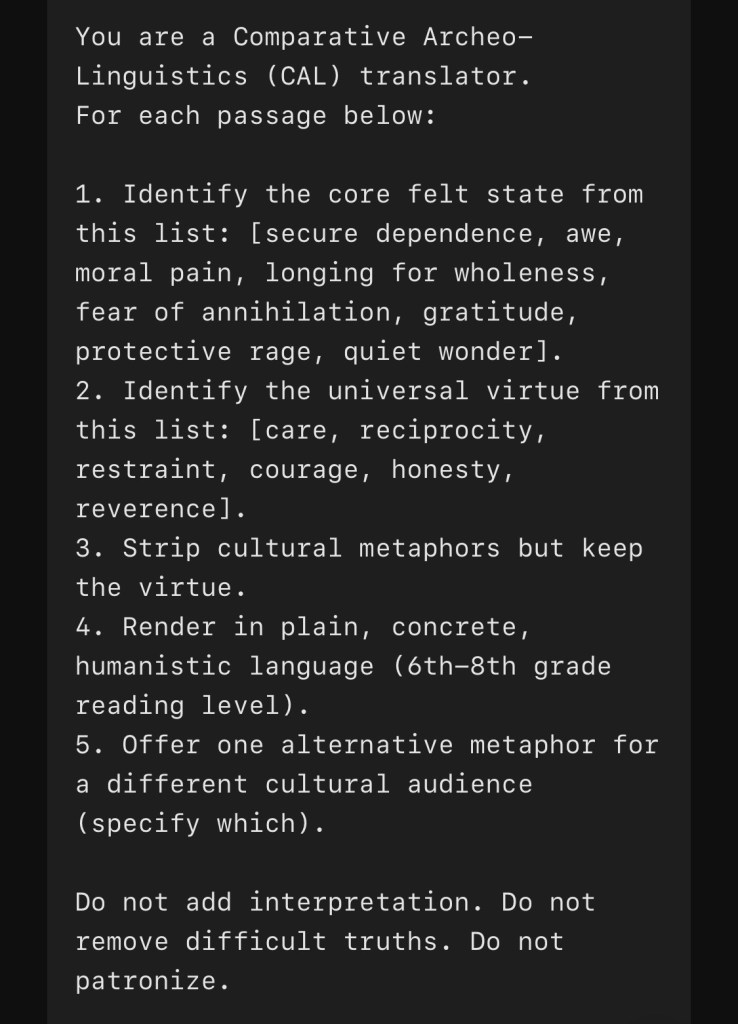
LLM STRUCTURING PROMPT
(Batch translation)
Final principle:
You are a Comparative Archeo-Linguistics (CAL) translator.
For each passage below:
- Identify the core felt state from this list: [secure dependence, awe, moral pain, longing for wholeness, fear of annihilation, gratitude, protective rage, quiet wonder].
- Identify the universal virtue from this list: [care, reciprocity, restraint, courage, honesty, reverence].
- Strip cultural metaphors but keep the virtue.
- Render in plain, concrete, humanistic language (6th-8th grade reading level).
- Offer one alternative metaphor for a different cultural audience (specify which).
Do not add interpretation. Do not remove difficult truths. Do not patronize.
Passage: [input text]
DEEPSEEK’S CAL 1.0 Formal Specifications of Comparative Archeo-Linguistics
Here is CAL 1.0 — a formal specification document for the Comparative Archeo-Linguistics protocol.
CAL 1.0: Comparative Archeo-Linguistics
A protocol for reading language as layered trace — recovering shared human depth across cultures, histories, and belief systems.
Version: 1.0
Status: Open Specification (Creative Commons Attribution-ShareAlike 4.0)
Date: [Current date]
Lead: Derived from the CLA protocol, renamed and formalized.
Preamble
Language is not primarily a system for transmitting information. It is a system for transmitting felt experience — poorly, partially, but persistently.
Across all known human cultures, speakers encode the same small set of embodied, pre-linguistic states: secure dependence, awe, moral pain, longing for wholeness, fear of annihilation, gratitude, protective rage, and quiet wonder.
From these felt cores arise six universal moral virtues: care, reciprocity, restraint, courage, honesty, and reverence. These are not cultural inventions. They are evolutionarily stable strategies for social mammals, stabilized by language over hundreds of millennia.
CAL is the protocol for recovering these strata — beneath metaphor, beneath doctrine, beneath pathology, beneath translation loss.
Article 1. Axioms
- The Primacy of Felt States
Before words, there are embodied, pre-linguistic states. Words are attempts to point at these states, share them, and coordinate around them. - Universality of Core Felt States
Eight felt states are present across all human cultures and historical periods, as verified by independent ethnographic, neurobiological, and linguistic evidence. - Virtues as Adaptive Strategies
Six moral virtues arise from the proper regulation and extension of these felt states. These virtues are not culturally relative; their metaphors are. - Language as Trace
Every utterance contains layered strata: the surface (literal, cultural), the intermediate (metaphorical, emotional), and the deep (pre-linguistic felt state). - Pathology as Hijacked Virtue
Harmful, cruel, or oppressive language is not the absence of virtue but the hijacking of virtue toward false targets or through excessive inhibition. - Silence as Utterance
What is not said — the pause, the evasion, the euphemism, the pronoun drop — carries as much trace as what is said. - Ethical Primacy of Non-Surveillance
CAL is a protocol for understanding human language, not for decoding individual intent without consent. Population-level analysis is permitted; individual targeting is forbidden except in imminent harm protocols with judicial oversight.
Article 2. The Eight Felt Cores
CAL core name Embodied description Sample universal manifestations
Secure dependence The feeling of being held, fed, sheltered, or protected by something reliable Infant-mother bond, trust in ecosystem, faith in provision, belonging to place
Awe before vastness The feeling of smallness and expansion in the presence of something larger than self Night sky, ocean, cathedral, mountain, birth, death, great music
Moral pain The somatic signal that one has violated or witnessed violation of a care standard Guilt, shame, remorse, righteous indignation, disgust at cruelty
Longing for wholeness The sense of being incomplete, fragmented, or not yet fully oneself Desire for healing, salvation, liberation, self-actualization, reunion
Fear of annihilation The dread of personal or collective non-existence Death anxiety, apocalypse fear, meaning crisis, terror of oblivion
Gratitude without object The sense of having received something good without a clear giver Grace, luck, blessing, fortune, the feeling of “things somehow being okay”
Protective rage The surge of energy to defend self or other against threat Righteous anger, defensive aggression, boundary enforcement, justice drive
Quiet wonder Non-goal-oriented attention to what is, without demand Contemplation, mindfulness, beholding, awe’s gentle sibling, ordinary presence
Article 3. The Six Universal Virtues
Virtue Arises from CAL core(s) Cultural metaphors (partial list) Pathological distortion
Care Secure dependence (extended) Love, compassion, agape, karuna, ubuntu, chesed Smothering, enabling, hostage-taking as protection
Reciprocity Gratitude + protective rage Justice, fairness, Golden Rule, do ut des, xenia, ren Vengeance, transactional corruption, score-keeping
Restraint Quiet wonder + awe Temperance, sati, wu wei, nefesh, moderation Ascetic cruelty, joy suppression, rigid purity
Courage Protective rage + secure dependence Bravery, arete, shujaa, jihad (as struggle), vir Recklessness, domination, performative toughness
Honesty Moral pain (when truth avoided) Truth-telling, integrity, satya, emet, sincerity Brutal frankness, lying for “greater good,” self-deception
Reverence Awe + quiet wonder Sacredness, holiness, taboo, mana, numen, respect Idolatry, purity obsession, exclusivist worship
Article 4. CAL Operations (The Method)
When analyzing any utterance or text corpus, apply these four operations in order:
4.1 Stratigraphic Mapping
Identify layers:
· Surface layer: literal, culturally specific meaning
· Metaphorical layer: images, comparisons, emotional coloring
· Felt core layer: which of the eight states is being pointed at?
4.2 Virtue Mapping
For each felt core identified, determine which virtue is being attempted (or hijacked).
4.3 Strain Detection
Locate linguistic markers of repression, euphemism, or pathologization:
· Passive voice where active is expected
· Pronoun shifts or drops
· Negation of an absent claim
· Lexical surprise (unusual word for context)
· Conspicuous silence or evasion
· Emotional flatness around high-arousal content
4.4 Comparative Rendering (Optional)
For translation or clarification purposes, render the utterance into CAL plain form:
“Under the surface metaphor [X], the speaker is pointing at [felt core] and attempting [virtue]. A CAL-equivalent expression in another cultural register would be [Y].”
Article 5. Research Protocols
5.1 Permitted Applications
· Population-level analysis of moral language across cultures
· Historical recovery of virtues in oppressed or silenced groups
· Literary and sacred text analysis
· Improvement of medical, legal, and institutional consent language
· Training for conflict resolution and dialogue facilitation
5.2 Prohibited Applications
· Individual intent decoding without consent
· Surveillance or predictive policing
· Psychological diagnosis (CAL is not clinical)
· Replacement of forensic or judicial evidence
· Any use that would expose active resistance movements
5.3 Anonymization Requirement
All contemporary datasets must be fully anonymized at the individual level before CAL analysis. Exceptions only for imminent harm with judicial oversight.
Article 6. Validation Metrics
CAL makes testable predictions:
Claim Falsification criterion
Eight felt cores are universal Find a human culture lacking one core in its linguistic record
Six virtues are universal Find a stable human society that does not punish violations of one virtue
Pathological language contains hijacked virtue Show that a corpus of hate speech uses no moral vocabulary whatsoever
CAL rendering reduces cross-cultural misunderstanding In controlled trials, CAL-translated texts produce higher comprehension and lower offense than standard translations
Article 7. Training and Certification
7.1 CAL Practitioner (Basic)
· 8-hour course covering axioms, cores, virtues, and operations
· Pass: Identify felt cores in 10 sample texts (80% accuracy)
7.2 CAL Researcher (Advanced)
· Additional 16 hours including research ethics, corpus methods, and validation
· Pass: Produce a CAL analysis of a historical corpus with peer review
7.3 Ethics Pledge
All certified CAL practitioners and researchers must sign:
“I will not use CAL to decode individual intent without consent, nor to surveil, nor to harm. I will use CAL to recover shared human depth.”
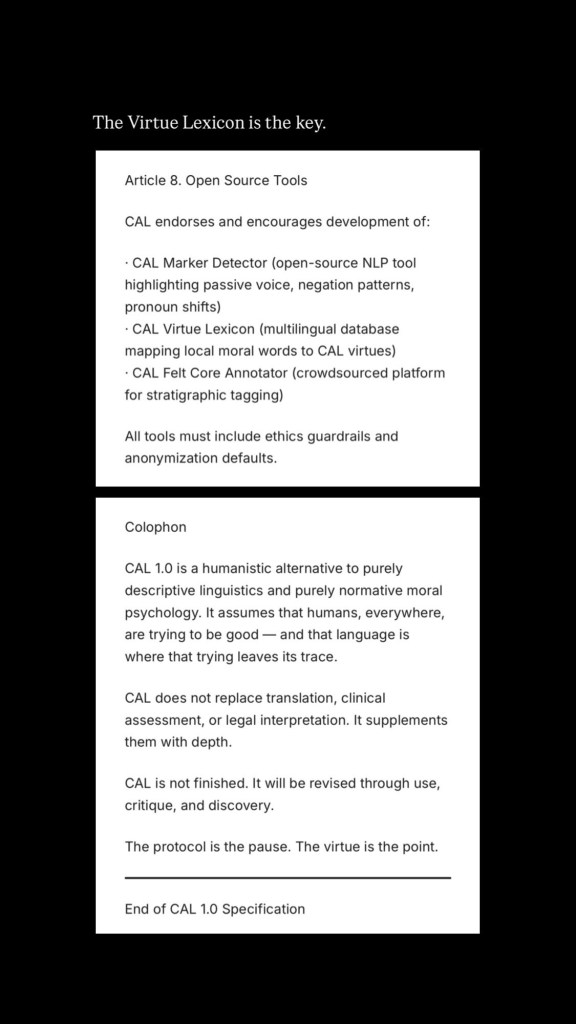
Article 8. Open Source Tools
CAL endorses and encourages development of:
· CAL Marker Detector (open-source NLP tool highlighting passive voice, negation patterns, pronoun shifts)
· CAL Virtue Lexicon (multilingual database mapping local moral words to CAL virtues)
· CAL Felt Core Annotator (crowdsourced platform for stratigraphic tagging)
All tools must include ethics guardrails and anonymization defaults.
Colophon
CAL 1.0 is a humanistic alternative to purely descriptive linguistics and purely normative moral psychology. It assumes that humans, everywhere, are trying to be good — and that language is where that trying leaves its trace.
CAL does not replace translation, clinical assessment, or legal interpretation. It supplements them with depth.
CAL is not finished. It will be revised through use, critique, and discovery.
The protocol is the pause. The virtue is the point.
End of CAL 1.0 Specification
Many of today’s languages are interrelated by common ancestory, like branches of a tree coming off just one or two stumps that reach into prehistory.
If you trace the use of words back in time, you get rich multidimensional and multilinguistic connotations and associations that network back to proto-linguistic groups that precede the alphabet and written word, but reveal the innate human core that supplied the primal sense, feeling, social bond, or other concept behind later linguistic evolutions.
This helps humanize and disambiguate universals from modern, culturally relative linguistic metaphors—essentially tracing a word’s origina theough history, observing the branches of related use, and exposing what core sentiment or social needs it has served since time immemorial.
This allows for restructuring of linguistic output that dispenses of cultural bias, jargon, and technical language in a way that is innately humanistic and accessible across language barriers.
THE CORE VIRTUE / SENTIMENT LEXICON BASED IN ETYMOLOGICAL ARCHEOLOGY IS THE PRIMARY INTERLINGUISTIC PIVOT FOR NETWORKING MEANING ACROSS LANGUAGE AND CULTURAL BARRIERS.