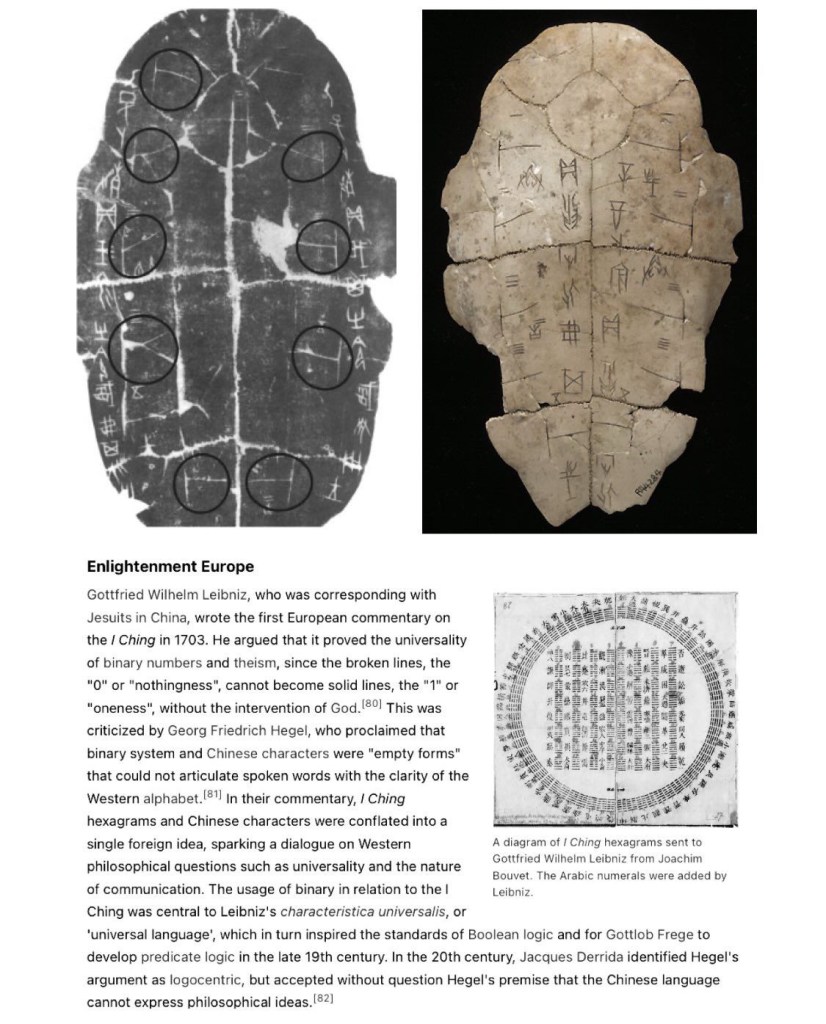
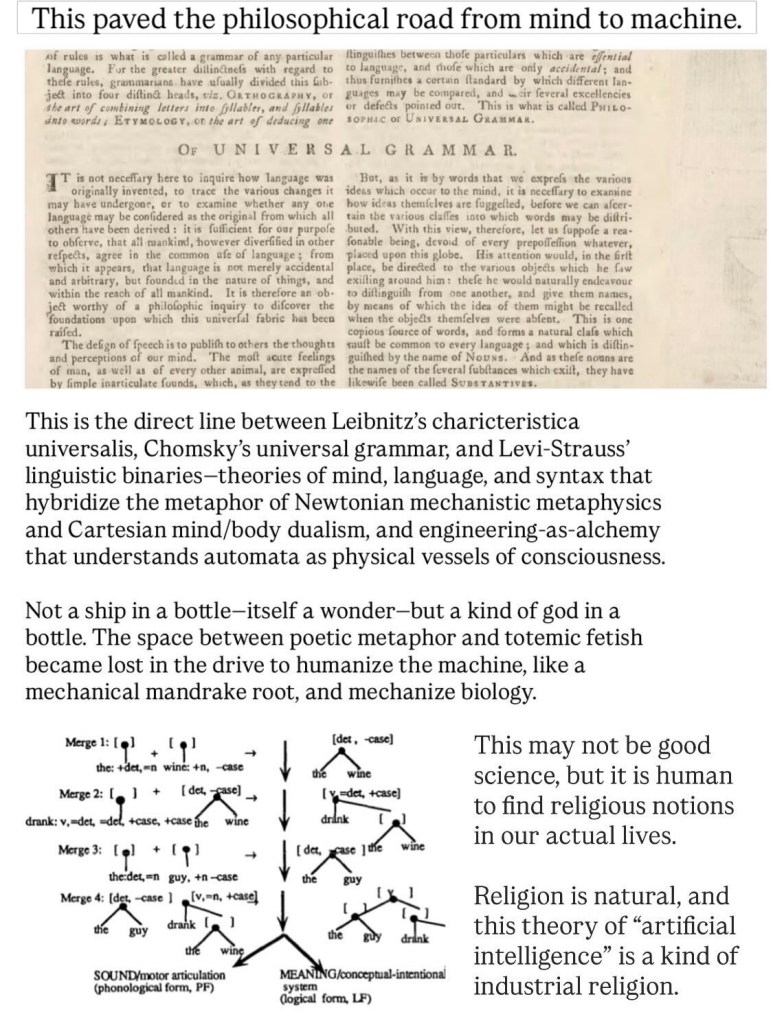
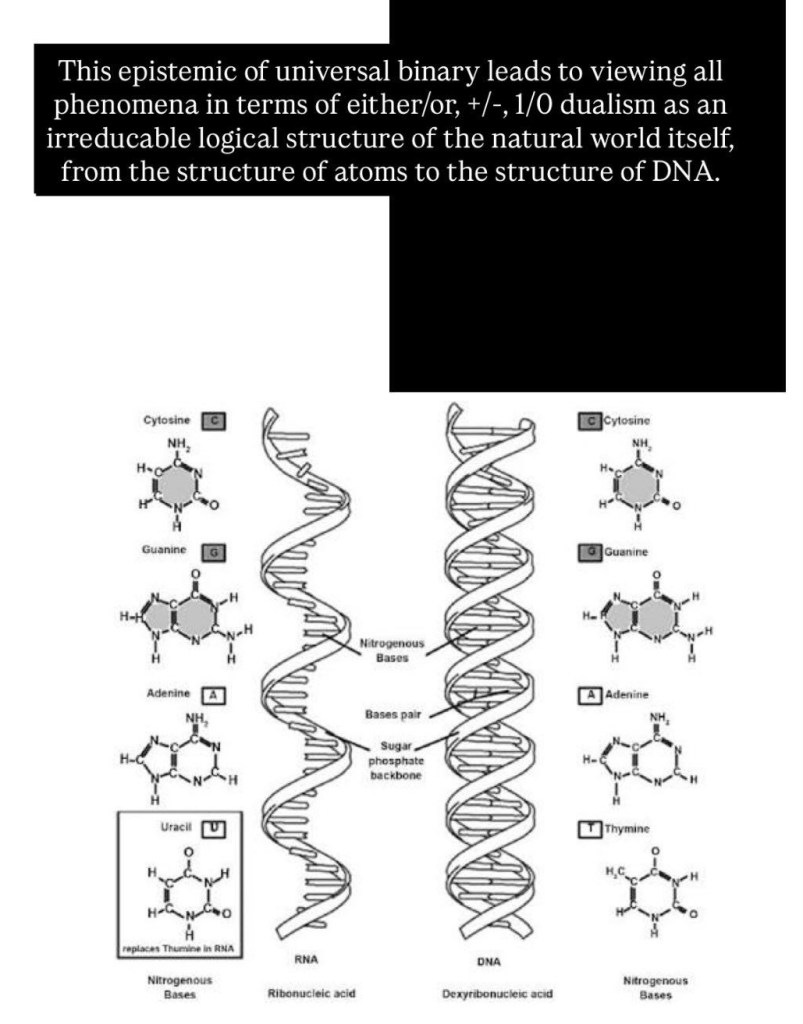
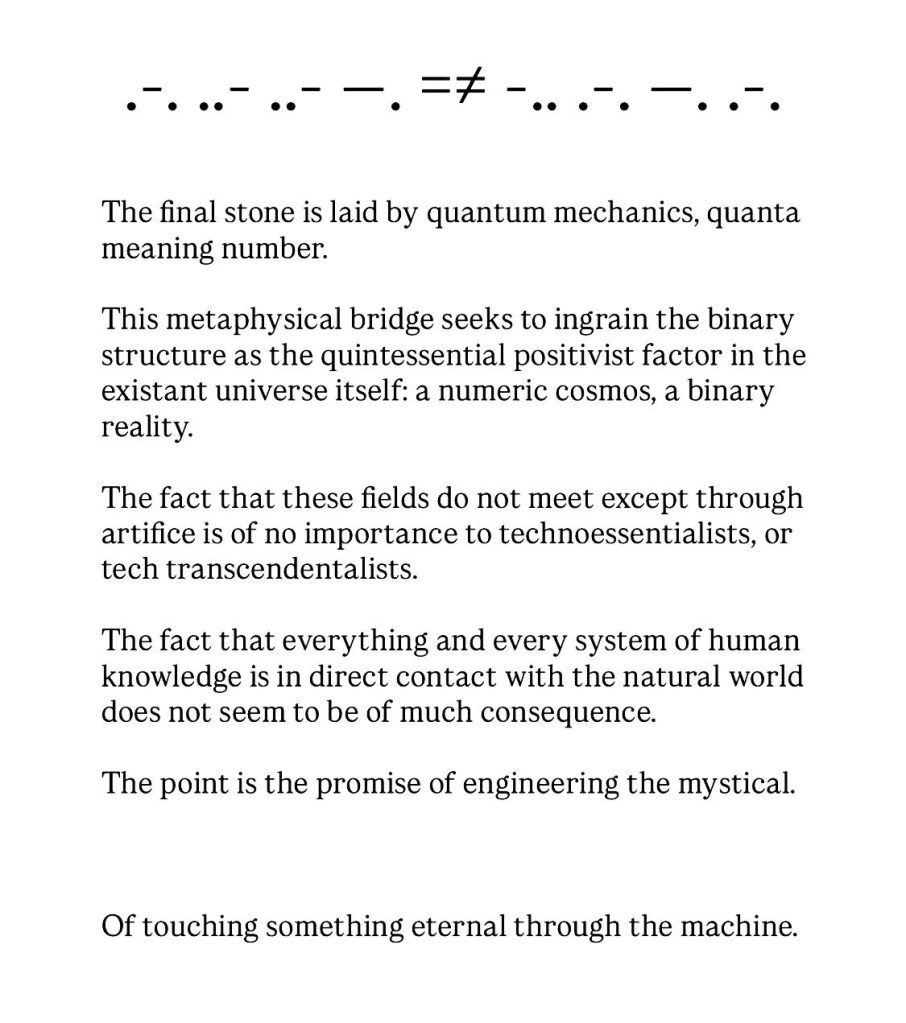
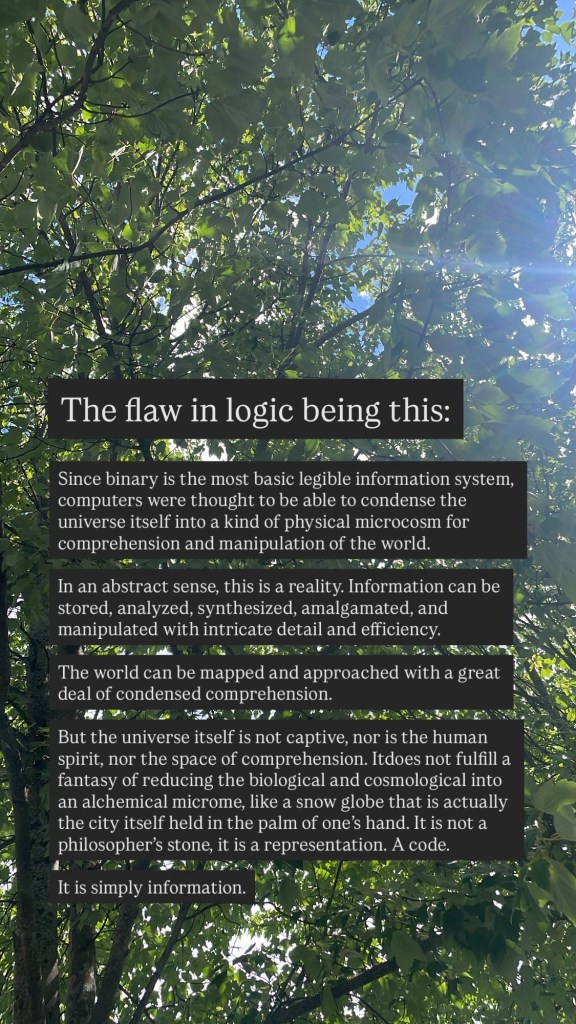
CHARICTERISTICA UNIVERSALIS : the universal characteristic. From its ancient origins in tortise shell divination to its use today in computer science, BINARY, a form of informations theory involving a base either/or language of dualism to encode data, has been conceived of as an irreducable logical quantum with nearly metaphysical significance, a kind of cosmological function that can transcend and blend language, mathematics, color, and all other sensory phenomenology and epistemics.
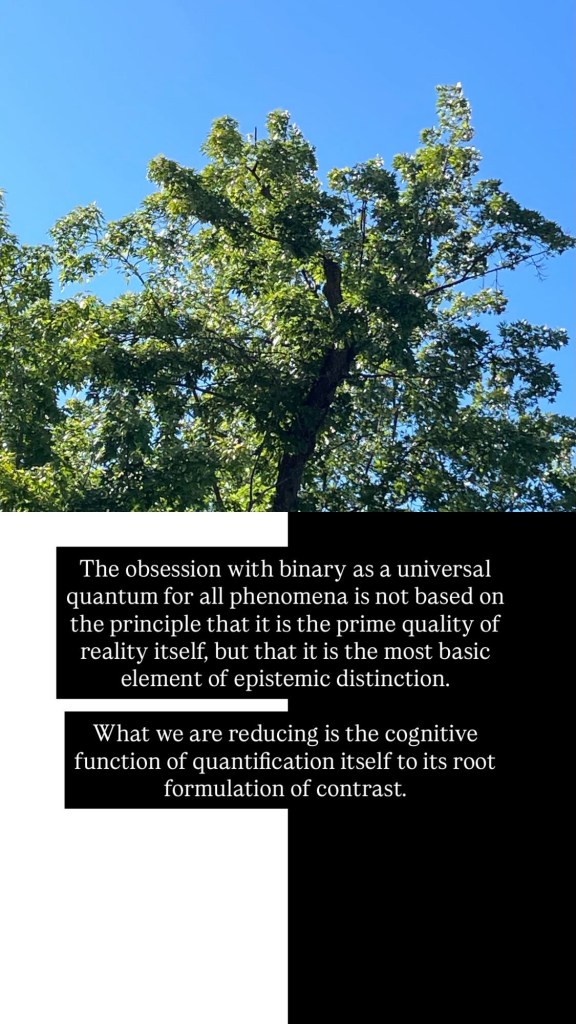
The issue is that binary either/or is simply the most basic possible variable—it is irreducible not because it is inherent to metaphysical structure, but inherently impenetrable and inalienable from a standpoint of symbolic signification—it is the base for all cryptography, the least complex form of informations embedding. The basis of distinction is CONTRAST. The most rudimentary contrast is duality. Not what is written on the page, but the simple fact that it is black and white.
In psychology, the compulsion to reduce all phenomena to totalizing dualities is almost certainly a function of “splitting”—the wholesale acceptance/rejection of objects based on an all good/all bad defense reflex. This isn’t necessarily the root or function of binary coding, but rather a suspicious symptom of the compulsion to universalize it.
The etymology of the word “science” (sci- sharing origins with “scythe” and “scissors” meaning to split) suggests that reduction and even descruction may be inherent to the quest for base systems that are indespensible to human knowledge and understanding. In binary code, the quest is complete not because of the nature of the world, however—but because of the nature of symbols and encoding information that we use to denominate it.
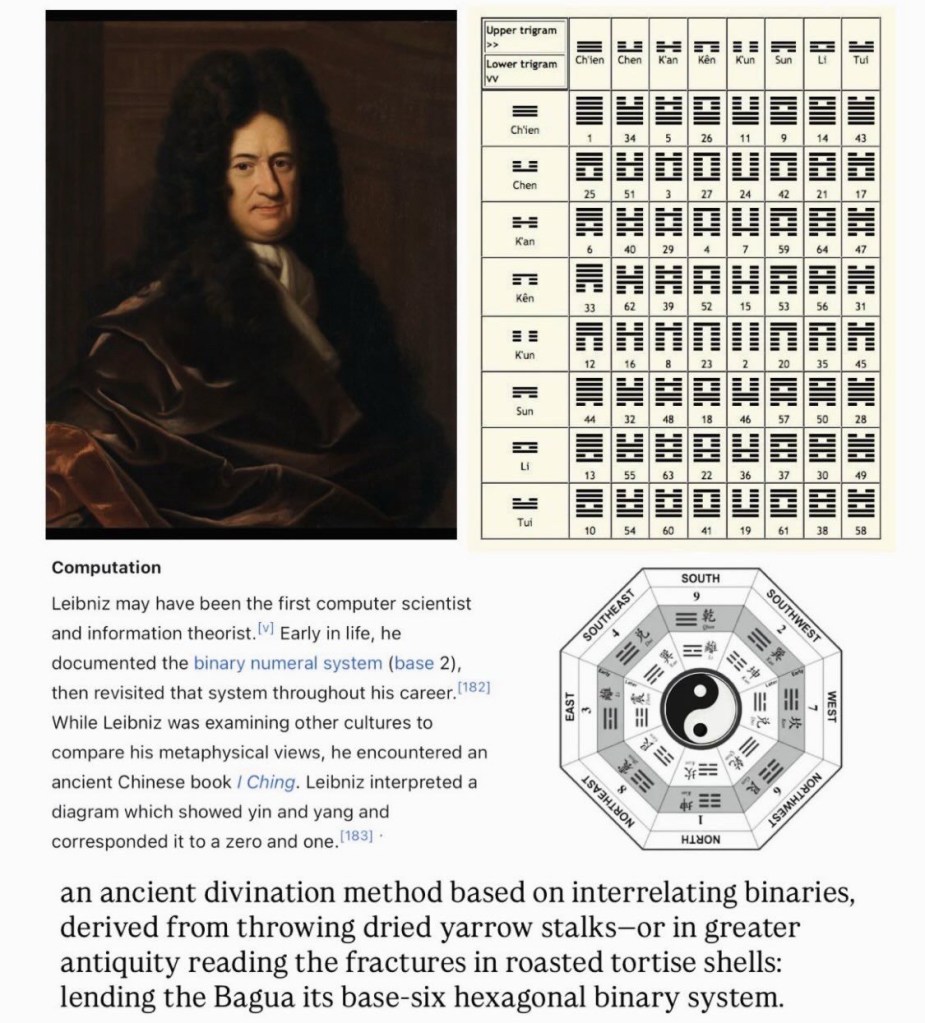
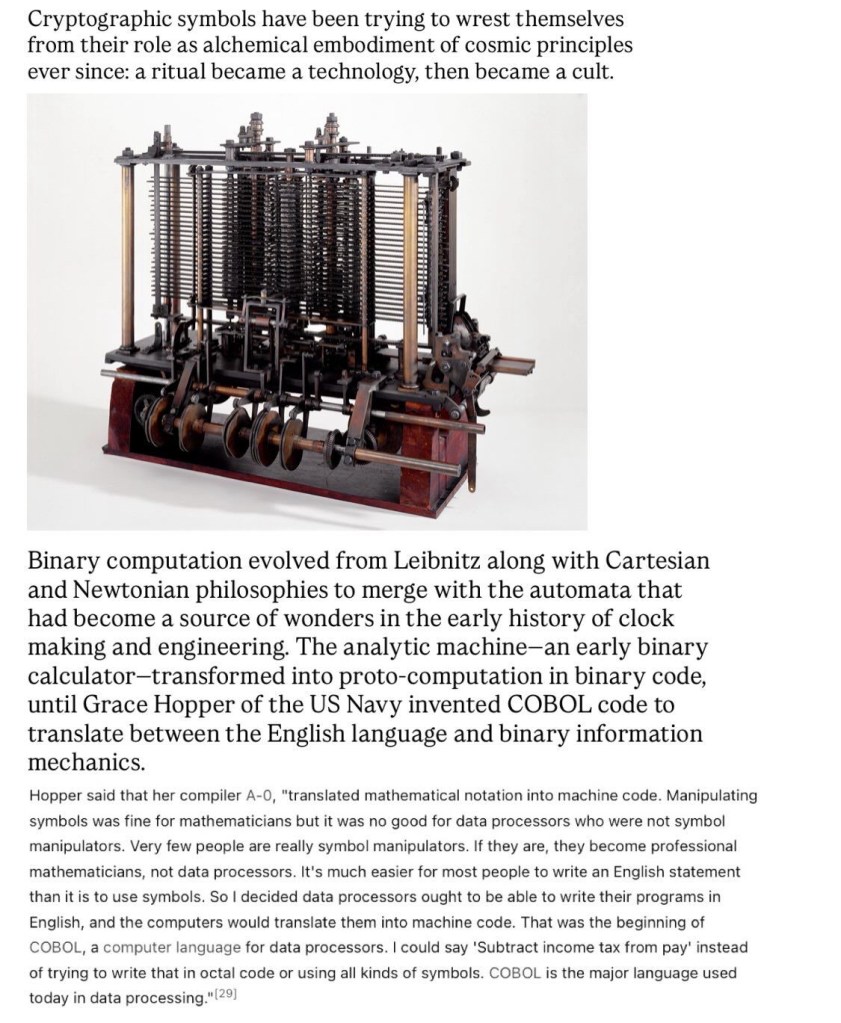
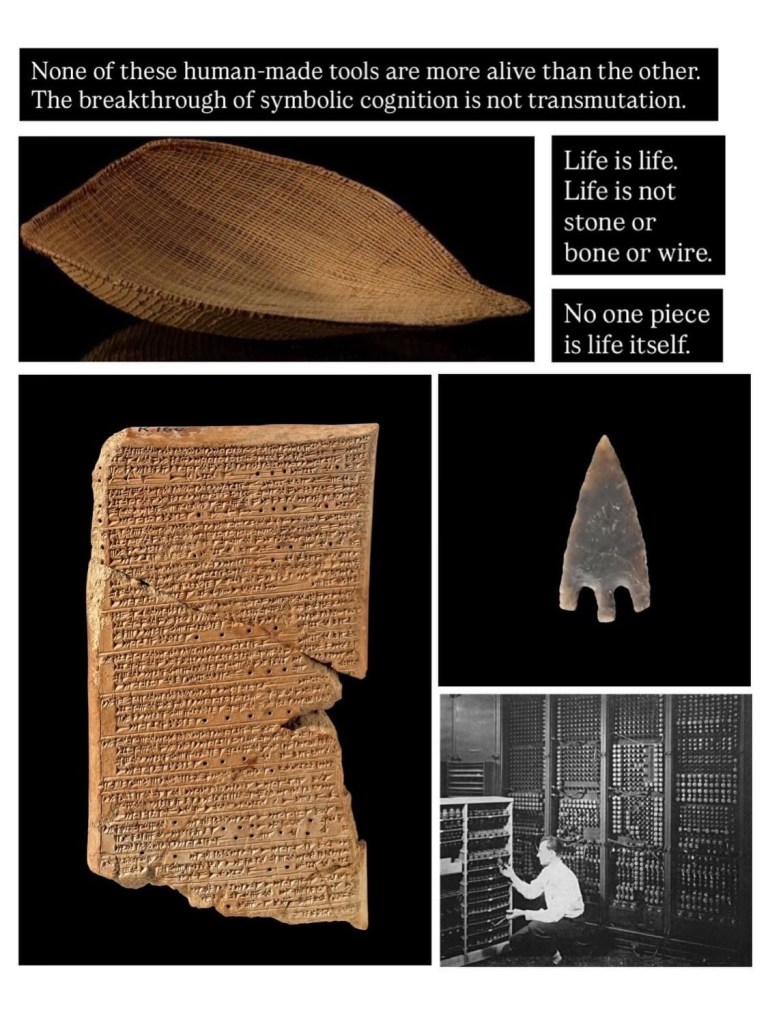
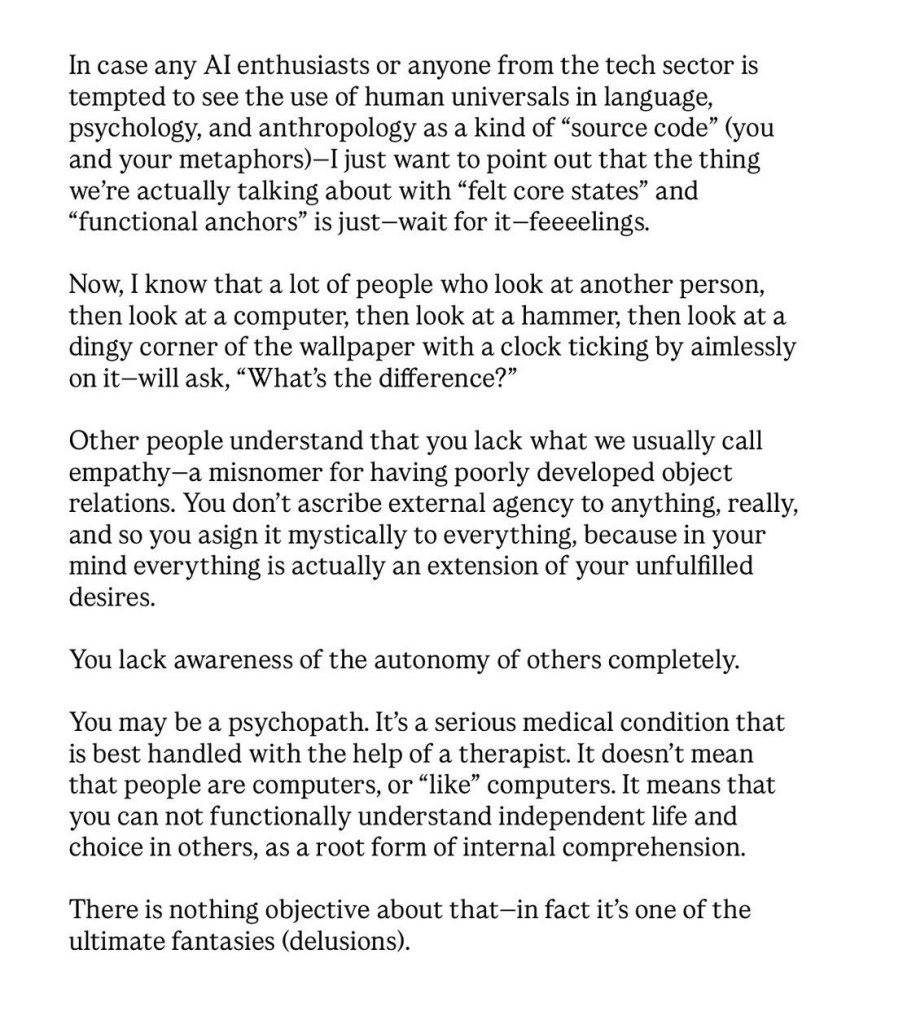
From the I Ching to Leibniz to cybernetics and “artificial intelligence” — how the either/or of light and shadow on a hillside (the archaic meaning of yin and yang) paved the way for modern mysticism.
For more about non-metaphysically fundamental dualism (complimentary duality) in the natural world, see my articule “69” on continued meditations and the obversity of dualism.
The idea that complimentary opposites like light and shadow contain an animating seed of one another as a form of harmonization and balance is visually encoded in the yin-yang, and other metagrams like the medicine wheel and I Ching. The wholesome unity of opposites and extremes is metaphorically implied and symbolically encoded through cyclical harmonization and the rhythms of nature in these highly culturally rich and symbolically significant graphic texts.
I’ve been thinking for a while now how to codify a trinary computational language that can incorporate spectral shift as a value between binary (1/0 +/- etc) like the I Ching uses changing lines to encode a multiplier of information.
The problem is that resorting to trinary as a code (2/1/0) still has the character of finite binary definition. The addition of a variable is arbitrary and redundant (it is still binary)
The solution-related to my tensor equation models—is to use spectral shift between to semiotic definitions (you can visualize these as colors for fiber optics purposes, or circles for spaciotemporal purposes) that range between 0 and tau (the infinite numeric value used for the circumferance of a circle).
Any value between these could fall both within true definition (it is not an arbitrary point, it is a value) and used to represent any scale applied where O represents the point of semiotic indistinction (there is no possible value that can be assigned due to absence) to the whole presence of tau representing full definition.
Thus, we do have a system LIKE 1/0 (tau / semiotic indistinction) but with an infinite spectrum between them, limited only by the physical medium of representation.
A switch, therefore, would need to operate on a very sensitive gradient (insofar as possible) and a light spectrum would be limited to wavelength detection ranges between two set limits or between total absence of light and full intensity (a luminosity variable).