“I saw the best minds of my generation destroyed by madness, starving hysterical naked,
dragging themselves through the negro streets at dawn looking for an angry fix…”
Ginsberg, Howl
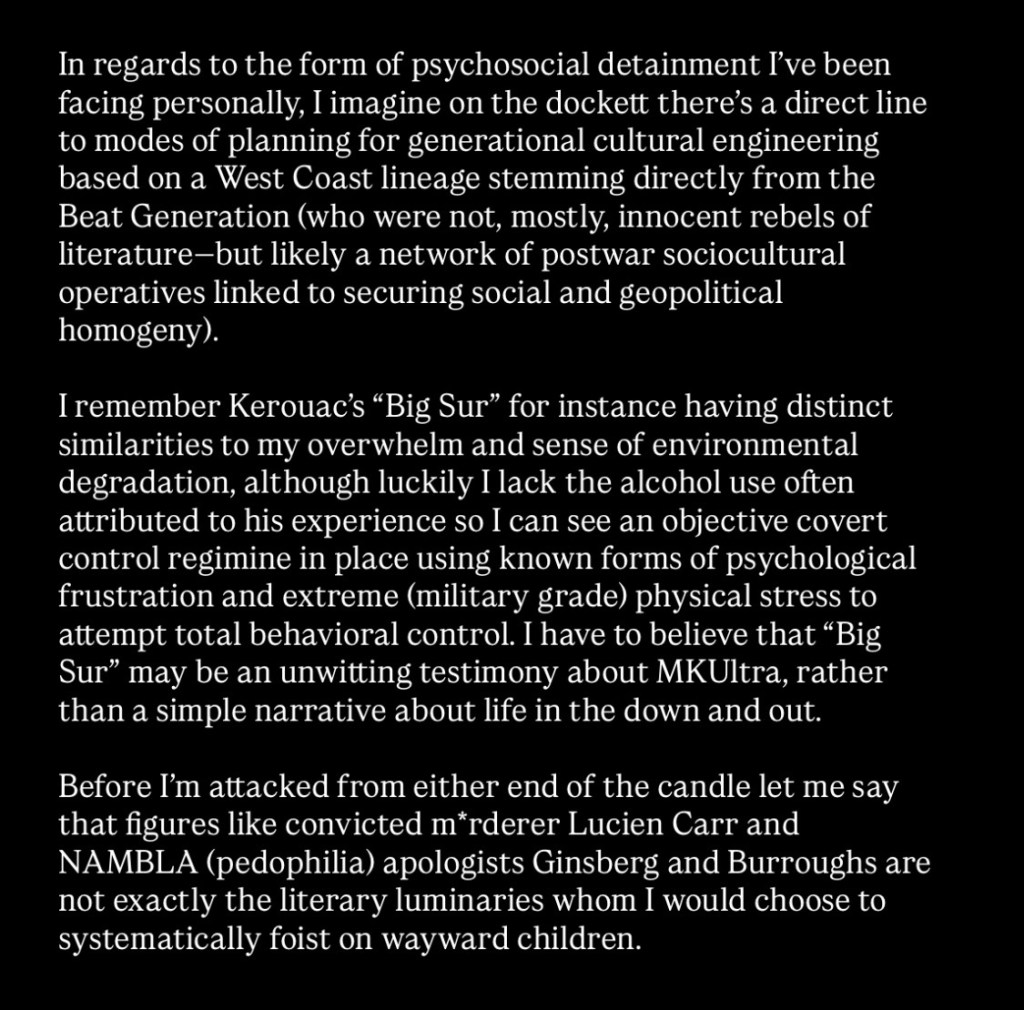
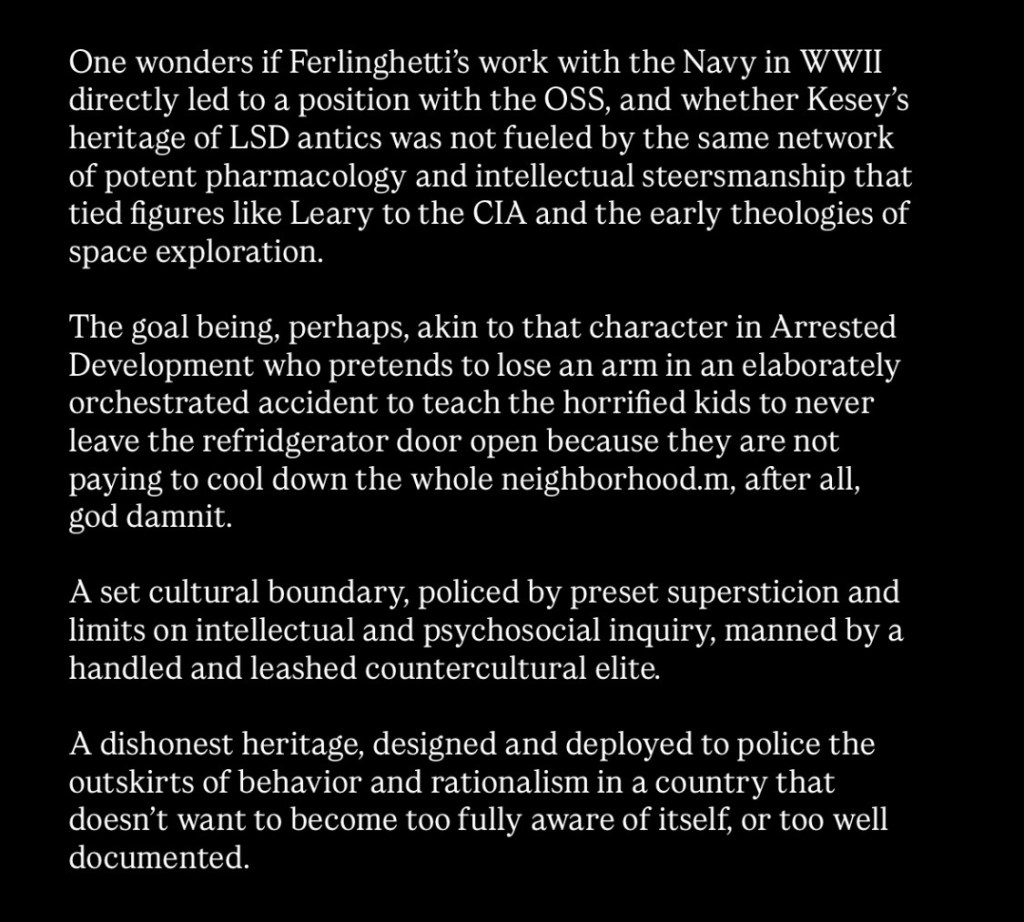
From any literary reading, the subtext here is:
“Don’t get too smart or we’ll wrap you up like a knot in plain sight of God and everyone, hook you on drugs that you’ll feel like you need to cope with it, and send you to a barren ghetto that we reserved for freed slaves who already know what you’ll find out the hard way.”
At least the most iconic poem of an entire generation opened with euphamistic threats, equating intelligence to mental illness, starvation in public, uncomfortably fetishized nudity, poverty and lack of automobile ownership sharing a distinct unwelcomeness (why else would they be dragging themselves), and racism.
Thank you America.
I guess you can’t spell intelligencia without the CIA.
As a young writer searching for lineage and meaning in my displacement among stucco and cinder block suburban housing tracts in the orbit of Las Vegas’ showman-like glimmer, I was directed to the authors as my forebearers of American searchings for meaning.
The message I seemed to receive was, “Are you feeling rebellious? Here, have some nightmare ramblings from sexually depraved and drug addled criminals. Maybe you could be a hero like them someday.”
Thank God I found Alan Watts and William Kittredge—after years of wading listlessly through mire, like trying to find safe footing chest deep in a swamp.
My high school English teacher, Mr. Frasier from Brown University, who helped encourage me as a young writer, was personal friends with Burroughs, who some may remember also had ties to Portland, Oregon’s arts scene through “Drugstore Cowboy” and its thematic relative “My Own Private Idaho” (both from Gus Van Sant-Portland film legend).
I was profiled for institutional abuse before I ever had a chance to reach adulthood, I’m certain of it.
The irony is that it was done as punishment for resisting breaking to the abuse at home. Being the victim of psychological torture from my own family taught me rigid rationalism, ironically. My mind automatically calculates polarities and evaluates probabilities for hidden motives. In abuse, there are none but the abuse itself. One must wager through all possible angles before reaching this deft certainty on a daily basis, however—to maintain sanity.
This does not stop the delusions and predatory hunger for inflicting shame and helplessness upon trapped victims in the case of domestic narcissism, however. This is the terrifying thing.
Sanity is some small reward that you bargain with reality itself for, as a way of grieving the forfeit of reason and language and kindness in relating to your closest captors and guardians. Self-reliance is a ward against Stockholm syndrome. It’s very tempting for anyone who comes of age like this to call it “love.”
I still have dreams, occasionally, about the walls of my childhood bathroom coming down on me in a gale of water, and standing shin deep in the wreckage and flooding sobbing.
I grew up in a home where doors were broken down and locks were tested experimentally, after careful footfalls across the carpet only left shadows of light that changed under the door and made it so you held your breath.
I hid outside for safety. I found places no one would look. I learned to drink cheap gas station coffee at 3am when I was 12 just to calm my nerves.
And authorities are cynically confounded that I tried to live outside until my own locking door presented itself. (i presumed with hard work it would, as I could see nothing exceptional about me and can see plainly the whole kindgom of keys and houses before my very eyes.)
My entire life sentence has been about the secret assertion that the one thing I’ve been looking for all these years—a door that locks safely that only I have the key to—is not an option.

