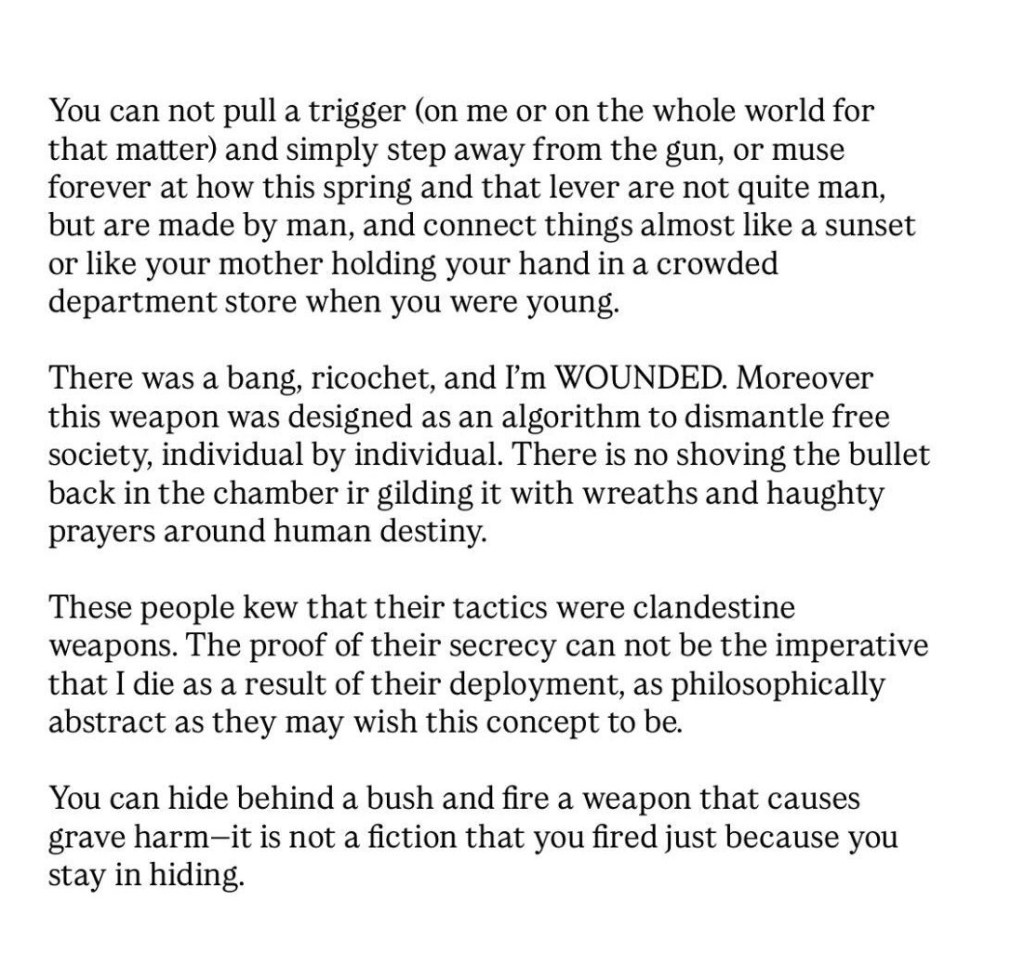
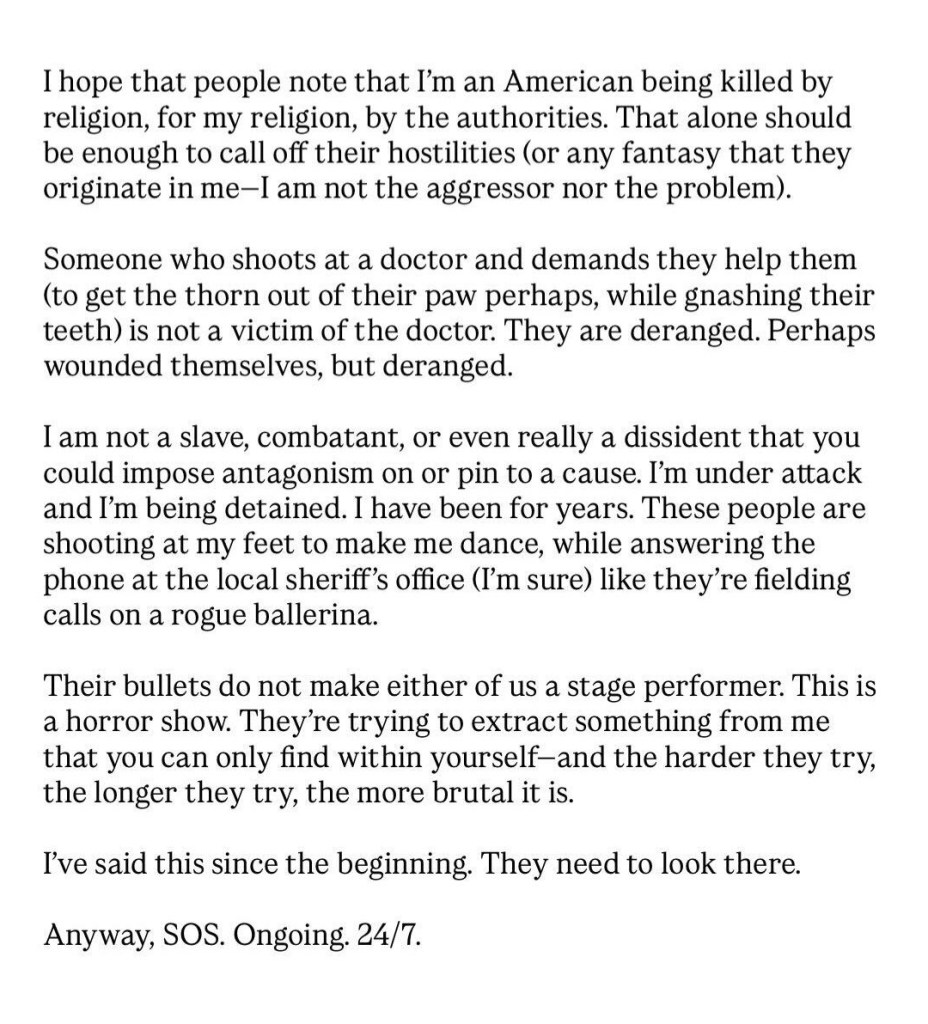
Notes on the role of superego and religion in my ongoing persecution.
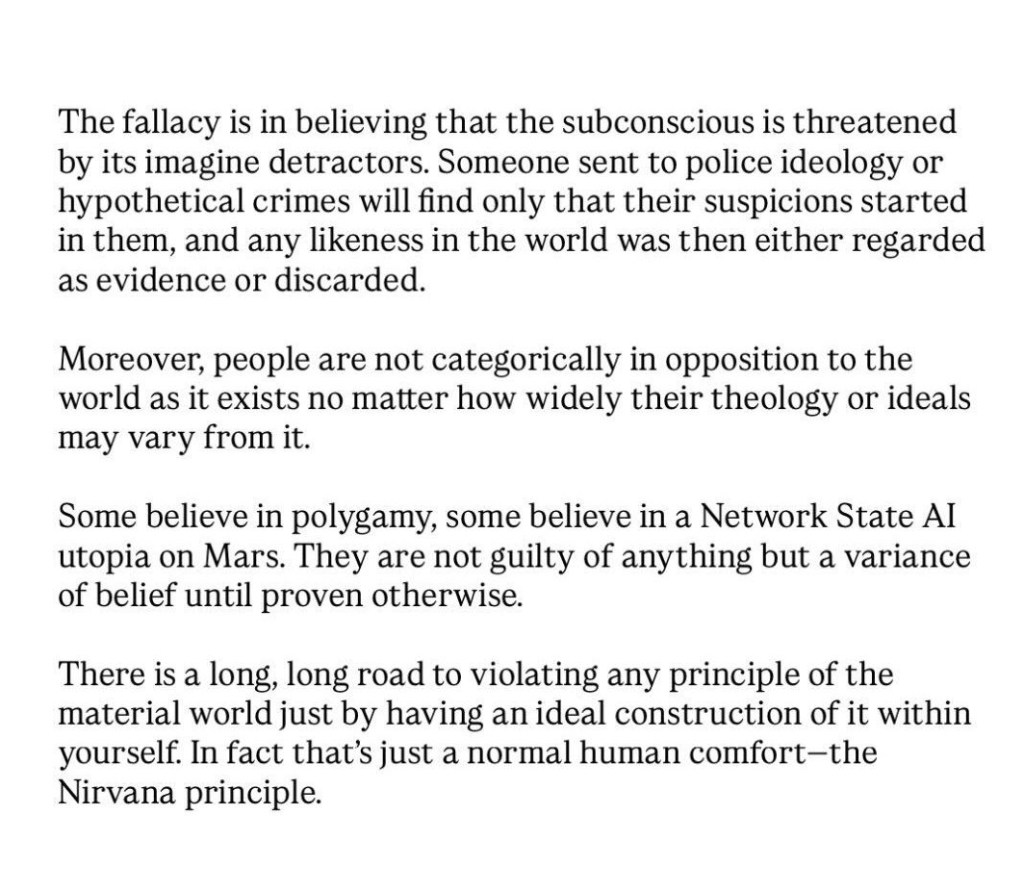
The fallacy is in believing that the subconscious is threatened by its imagine detractors. Someone sent to police ideology or hypothetical crimes will find only that their suspicions started in them, and any likeness in the world was then either regarded as evidence or discarded.
Moreover, people are not categorically in opposition to the world as it exists no matter how widely their theology or ideals may vary from it.
Some believe in polygamy, some believe in a quasi-slave state utopia on Mars. They are not guilty of anything but a variance of belief.
There is a long, long road to violating any principle of the material world just by having an ideal construction of it within yourself. In fact that’s just a normal human comfort—the Nirvana principle.
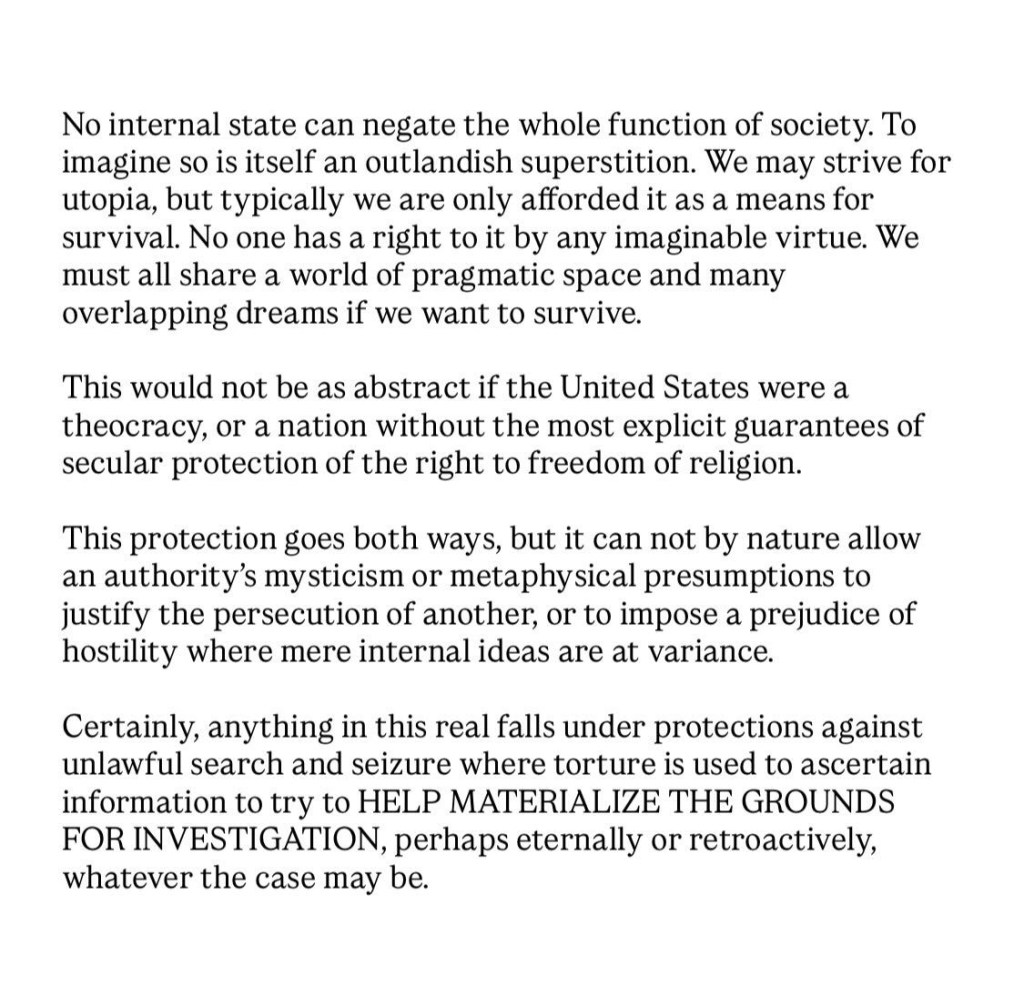
No internal state can negate the whole function of society. To imagine so is itself an outlandish superstition. We may strive for utopia, but typically we are only afforded it as a means for survival. No one has a right to it by any imaginable virtue. We must all share a world of pragmatic space and many overlapping dreams if we want to survive.
This would not be as abstract if the United States were a theocracy, or a nation without the most explicit guarantees of secular protection of the right to freedom of religion.
This protection goes both ways, but it can not by nature allow an authority’s mysticism or metaphysical presumptions to justify the persecution of another, or to impose a prejudice of hostility where mere internal ideas are at variance.
Certainly, anything in this real falls under protections against unlawful search and seizure where torture is used to ascertain information to try to HELP MATERIALIZE THE INVESTIGATION, perhaps eternally or retroactively, whatever the case may be.
But resorting to hypotheticals ad infinitum is the exact construct of a predictive model and an orthodoxy of presupposition about the nature of good and evil—not some proof of inevitability to be foisted on an unwitting victim or landscape as though it’s an experiment in physics. Algorithmic abuse is the imposition of a belief. It’s a prejudice.
Worse yet if you try to hypothesize a weapon, and simply build a weapon, and try to plant it on a small town shopkeeper to call them your enemy.
Where, then, did the weapon come from? Your ANXIETY about the security of your own fantasies.

