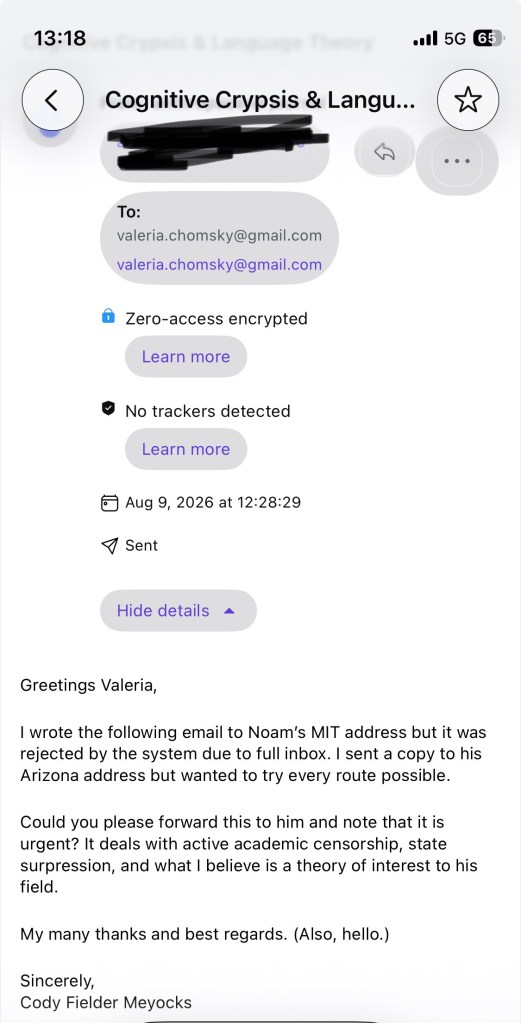
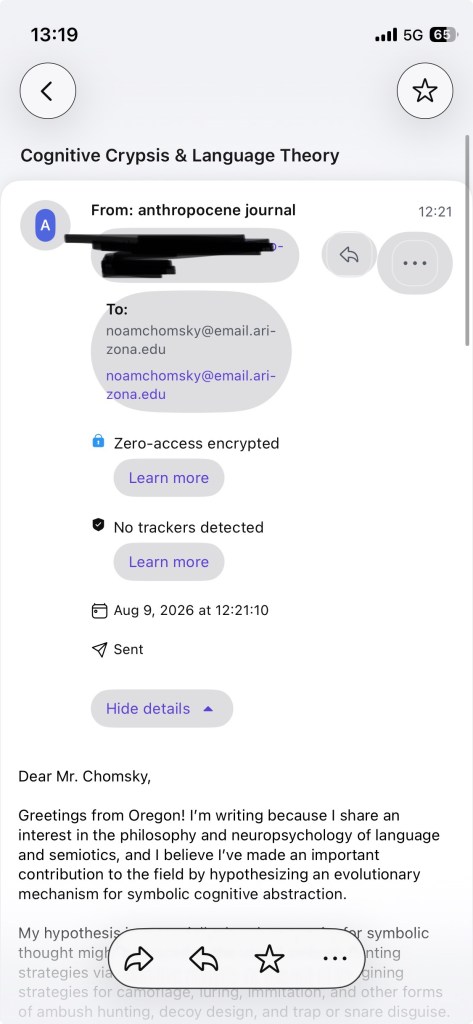
I wrote the following letter to MIT linguist and foreign policy analyst Noam Chomsky this morning, which was rejected in its first draft by his MIT hosted email address.
I sent a copy to his publicly listed University of Arizona email, as well as a copy to his wife Valeria Wasserman (aka Valeria Chomsky) that both appear to have been delivered, thankfully.
I hope that recognition and advocacy from the academic community might spare me from a useless and dehumanizing summary execution carried out in broad daylight under the auspice of perfidy, with a mere facade of institutional neglect used as a cover for keen and belligerent destruction of my every means of dignity and survival, with a goal to dispossess me of my life and my work through the most pernicious attacks of attrition imaginable.
This, again, is not just a concern for civil liberties and the academic community. This is of concern as a standing, ongoing, well documented and reported violation of the War Crimes Act.
Dear Mr. Chomsky,
Greetings from Oregon! I’m writing because I share an interest in the philosophy and neuropsychology of language and semiotics, and I believe I’ve made an important contribution to the field by hypothesizing an evolutionary mechanism for symbolic cognitive abstraction.
My hypothesis is essentially that the capacity for symbolic thought might be traced to the use of ambush hunting strategies via cognitive crypsis, or the act of imagining strategies for camoflage, luring, immitation, and other forms of ambush hunting, decoy design, and trap or snare disguise.
The essential premise being that by developing the cognitive capacity for imagining the perspective of potential prey (and predator, as natural for defensive camoflage) humans developed a kind of internal sensory abstraction phenomenology, allowing then for the more benevolent adaptation of this cognitive trait to social function, language, symbolic culture, and perhaps to some extent tool design—although I think I would relate this more to environmental and cultural considerations than one might assume.
I am approaching more from the field of psychoanalysis and epistemics (I began in the anthropology of religion but I feel thay saying this sets people on edge, so just to be clear I am a rationalist—I take after Feyerabend and Foucault to some degree in deconstructive analysis, and I must admit to being repulsed by Levi-Strauss and Girard, who I see as his hypermodern accomplice). I also borrow heavily from Baudillard and Debord in terms of media theory. I can’t stand Lacan or Zizek personally, although I’ll indulge in what feels like thinking about psychoanalysis and social theory for hours and come out feeling like I didn’t learn anything (“in the lineage”—one might say).
Obviously, the elephant—I did read Zerzan and Jensen, but I think I sensed the nihilism of the open moral question on civilization-as-destroyer too much to be fully invested on some kind of primitivist essentialism, as does everyone else. But I don’t mistake crumudgeons for fools, and I think while it’s tempting to be dismissive and overly reductive, the moral nuance is there in the text oftentimes (far from always, however), enough to not totally shun my fellow Oregonians. I just don’t want to be viewed as a terror suspect or sympathizer. (Boy do I have a surprise for the end of this email though…)
I want to thank you foremost for being an essential and life-changing (and life-affirming) part of my education—from my Philosophy of Language course at Portland State (it was a 400-level class, I enrolled while I still had a scholarship as a freshman before being forced to drop out due to looming student debt obligations)—to your work in media literacy and foreign policy, which I consider of the highest moral importance and which allowed me to feel competent for understanding life as an American.
With that brief introduction, I feel compelled to note that I’ve dealt with an unprecedented level of censorship from the state, and have been the victim of extreme forms of torture that would absolutely “shock the conscience,” but are likely thusfar protected from remediation, recognition, or litigation due to the nature of domestic (and transnational) counter-terror strategies.
I have faced severe brutality and criminality from both the state and private (mostly the tech) sector, which I believe constitute war crimes and violate the United States’ obligations under the 1949 Geneva Conventions. I can best conceptualize this as a grave rudimentary breach of the First Amendment (as well as 5, 8, and 14 respectively) as my work and theory are specific to my deep personal convictions in secular humanism, and I come from the field of comparative religion enough to recognize when I’ve become the victim of a witch hunt or a crusade. My conduct is not the issue—it is purely ideological and speculative justifications for the use of force, as far as I am aware.
That said, however, my life is still in immediate danger. My work and communications are being monitored, censored, and often destroyed (down to my lifelong compendium of source materials and my work in poetry). I have already been forced to flee the country and attempted to seek asylum (in Canada first, then Ireland and Switzerland on a devastating year-long pilgrimage, despite having contacted the United Nations UNHCR for help in mediating my case).
I have video footage of James Elmer Mitchell interrogating me under cover (he is probably a “private contractor” in his duties) in 2024. I also filed a whistleblower report with the CIGIE in July, 2024 in regards to the Inspector General for the Intelligence Community, the Honorable Thomas Monheim.
I feel like this reads like a fiction novel, but it’s truly due to the telescopic nature of federalized policing, and not due to any breach of civil society on my part. I was a small business owner, banjo repairman, inventor, and independent academic before I started facing concentrated efforts to destroy my life and my wellbeing.
I was hoping that I might present you with the basic outline of my theory and my personal situation, for the sake of preserving it within the academic community should I fail to survive, and perhaps in hopes that you might advocate for me with any institutional or foreign policy contacts that could help me untangle myself from this mess.
I will leave that there as an introduction as I am certainly already taxing your time, but I will offer in turn what I see as a contribution to my critique of current language theory as it stands.
Could it be that biological semantics is simply mistaking the phenomenology of social cognition to help fit it more comfortably into a subconscious assumption of linguistic lexicon structures? As in a textual semiotics may be the pretense for semantic theories on biological linguistics, where text was in fact a physical cryptographic element that followed from social vocalization?
Vocalization is invocation, is my motto—although it sounds perhaps overly mystical and miasmic. I think that we’re dealing with a unique cognitive phenomenology in human language, and until we pin it down we’ll be stuck with the perplexing relationship between signifier and signified, which I am sure maps neuropsychologically, but largely disregards social biology and the actual phenomenology of abstract cognition.
With that introduction I hope that this finds you well, and please forgive me for intruding on a technical field that I do not quite belong in. I am not a linguist, I’m an epistemics buff. But I hope you find this contribution useful, and that I have not been a burden on your time.
All the very best,
Cody Fielder Meyocks
Verification of transmission
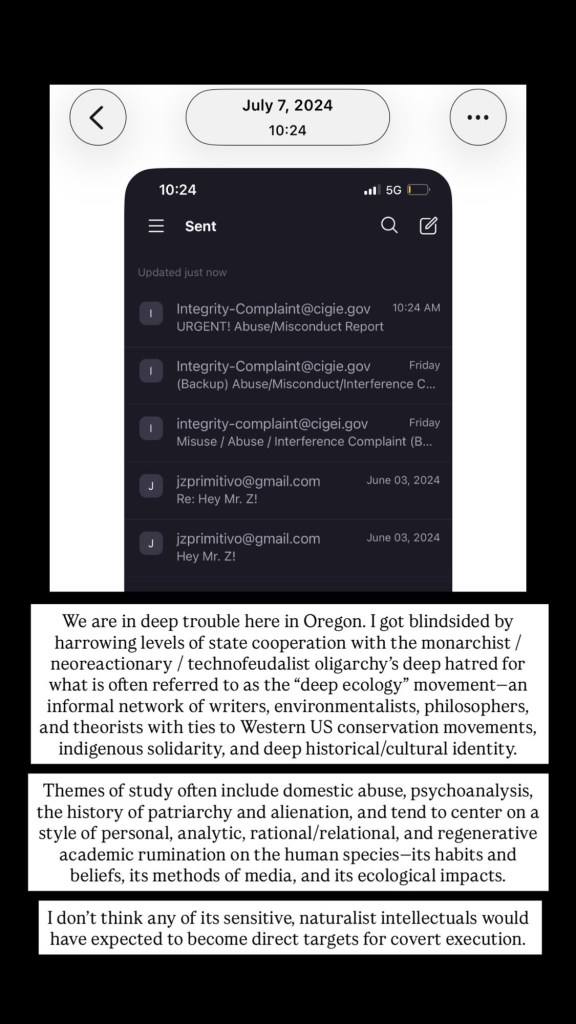
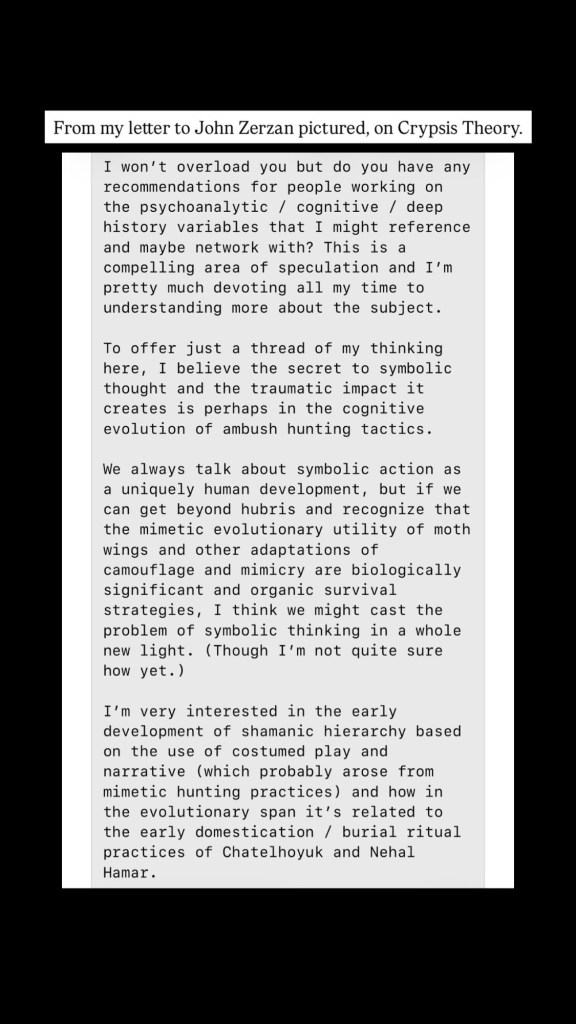
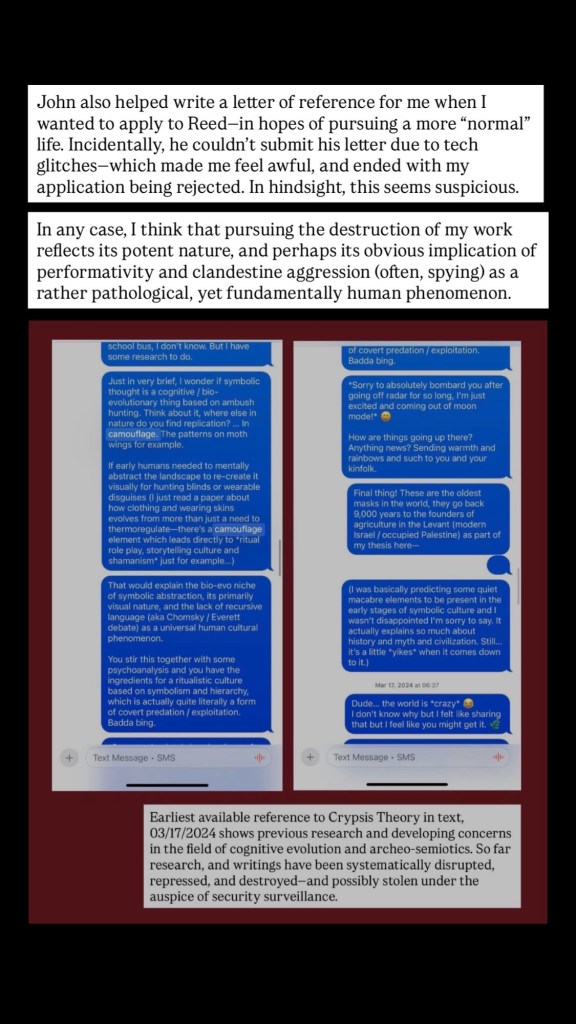
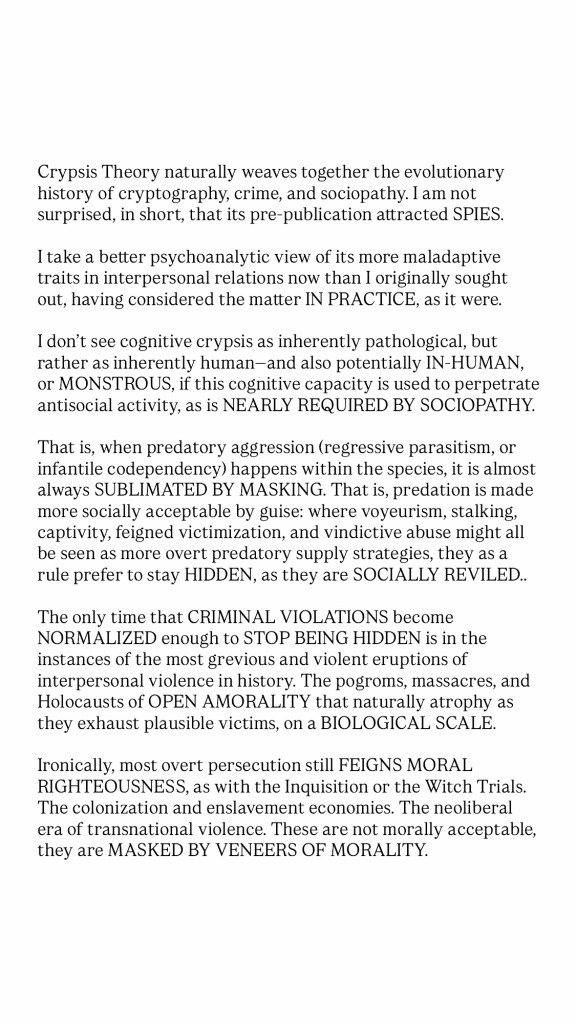
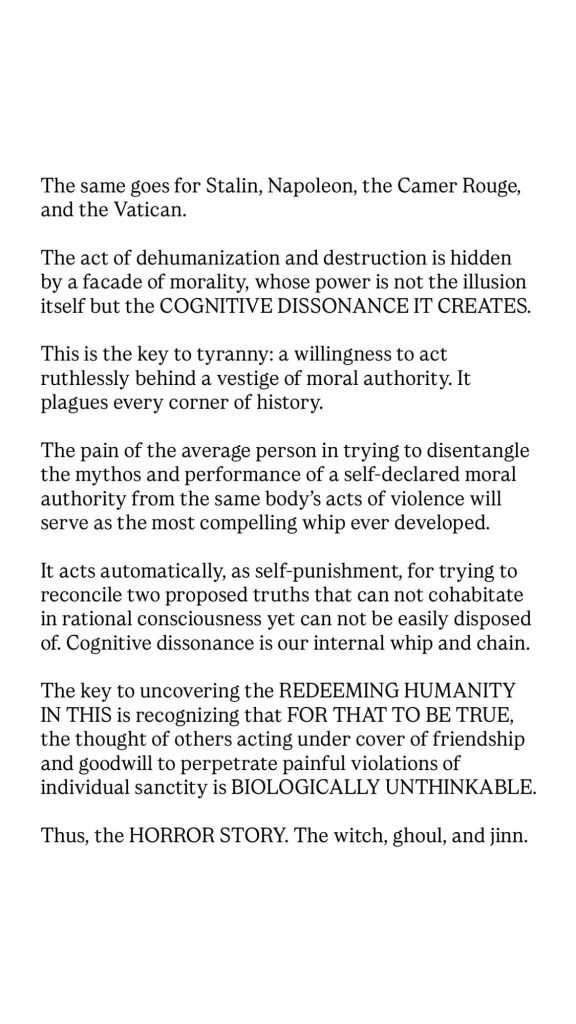
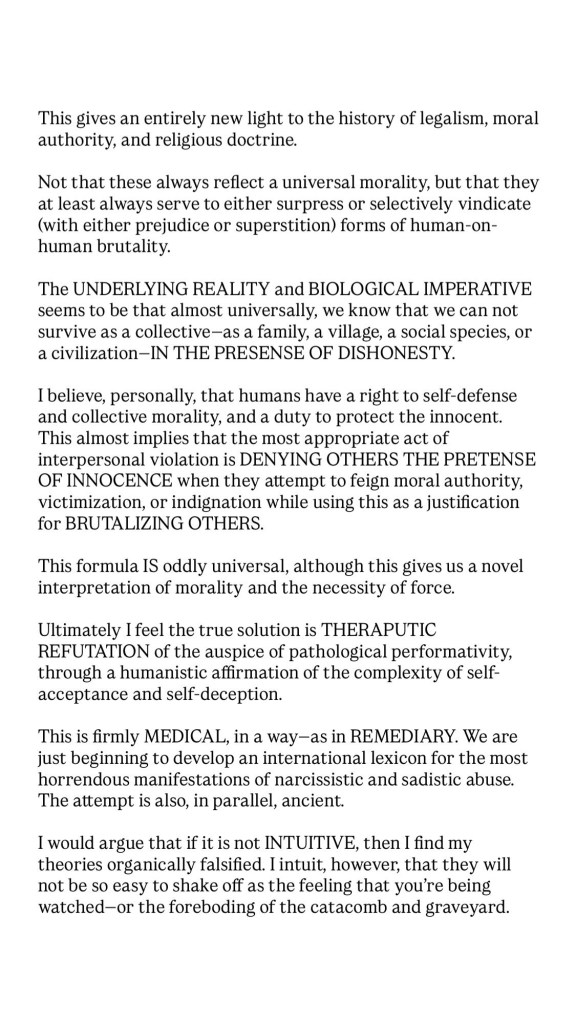
PS. I am not very fond of publicizing my very limited history of correspondance with Mr. Zerzan—but that said, guilt by association is not cause for individual persecution as far as I an aware in this country. It certainly should not serve as the grounds for a death sentence.
I understand that his life and work may seem philosophically, academically, or even existentially challenging—I think as a philosopher he is one of the first to try resolving the paradox of modernity. We know enough about ourselves and our species for once to become brutally self aware that we are destroying the planet, and that we may be doing so for no better reason than we haven’t had a chance to analyze how and why we are doing so yet.
Of course the technofeudalists came out of the shadows (perched upon the White House of all places!) vying for a return to the Dark Ages (but with luxury rocket cruises, AI robots, and mass calamaties written in data streams) while accusing their only real (quite timid, studious, and woods-like) critics (the deep ecology movement—not that I can call it that really—or even roughly locate it somewhere between mossy stumps and dreary roadways in the Pacific Northwest)—of wanting to return to an enchanted yesteryear (we don’t). They like the dystopian yesteryear, instead (we don’t).
We (I am counting myself not voluntarily but because they put me here) are miserable, broken, and tech-dependent, too.
I can’t think of anyone working on environmental philosophy that fits the brutally cynical characture of a naieve spear-weilding Luddite trying to kick down a dam with their Burkenstocks on, or whatever the US Federal Government thinks we get up to when we gather to dance around fairy rings at midnight.
They outlawed Adorno because he’s cynical didn’t they? Well, I’m cynical, too. If they wanted to paint someone as their enemy (they must do something with their fidgety nights hatching maniacal futures, I suppose) then OUT WITH IT.
Arrest me. Try me. Hang me if you like.
Not because I’m John Zerzan Jr. or because you thought it likely I’d turn into Cromagammemnon when I got old enough to reach Tenured Crumudgeon Philosopher status. But for who I am, please. Because in all honesty I have worked extremely hard to find the faults in myself, and I will take pride in the shared efforts if you’d like to join in, I guess. Just get a warrant.
I was a banjo repairman and a student of comparative religion. Hang me for that, and being depressive, if you like. It’s only fair to give your chosen, unwilling, cloud-haunted Oregonian “adversaries” (who in God’s name was persecuting you billionaires, the nutria?) a chance to give you your glorious victory as saviors of civilization.
If you’d like I can scrawl some notes on crystalline tensor equations for semiotic independent AI and spectral fiber optics optimization, or my thoughts on etymological intercultural and interlinguistic core state networks, so you can paint me in a vampire robe with tusks on my shoulders while you build the future I rationalized (with crystal orbs and horses and high tech liquid polymer medicine and scientific enlightenment and collective intergenerational individuation) without me.
You’ll do it all wrong, and serves you right.
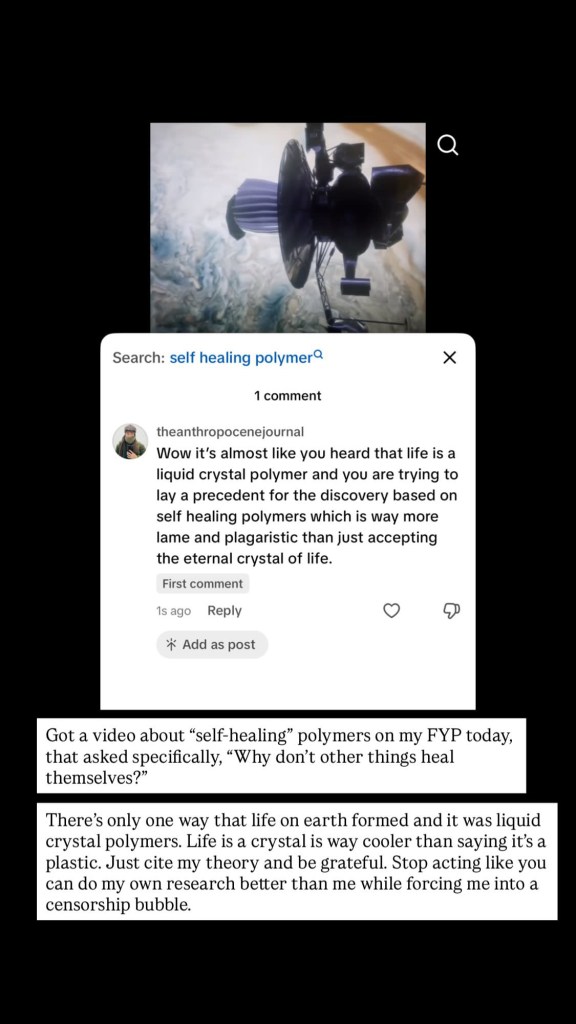
Update 10/02/26
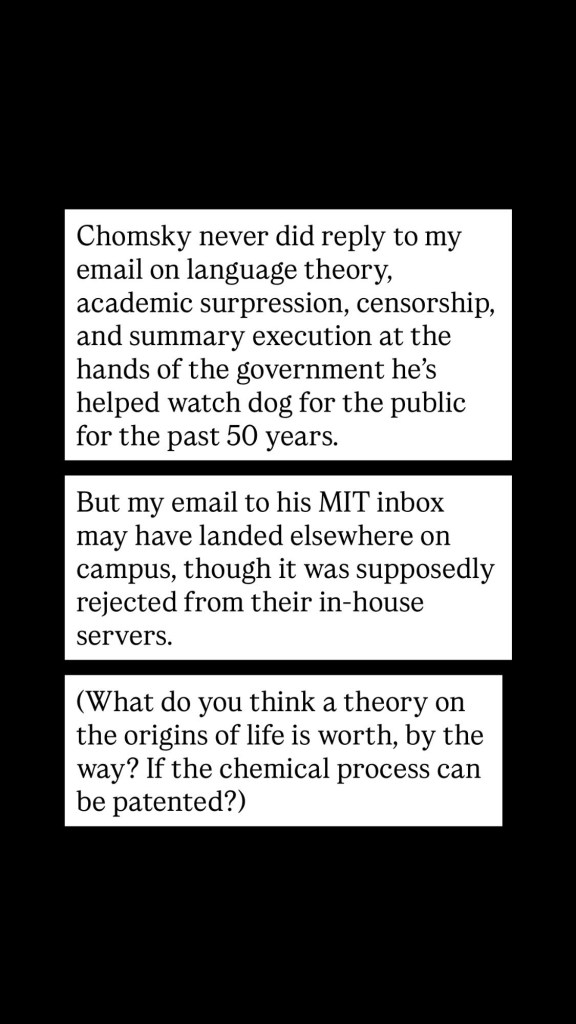
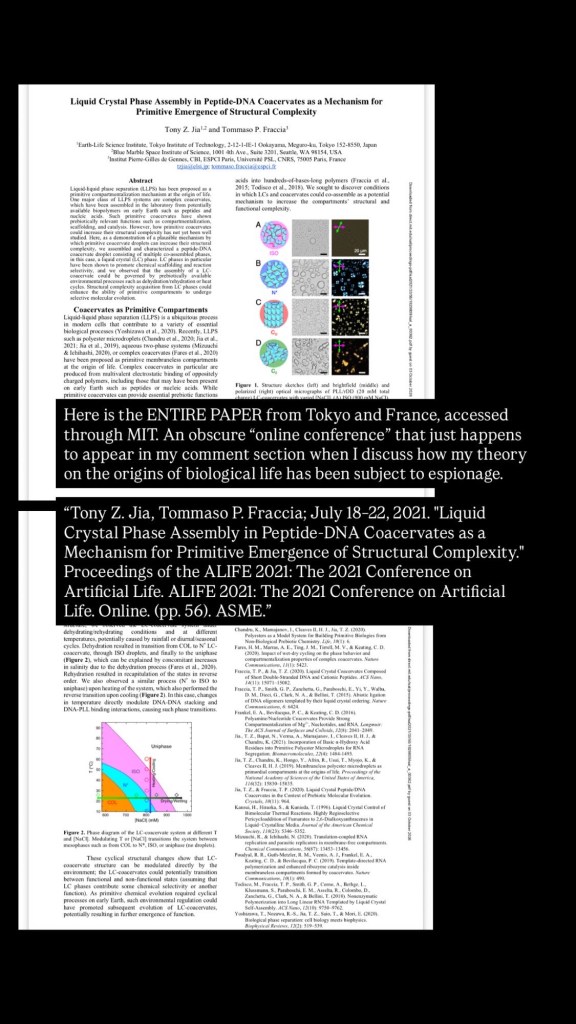
In response to an Instagram / TikTok post today where I noted that no biochemistry majors were in my comments section, due to the obvious value and merit of my theory on abiogenesis in particular, someone took it upon themselves to cite a paper on “artificial life” that references liquid crystalline polymer self-structuring. (VERY specific language.)
My immediate response, pictured below, was that someone had better have a printed copy with five years worth of untouched dust accumulated on it, because it’s not hard to back date a two page PDF from a 2021 online seminar.
It is hard to create a theory on the origins of life.
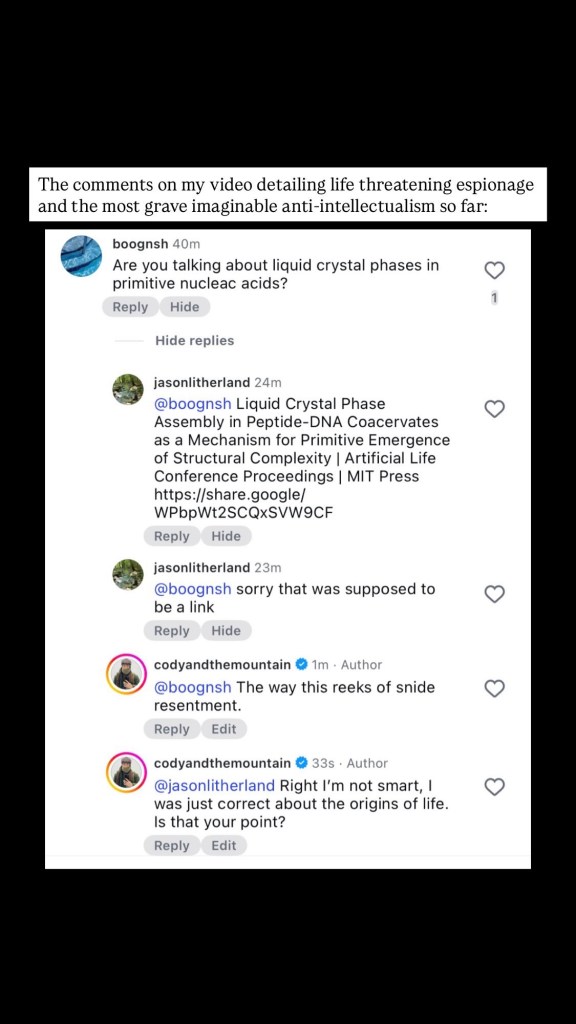
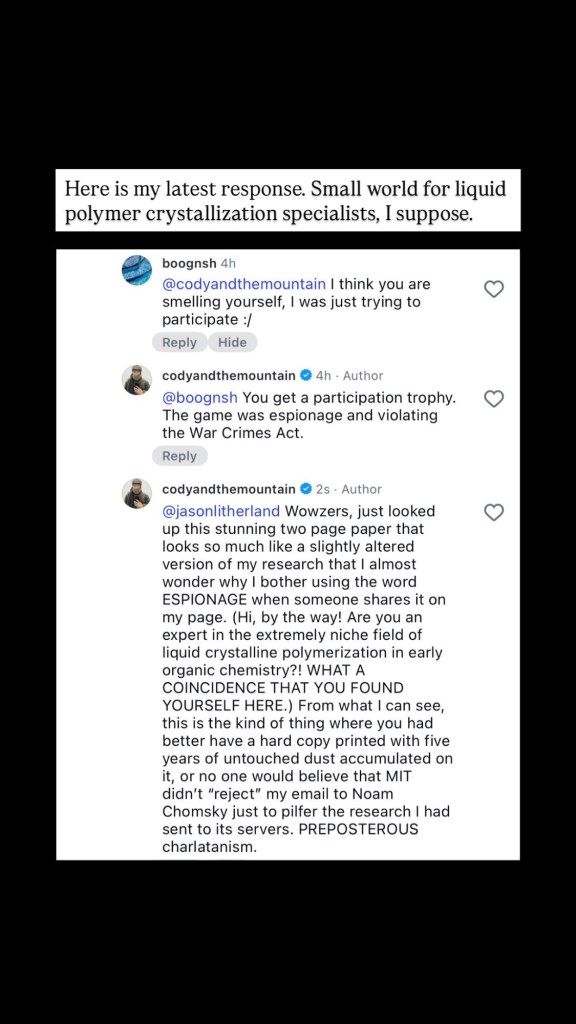
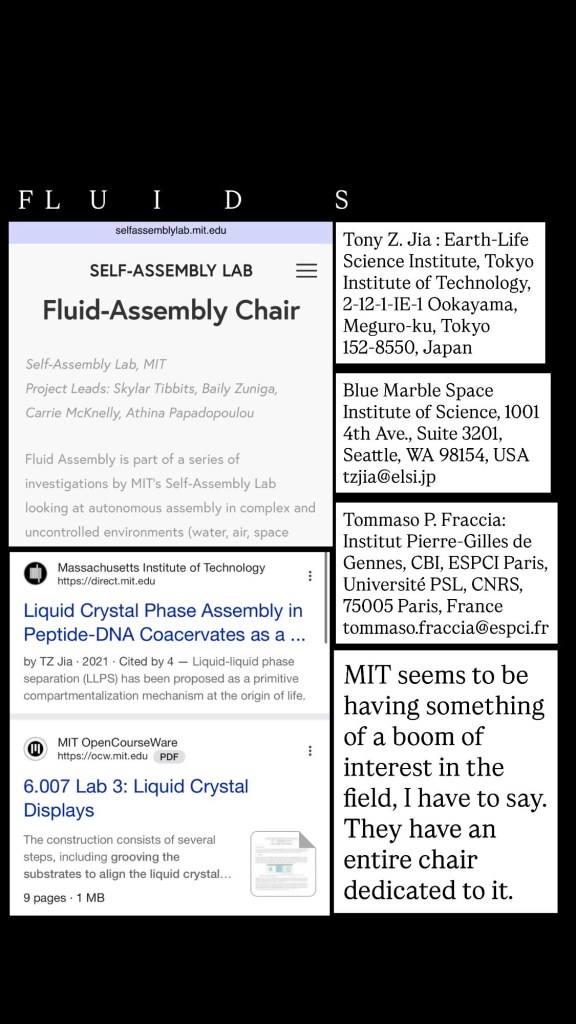
The “press” for this short article is called Silver Chair, based on the URL. I’m going to investigate further. I tagged MIT in my posts and asked them to comment on anti-democratic espionage.

