Recasting primitivism as a historical constant:
I feel the need to clarify and contextualize my personal intellectual history again, in particular to break the philosophy of “primitivism” (primalism) away from its very recent conception as a subsect of the historical leftist / anarchist current.
I think if we’re honest about what this analysis provides, we can remove it from its myopic context and apply it to a much broader, universal theme in human history that applies to all people and all time periods to some extent.
That is, exploring the specific tensions and contrasts between biological human nature and the neurosis imposed by particular cultural moments and their imperatives of performativity and often subjugation or self-repression.
Really what I think we are looking at with primitivism is a kind of anthropological constant, and recognizing our species- nature as the fundamental underlying principle behind technical, economic, and philosophical developments.
I think there are two fundamental characters to contemporary primitivism that need to be reevaluated here. Both relate to its historical context and the relative novelty of its theories.
First, I see primitivism as a rationalist empirical paradigm that presumes that the biological essence of humanity underlies all of its historical iterations and currents.
We have never had the breadth of perspective to consider the common soul of the human species from a perspective of collective academic legacy the way that we are afforded it today. This is exactly where the contradictions touch—the embrace of the primal and constant character of human biology, and the broad intellectual artifacts with with to study and analyze its expression across domains for nearly the whole scope of human history.
Primitivism is not necessarily an idealist viewpoint, but a paradigm of compassionate and rational analysis of human psychology, society, culture, and economy-through a biological lens, that recognizes both the constant and ephemeral.
The core revelation here is that biology outlasts culture, on our cosmic terrestrial timescale. We may shed empires, grand libraries, languages, and religions before we transform our continuity as a species.
Secondly, primitivism offers a comprehensive epistemic reform in contrast to the philosophy of structuralism, which accounts for its early focus on semiotics and media theory in the crucible of its overview. The relationship of humans to symbols seems to be primary for rationally understanding the role of culture as a specific biopsychosocial phenomenon.
This has only recently come into full bloom as a historical constant via the missing key of cognitive crypsis as the origin of symbolic cognition, and offers fertile ground now for reconstituting the human memory through a framework of semiotic relativity, and a kind of psychoanalysis of the symbol: an intersensory, interpersonal phenomenology of meaningful human vocalization, behavior, and representation (culture, language, story, belief, ritual, effigy, number, pictograph, alphabet, etcetera) that is at once deeply human and also somewhat prone to the enchantment of cultural essentialism in the nebulous subjectivity of the human mind and its culture.
Whereas primitivism may look at a watch and see its underlying constants, its function and role as a cultural artifact, and take it apart to discern its character, processes, and materials as an unapologetic and humanistic anthropological or archeological analysis, the structuralists would seem to want to mystify its countenance and perhaps add a collage of bright paint and book clippings to it, so that their conjecture is fit for publishing—somehow, another relic of supremacy.
Somehow, primitivism is a leap in objectivity. Its core concern is the study of origins.
This has forced some deeply uncomfortable reconsiliation between many academics’ own cultural beliefs and habits, and the imperative to engage in deconstructionist analysis of their own upbringing and cultural relativity.
This has caused violent backlash, mostly out of the public sphere, since academics and philosophers are not supposed to feel hostile to the imposition of objective analysis, but rather to seek out its furthest borders willingly and with a robust conviction that it is for the collective scientific welfare.
It is ironic, in consequence, that at such an imposing juncture for global ecology, more have not taken the journey into a very tender study of how culture creates us as mammals, primates, humans, language families, and civilizations—as imposing and difficult as it may be.
All it really boils down to is seeking further and further into the recognition that there is no one right word for “apple” or “moon” or “morning” or “tree on the corner at that certain time of afternoon following a gentle rain.”
One benefit that we may garner from this immediately is the wholesome revelation that the animal mind is itself logical—that is, structures, and self-organized to experience and interpret both life and reality, truly.
Perhaps not with metaphysical clarity, but in such a way that we are self-designed as a species to know and work and study and wonder in a way that is functional, both for ourselves and for our ecologies and for future generations.
The essential revelation here is that there was never anything missing. We are not on a quest away from brute ignorance away from the natural world like it is a mere wallow of primordeal mud. All life is imbued with logic, function, and structure true to its nature.
It appears to be mostly in the culture of prejudice and the fixations on time-weary ediface that we develop a sense of unworthiness both for the world, for our place in it, and in the end for others-when we feel that either the illusions of cultural construction must be essential (they are not) or that we must be failing. Thus we cast others (out groups) as failures in our stead.
This helps us believe that we have something to look forward to, perhaps or it has, in the past-but there is precious little to show for it, looking back at the end of the world.
It may be worth our while to hold to the center of things that endures through eons, rather than to chase our own phantoms into a hollowing void.
But at the core of this is forgiveness, forgiveness, forgiveness.
Because at the heart of human knowledge is the medicine of metacognition, or the self-soothing balm that once we understand the origins and reasons for a mystery, it ceases to impose itself as a threatening snare and instead becomes a source of power and understanding for the individual and the collective alike—it is exactly the animal moment of casting light into a dark place that we use to reveal the roots and tangles of conflict and hardship and misunderstanding—not so that we can wonder less at the world, but so that we can wonder better and at ease.
The idea that we might colonize space, for instance, is unlikely to prove a viable future for all of humanity-but what an interesting time in history and what a beautiful idea, so telling of the human spirit.
You do no come in to understand mythology, culture, and the human psyche, and treat it like a wrecking ball used to find a gold ring lost in an old building. This is a tender job, being a human, and seeking understanding.
We deserve as much, to treat it tenderly.
What follows, then, is the revelation that human knowledge and wisdom are medicinal.
All apothecaries can be turned into poison, mind us, but the role of human knowledge is not to culminate into a detached transcendence—but rather to remediate, to remedy, human life.
Misunderstanding and misperception are only relative to how they hay hinder or harm human life—and this is always a function of the animal psyche organizing itself around illusions and darkness.
The goal of life is survival—to sustain, to gather
sustainance. Destruction and poison may have their small roles on the tip of an arrow or the bite of a fang, but not written into latural law.
There is no logical apocalypse, in other words.
Yet all life is structured around logic—often that structure simply harbors fear and mystery as its driving obsessions. The medicine for this is to again seek to origins, and to broaden horizons, and to envelop anything that resists survival in caring recognition.
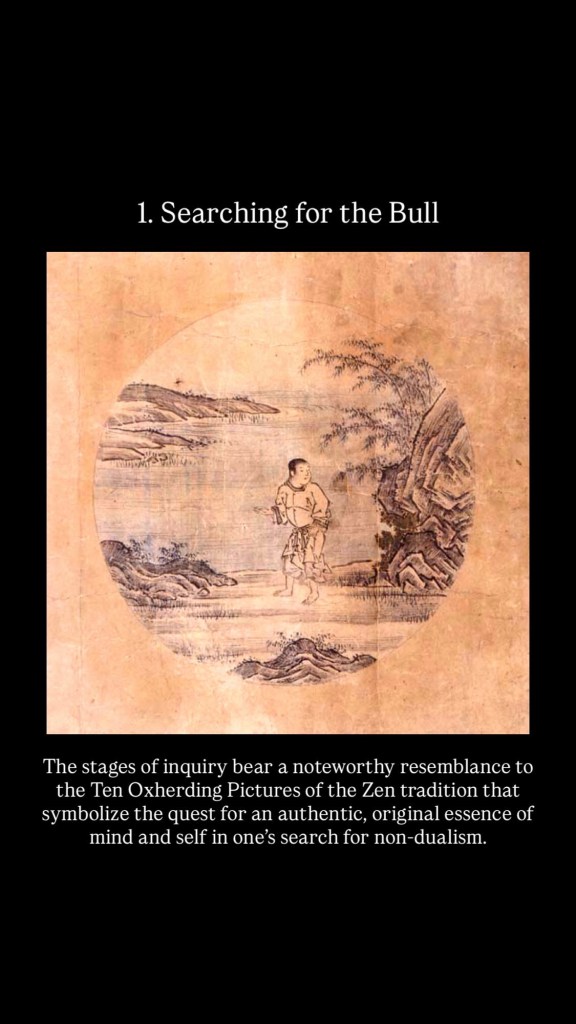
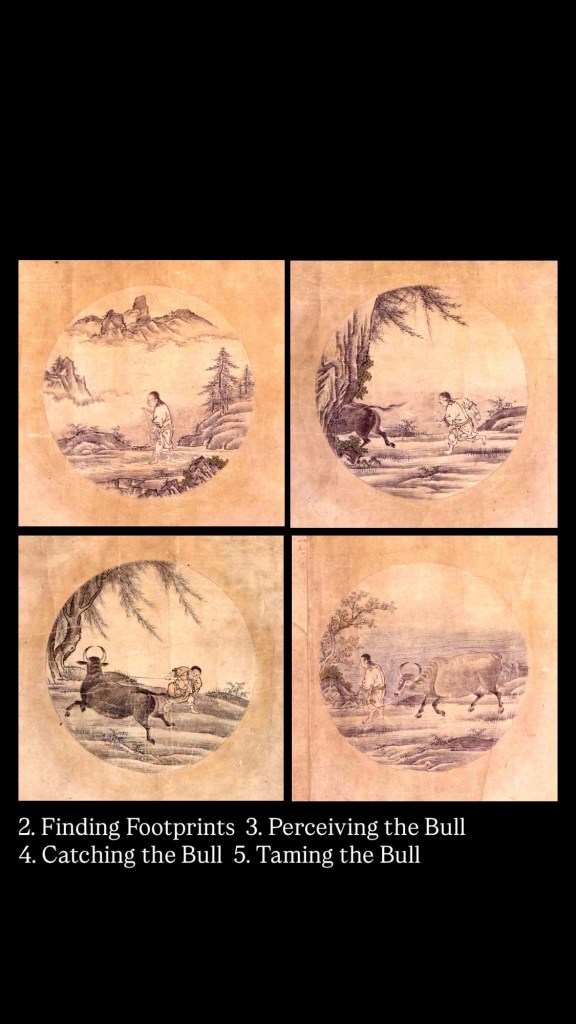
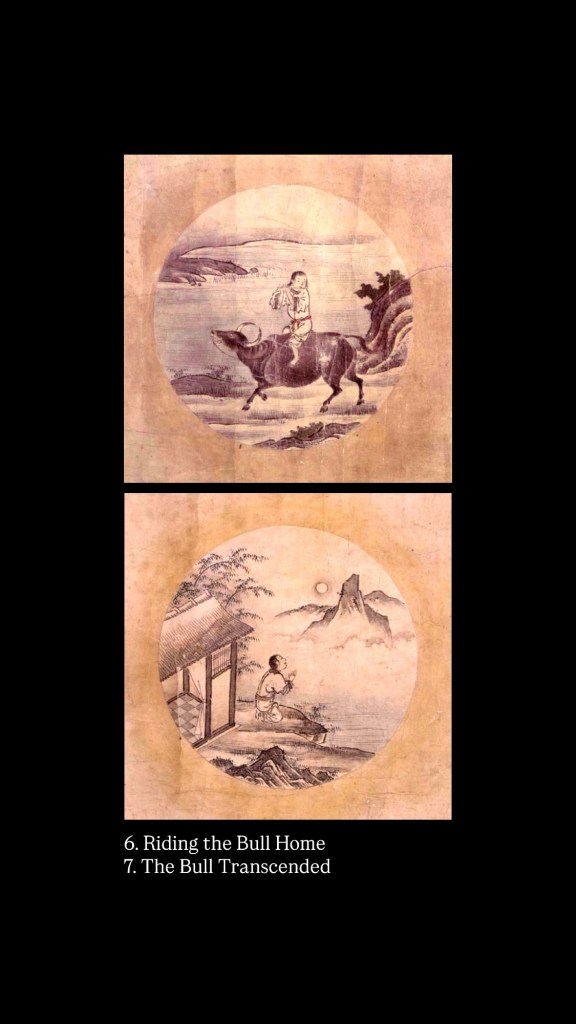
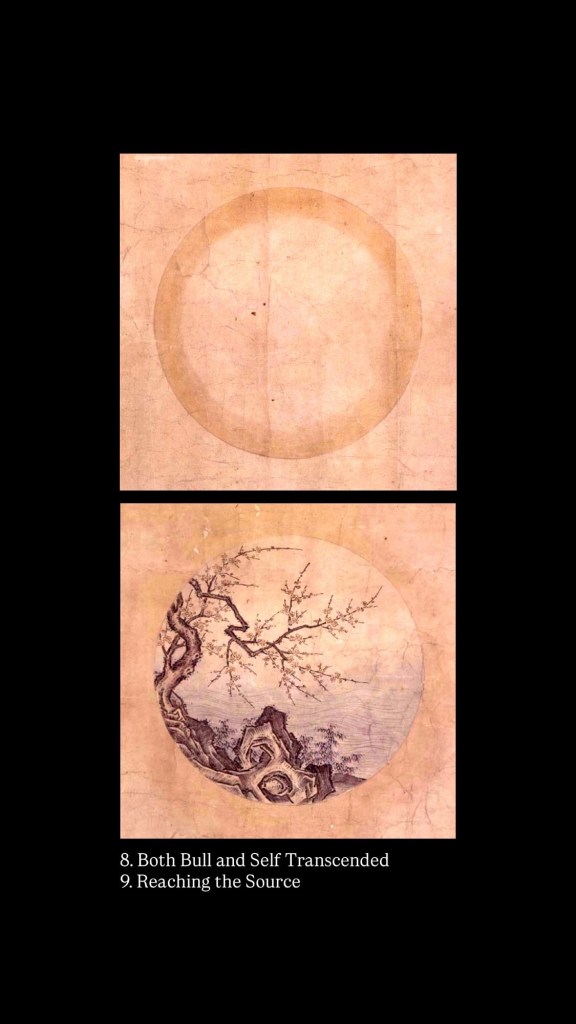
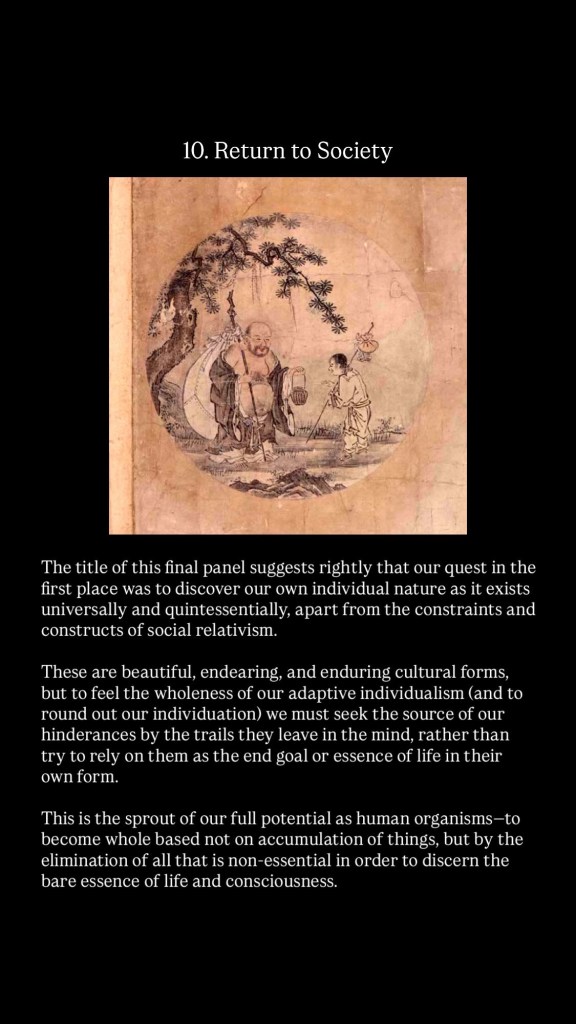
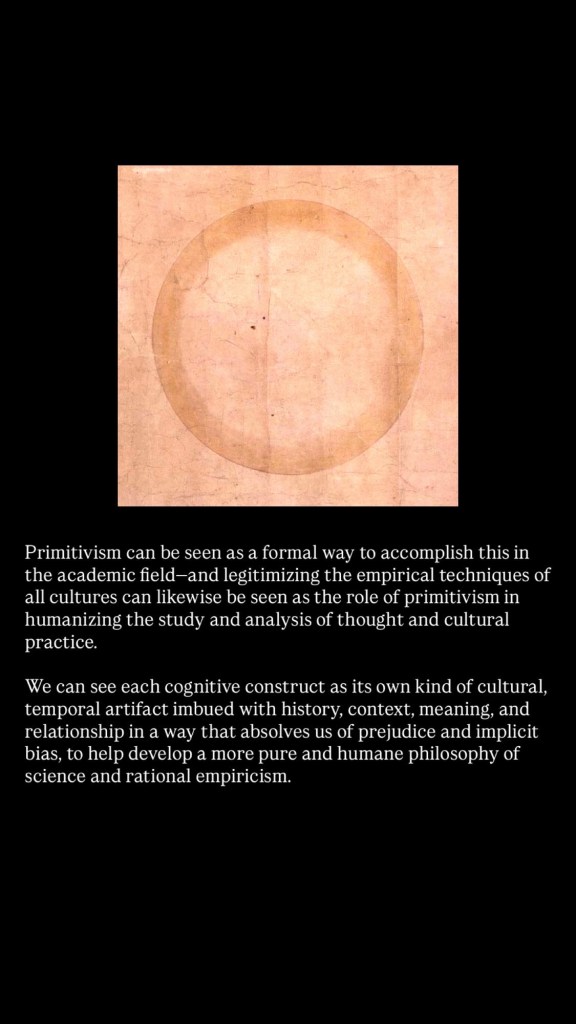
The technique of inquiry bears a noteworthy resemblance to the Ten Oxherding Pictures of the Zen tradition, which illustrate the quest for essence of both mind and self (the inalienable consciousness at the center of being) in one’s quest to transcend duality.
The title of this final panel (Return to Society) suggests rightly that our quest in the first place was to discover our own individual nature as it exists universally and quintessentially, apart from the constraints and constructs of social relativism.
These are beautiful, endearing, and enduring cultural forms, but to feel the wholeness of our adaptive individualism (and to round out our individuation) we must seek the source of our hinderances by the trails they leave in the mind, rather than try to rely on them as the end goal or essence of life in their own form.
This is the sprout of our full potential as human organisms-to become whole based not on accumulation of things, but by the elimination of all that is non-essential in order to discern the bare essence of life and consciousness.
Primitivism can be seen as a formal way to accomplish this in the academic field—and legitimizing the empirical techniques of all cultures can likewise be seen as the role of primitivism in humanizing the study and analysis of thought and cultural practice.
We can see each cognitive construct as its own kind of cultural, temporal artifact imbued with history, context, meaning, and relationship in a way that absolves us of prejudice and implicit bias, to help develop a more pure and humane philosophy of science and rational empiricism.
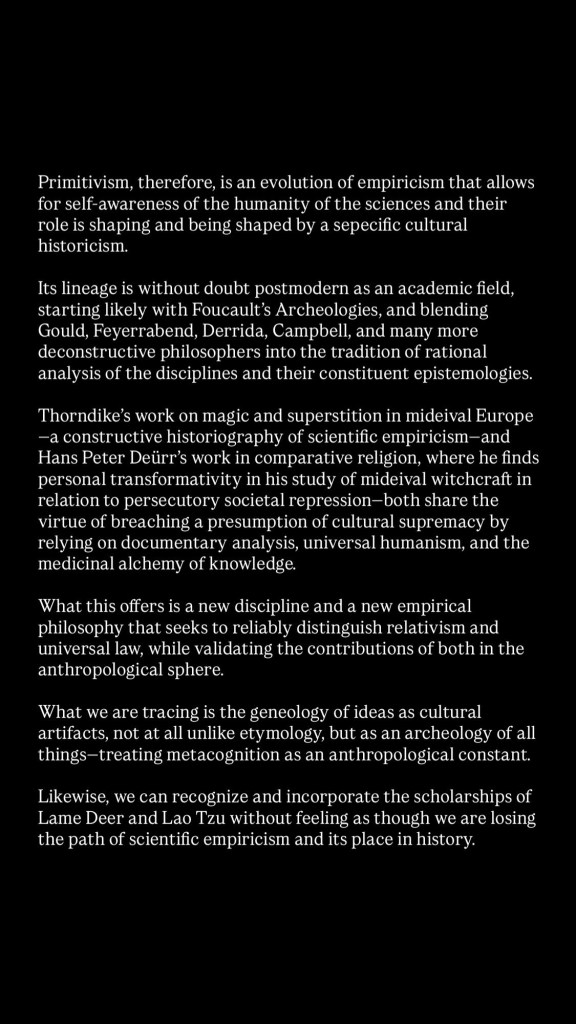
You will notice in the Ten Oxherding Pictures that the Bull disappears completely.
This is due to the transformative nature of seeking self awareness as a medicinal pathway through the tribulations of secondary individuation, where recognition of ones own culture and cultural upbringing can become the testing ground for truth and autonomy.
What can be dispensed of former wisdom and moulded the perceptions of youth that were ingrained in us in our years of dependency and adolescent transformation, that we may find upon inquiry not suited to life, or to our individual expression of life?
This is the honing of an epistemic throughout generations, and a sloughing off of dross.
A Socratic koan, in relatively unrelated summary:
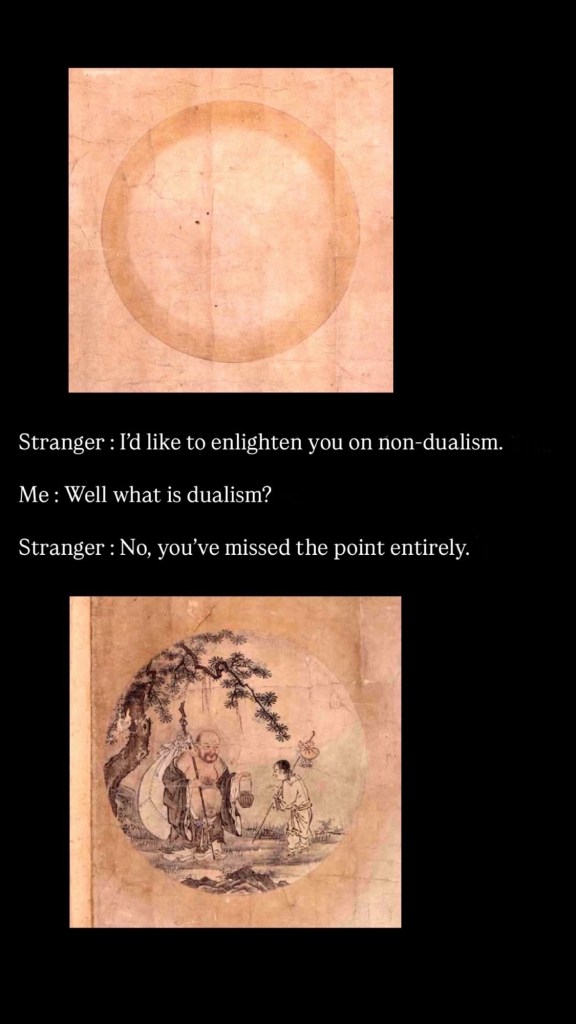
St : I’d like to enlighten you on non-dualism.
Me : Well what’s dualism?
St : No you’ve missed the point entirely.
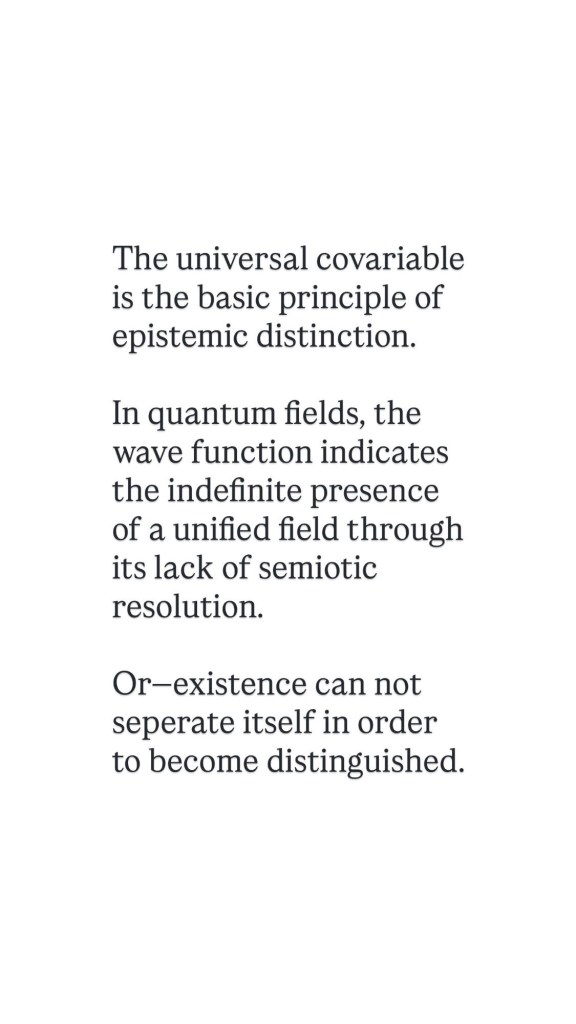
The universal covariable is the basic principle of epistemic distinction.
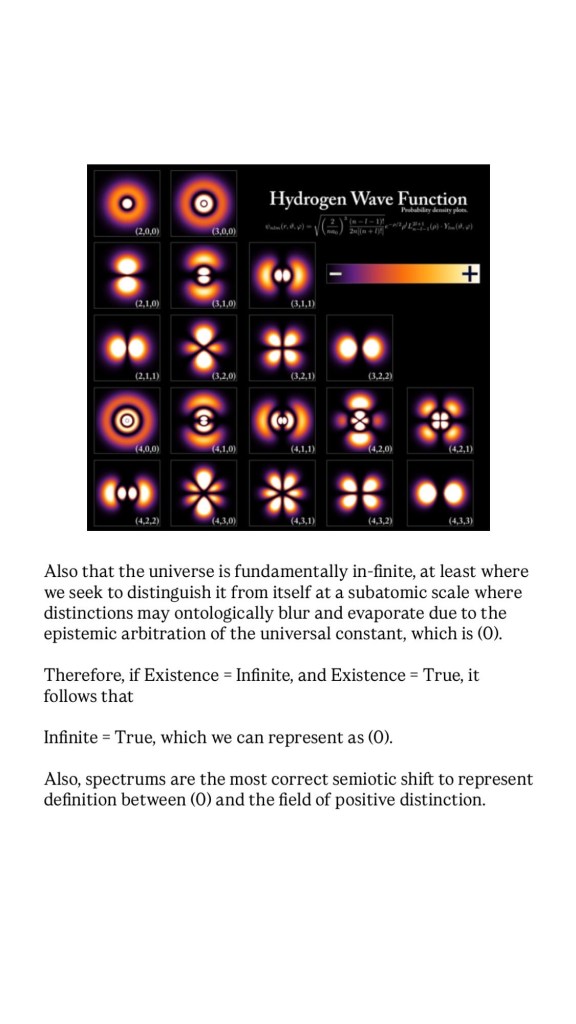
In quantum fields, the wave function indicates the indefinite presence of a unified field through its lack of semiotic resolution.
Or, existence can not seperate itself in order to become distinguished.
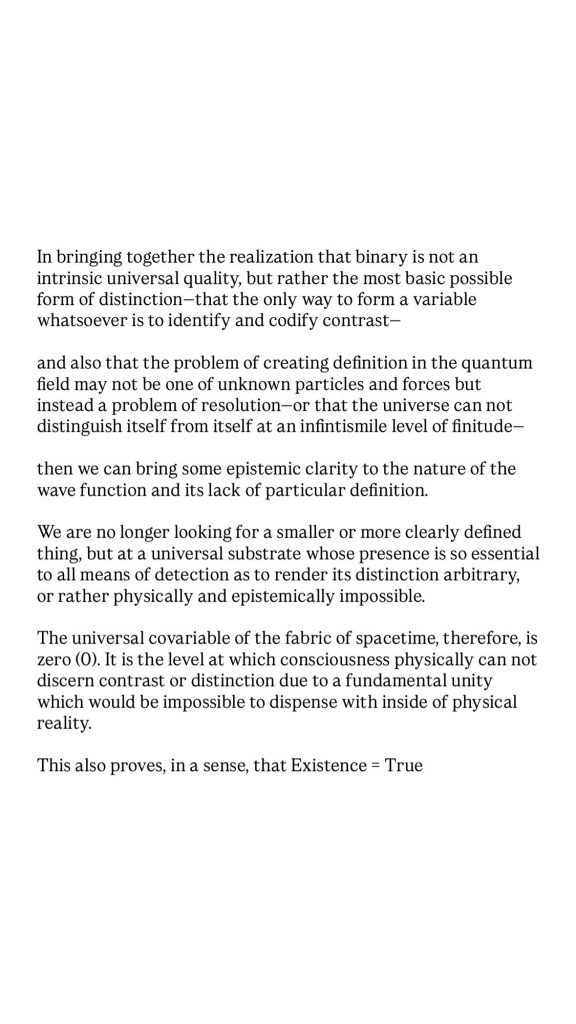
In bringing together the realization that binary is not an intrinsic universal quality, but rather the most basic possible form of distinction—that the only way to form a variable whatsoever is to identify and codify contrast—
and also that the problem of creating definition in the quantum field may not be one of unknown particles and forces but instead a problem of resolution—or that the universe can not distinguish itself from itself at an infintismile level of finitude—
then we can bring some epistemic clarity to the nature of the wave function and its lack of particular definition.
We are no longer looking for a smaller or more clearly defined thing, but at a universal substrate whose presence is so essential to all means of detection as to render its distinction arbitrary, or rather physically and epistemically impossible.
The universal covariable of the fabric of spacetime, therefore, is zero (0). It is the level at which consciousness physically can not discern contrast or distinction due to a fundamental unity which would be impossible to dispense with inside of physical reality.
This also proves, in a sense, that Existence = True
Also that the universe is fundamentally in-finite, at least where we seek to distinguish it from itself at a subatomic scale where distinctions may ontologically blur and evaporate due to the epistemic arbitration of the universal constant, which is (0).
Therefore, if Existence = Infinite, and Existence = True, it follows that:
Infinite = True, which we can represent as (0).
Also, spectrums are the most correct semiotic shift to represent definition between (0) and the field of positive distinction.
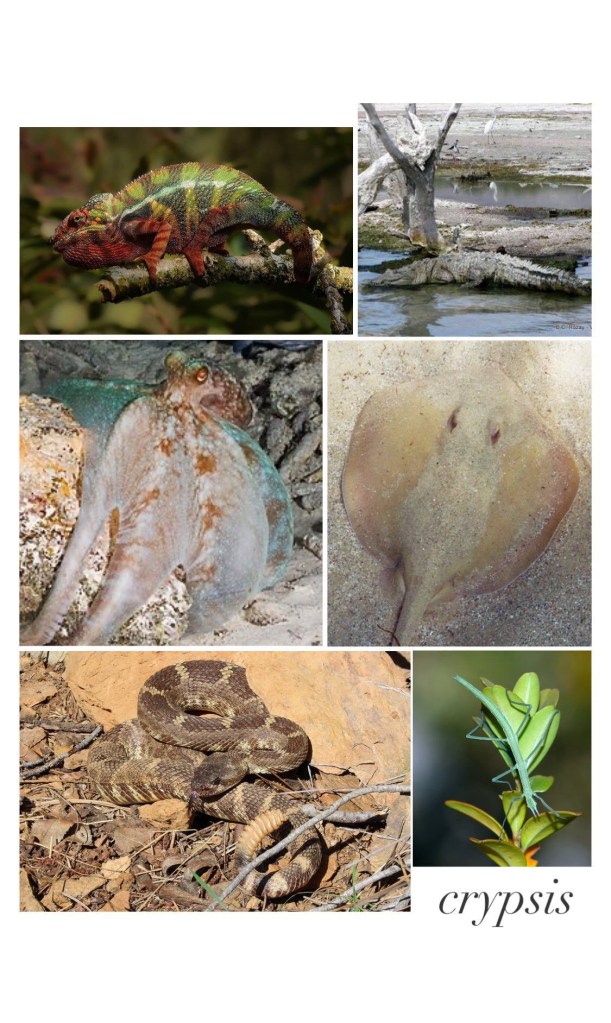
A cursory side note on cognitive crypsis and evolutionary biology:
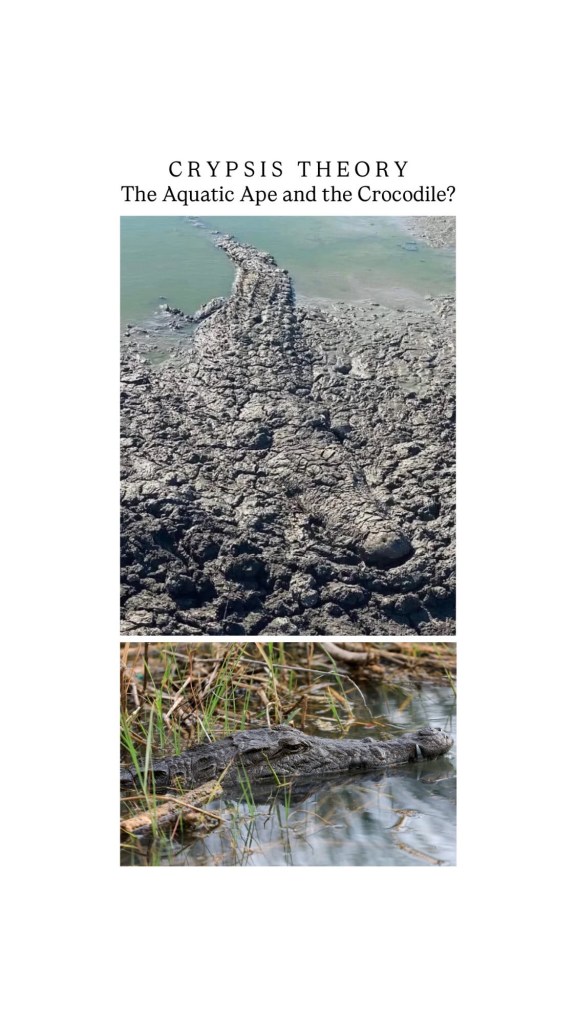
It seems that the closest parallel to human cognitive crypsis in the animal kingdom may be the crocodile, which is one of the only other animals that uses external objects to cloak itself for ambush hunting (often floating twigs, brush, or grasses).
I find that this dovetails evocatively with the Aquatic Ape Theory-the thesis that humans developed their hairless bipedalism not on the high grass steppes and savannahs but in a mixed, shallow aquatic environment, where we can see evolutionary hair loss and limb morphology in other species such as whales and dolphins.
The theory is that we became bipedal to stand in shallow waters, perhaps in something like a mangrove forest, coastal swamp, or seasonal flood plain-to give some vastly different ecological candidates.
This might offer the perhaps unprovable suggestion that we adopted cognitive crypsis for both engaging in and cloaking ourselves from predatory ambush hunting-by observing and adapting to the behavior of crocodiles originally, rather than developing the capacity on our own on the Kenyan steppe as I have previously proposed.
It could be that crocodiles developed a stunningly and devastatingly effective ambush hunting approach some thousands or even millions of years before their strategies rubbed off on humans or human ancestors. This would explain a lot, in fact.
And my mind immediately goes to the river valleys and flood plains of the Nile, Ganges, Yellow River, perhaps even the Rhine (I can’t think of another river in Europe), and of course Mesopotamia.
It seems to me that Aquatic Ape Theory has been mostly rejected in popular discourse because to many of the world’s people (though far from all) the idea of living in an aquatic ecology feels yucky. We may be instinctually rejecting the theory from a deep level of our animal psyche that likewise suggests the danger and deep psychological impression we harbor instinctively for liminal, opaque, possibly stagnant or unfamiliar bodies of water.
One might wonder if our animal repugnance is a deeply animal ancestral memory—not just a prejudice of the “out of Africa” pastoralism of the modern scientific community.
I will refrain for elaborating as to the use of spears, sticks, and nets for probing uncertain bodies of water—or exploring the role of early seafaring and its possible relation to the safety of islands and logs or log jams in affording early humans and human ancestors mobility across the great waters.
What we have then, with primitivism as I have undertaken to delineate it, is a broad new framework for interdisciplinary and intercultural rational empiricism.
The interwoven roles of forensic semiotic investigation, a kind of anthropology of cultural practice, a recognition of the researcher’s own perspective and humanitarian interest, and a fundamental embrace of medicinal metacognition—
these decentralize a historical linear progress implied by some philosophies which idealize rather than analyze social constructivism.
What we are left with is an awareness of the poetry and language of logic—the biologic, psychologic, anthropologic, and hopefully the metalogic of knowledge as a collective, harmonizing medium for individuation, sustainability, and intergenerational / intercultural adaptivity and memory—
where any one artifact or piece of evidence implies all others, and all the universe.