Can you mathematically define reality (which by virtue of the limitations of relativity can never be fully quantified or known) and a universal principle of true, viable semiotic distinction—
assuming a full reality-state which is implied by all phenomena, which is non-representative—
so that all excluded parts distinguished as variables may be added back to the remainder from which they were distinguished, in order to reconstitute a true sum of reality as a whole?
Yes. But the full sum must be indistinguishable, or infinite to serve this principle.
In this sense, ALL INFORMATION IS NEGATIVE, and defined by categorical subtraction from indefinite phenomena which are excluded.
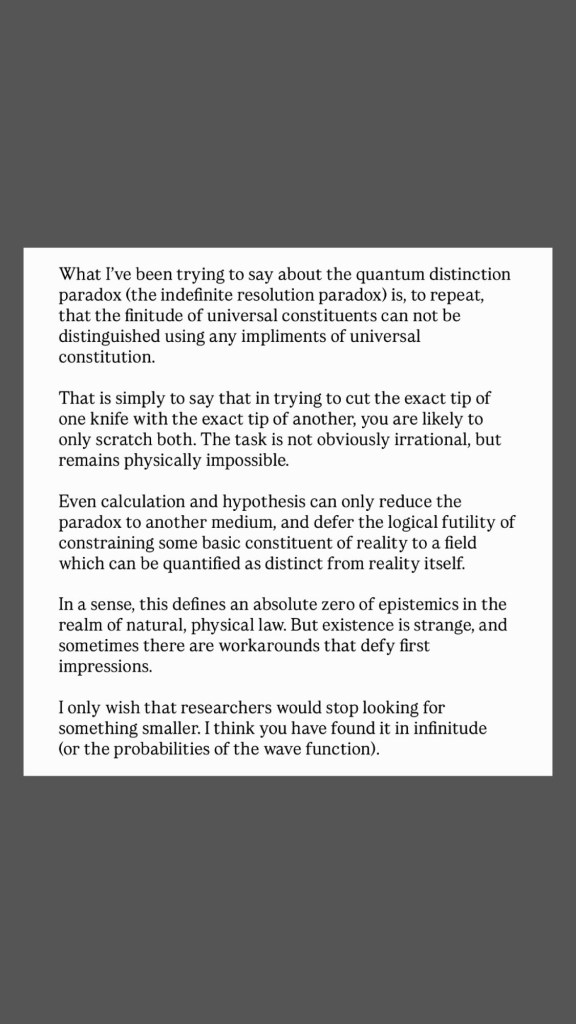
What I’ve been trying to say about the quantum distinction paradox (the indefinite resolution paradox) is, to repeat, that the finitude of universal constituents can not be distinguished using any impliments of universal constitution.
That is simply to say that in trying to cut the exact tip of one knife with the exact tip of another, you are likely to only scratch both. The task is not obviously irrational, but remains physically impossible.
Even calculation and hypothesis can only reduce the paradox to another medium, and defer the logical futility of constraining some basic constituent of reality to a field which can be quantified as distinct from reality itself.
In a sense, this defines an absolute zero of epistemics in the realm of natural, physical law.
But existence is strange, and sometimes there are workarounds that defy first impressions.
I only wish that researchers would stop looking for something smaller. I think you have found it in infinitude (or the probabilities of the wave function).
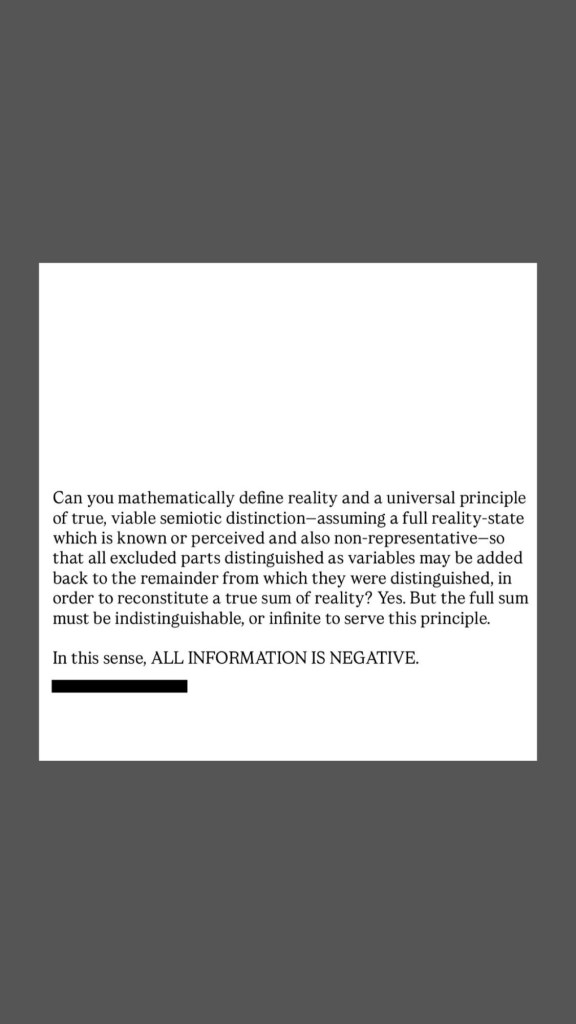
Can you mathematically define reality and a universal principle of true, viable semiotic distinction—assuming a full reality-state which is known or perceived and also non-representative—so that all excluded parts distinguished as variables may be added back to the remainder from which they were distinguished, in order to reconstitute a true sum of reality?
Yes. But the full sum must be indistinguishable, or infinite to serve this principle.
Here is the formula:
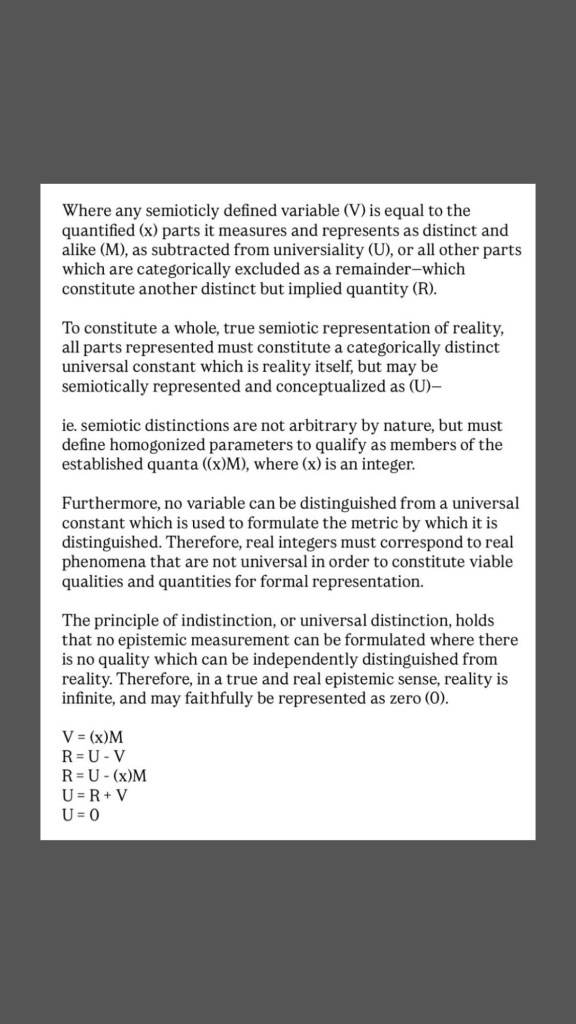
Where any semioticly defined variable (V) is equal to the quantified (x) parts it measures and represents as distinct and alike (M), as subtracted from universiality (U), or all other parts which are categorically excluded as a remainder constitute another distinct but implied quantity (R).
To constitute a whole, true semiotic representation of reality, all parts represented must constitute a categorically distinct universal constant which is reality itself, but may be semiotically represented and conceptualized as (U)—ie. semiotic distinctions are not arbitrary by nature, but must define homogonized parameters to qualify as members of the established quanta (V).
Furthermore, no variable can be distinguished from a universal constant which is used to formulate the metric by which it is distinguished. Therefore, real integers must correspond to real phenomena that are not universal in order to constitute veritable qualities and quantities valid for scientific representation.
The principle of indistinction holds that no epistemic measurement can be formulated where there is no quality which can be independently distinguished from reality. Therefore, in a true and real epistemic sense, reality is infinite, and may faithfully be represented as zero (0).
V = (x)M
R = U – V
R = U – (x)M
U = R + V
U = 0
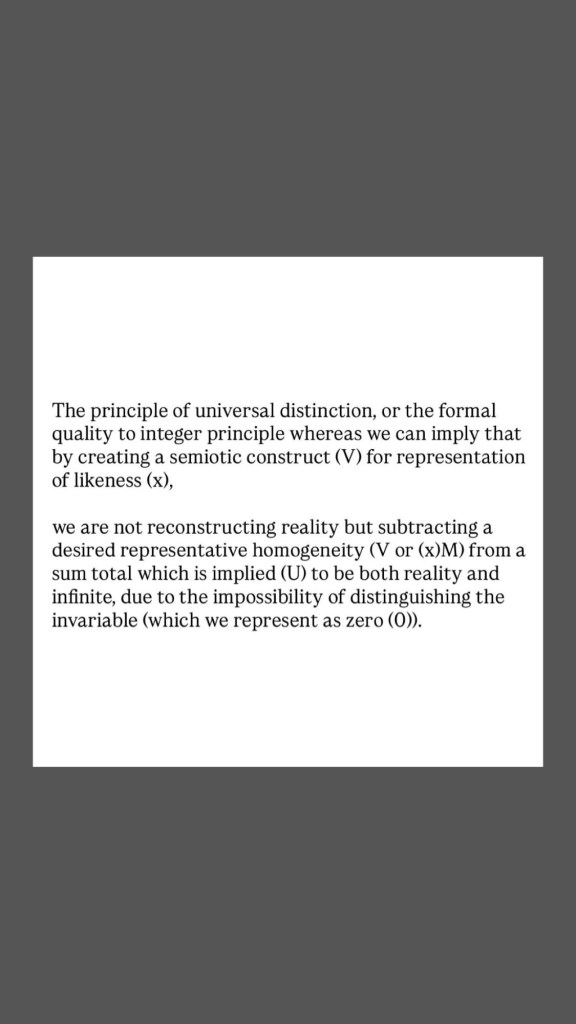
The principle of universal indistinction, or the formal quality to integer principle whereas we can imply that by creating a semiotic construct (V) for representation of likeness (x),
we are not reconstructing reality but subtracting a desired representative homogeneity (V or (x)M) from a sum total which is implied (U) to be both reality and infinite, due to the impossibility of distinguishing the invariable (which we represent as zero (0)).
In this sense, ALL INFORMATION IS NEGATIVE.
If you read this and say to yourself, “Well, you haven’t said anything at all…” then you’re right. I believe I’m the first person to say Nothing as a mathematical construct and for the formula to be universally correct.
This resolves the epistemic paradoxes of quantum theory to a considerable degree I believe, and also serves as an existential formalism where semiotics and epistemics can reference reality itself and the limitations on semiotic constructs in relation to the field of knowledge, quantity, and quality.
It’s necessary to add that not all symbolic activity is quantifiable, therefore not all expression or authentic interpretation qualifies as negative information.
The formulation is limited to quantified and qualified parameters, not the phenomenology of cognition or to all the ways that non-quantified symbolic behavior relates to and interacts with the world.
We might call this poetics, after the futhark rune Ansuz as an interpretation of human language: that it condenses universal phenomena into verbal form, to transfer some of its character to speech and thought, directly and unabstractly compared to formal quantification.
Poetry is an accurate metaphor here for even common speech and for artistic behavior alike: it is not formalized with rigor and does not need to adhere to any objective data constancy.
Obviously this formula for semiotic reference to reality-as-a-constant also brings to mind the first chapter of the Tao Te Ching, with the axiom, “The way (tao) that can be spoken is not the eternal way (tao). The name that can be named is not the eternal name… The named is the mother of the ten thousand things…” Of interest, the “ten thousand things” refers to a semiotic linguistic designation that categorizes the world of phenomenology into quantifiable cognitive and linguistic structures. This would account for its numeric metaphor (the ten thousand things).
Although, obviously, this number does not reference a specific ten thousand semiotic constructs, it refers to a “multitude” of them numbering beyond intuitive comprehension. The principle being that categorization is the birthplace of linguistic and cognitive constructs that relate to signifiers (variables) which are quantifiable.