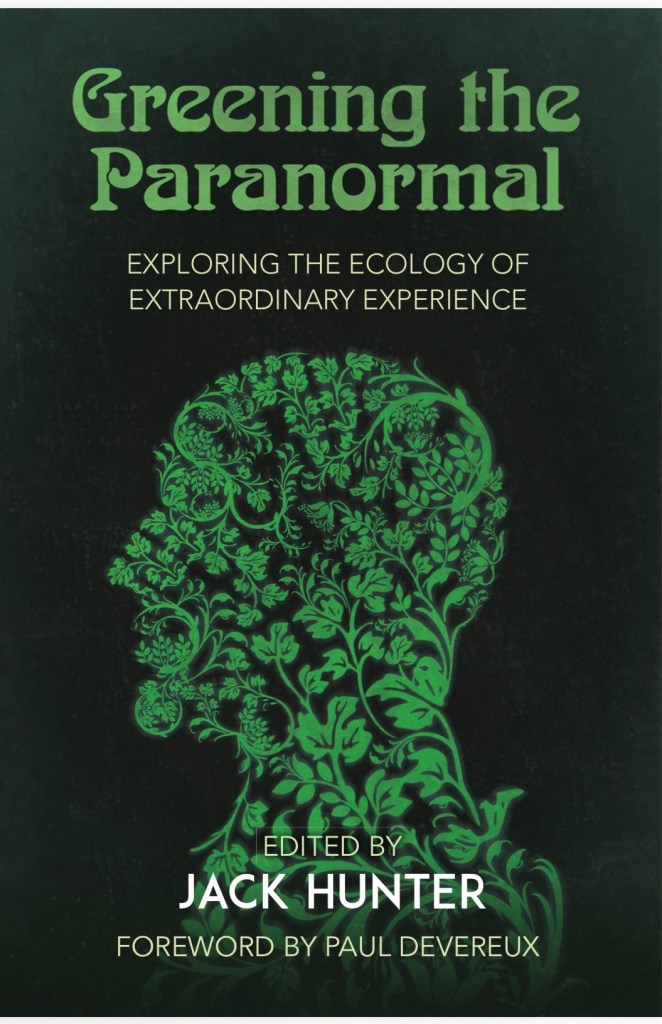
The following essay was originally published in the anthology “Greening the Paranormal : Exploring the Ecology of Extraordinary Experience” ed. by Dr. Jack Hunter (August Night Press, 2019).
It follows the early industrial historical development of the field of anomalistics (sometimes called Fortean studies) —a branch of fringe sciences (at least as conceived by its progenator Charles Fort) mainly concerned with documenting and categorizing the unexplainable in terms of empirical data being published into the modern age through newspapers, popular histories, medical journals, and periodicals.
I have always loved this field of research, which includes some significant overlap with the fields of comparative religion and epistemic philosophy.
I wrote this article for popular distribution and was grateful for its inclusion, if a little concerned that it may have cooled reception of the book in its rather niche (and often futurist / technoutopian / pseudoscientific) field of “paranormal studies,” or what have you. The article is meant to briefly critique unconscious cultural prejudices in the modern sciences, and to serve as a kind of cursory archeologie (in the tradition of Foucault) for this mostly ignored and often overlooked branch of empiricism.
It’s always interesting to see how cultures and epistemic traditions treat things that “don’t fit”—or that openly pose contradictions to their presumptions based on their anomalous appearance in the natural world or commonly accepted human interpretations of it.
The point is that the obscure field if anomalistics, while often treated as a curiosity cabinet for the masses, is actually an important field of reference for the natural sciences. Definitive conclusions are simply less sound when they refuse to consider exceptions to their own rules. That is not a robust science—it is dogma and hubris in a lab coat.
Mysteries abound. Never dispose of the unknown simply to make your inner map of the world feel more monolithic and insoluble. Evidence-to-the-contrary is still valid evidence, no matter how sacrosanct the pillars of pretense that it may cast new light on are. Openness and curiosity are assets in the field of natural philosophy.
The Anarchist & The Unicorn :
On Science, Spirit, and Civilization
People who deny the existence of dragons are often eaten by dragons. From within.
–Ursula K. Le Guin
Paranormal research as a field crystalized with Charles Fort’s 1919 work The Book of the Damned, published just months after the close of the First World War, as the world staggered away from the trenches and wastelands of the battlefield into a new age. These two events, though one tragic and one fairly comic, are not unrelated.
Fort’s exhaustingly researched volume of empirical oddities, foraged from archives where science had ‘damned’ them to obscurity for not fitting in with prevailing theories, was a whimsical retort to what he saw as scientific pretence and hypocrisy. ‘We shall have a procession of the damned which science has excluded,’ he began. Light-hearted as it was, it would prove as grave an omen for the fate of life in the new era as the Great War itself. The modern age had arrived, and with the dispassionate logic of science at its core and the ravenous appetite of the technological economy at its vanguard, it began its megalithic corrosion of the natural world.
The First World War cemented the sombre reality that technologically advanced nations could readily demolish others who lagged behind in their command of manufacturing, infrastructure, and the sciences. The Industrial Revolution had reached a critical tipping point in the importance of technical affluence for military superiority. Far from stemming from simply a crisis of international alliances, World War One was the inevitable culmination of an international landscape re-shaped by the industrial age.
To A.J.P. Taylor (1969) the First World War was ‘imposed on the statesmen of Europe by railway timetables.’ Taylor found that the meticulous, rigid scheduling necessary to mobilize troops via railcar – a system meant to deter war with the threat of rapid troop deployment – ended up boxing the great powers into hair-trigger responses and forcing an otherwise unwanted war. The tsar of Russia, for instance, on the day he mobilized troops to the German border, wrote in his diary about spending a warm day bathing in the sea, but said nothing about the mobilization in his journal. A devastating international confl ict seemed the furthest thing from his mind. Mobilization after all was just a threat, if a serious one. Germany, on the other hand, was trapped between two fronts – France and Russia – and if they failed to strike France quickly, risked a crucial delay in mobilizing to meet a Russian offensive. When Russia refused Germany’s order to demobilize, Germany had to pre-emptively invade France before any other country had taken a definitive step towards war – or else compromise its entire defence strategy, which was based around its infl exible rail timetables. ‘It was an unexpected climax to the railway age,’ Taylor concluded.
Decades later, the fate of the Second World War would likewise be dictated by industrial factors. The new Bonneville and Gran Coulee dams on Oregon’s colossal Columbia River would decide the war by providing Boeing enough electricity to smelt unprecedented amounts of aluminium – ultimately accounting for about a third of all planes in the Second World War, plus 750 large boats and twenty-seven percent of the U.S. naval fleet. Truman recalled in 1948, ‘Had we not had that power source, it would have been almost impossible to win this war.’
The Bureau of Reclamations had found an actual purpose for the dams they were obsessed with building, one to replace their ill-fated mission to remake the arid American West into a verdant agricultural Eden – rivers could become weapons.
John Zerzan (1988) speculates that the First World War was caused by a fermenting social unrest aimed at dissatisfaction with the constricting grasp of European industrialism. Total war was the blow necessary to retain state hegemony in the face of a mounting general rebellion. He called it the ‘most significant stroke of counterrevolution in modern world history … Th e scale and conditions of the war had to be equal to the force straining against society, in order to replace this challenge with the horror and despair that spread from the battlefi elds to darken the mind of the twentieth century West.’
No single underlying cause could ever suffi ce, but the dying rumble of artillery signalled a bleak post-war social reality, in which the core purpose of whole societies defi nitively shifted to embrace the primacy of industrialism. As the power of nation-states increasingly waxed and waned in step with their mastery of the industries and sciences–which became the central focus of production–so the values of societies came to align with these institutions. As if the trauma of the war had left an existential abyss gaping at the heart of the modern world, the zeitgeist of science stepped in to offer a rational and mechanical cosmology for a new rational and mechanical economy.
Just six years after Th e Book of the Damned was published, in 1925, the Tennessee v Scopes trial saw the U.S. Supreme Court rule in favour of John Scopes’ right to teach an evolutionary account of history from the textbook Civic Biology (1914), symbolically passing the torch from Christianity to scientism as the officially sanctioned cosmology of the state. The chief prosecutor for Tennessee, Senator William Jennings Bryan, wrote in his proposed summation, ‘Science is a magnificent force, but it is not a teacher of morals. It can perfect machinery, but it adds no moral restraints to protect society from the misuse of the machine. In war, science has proven itself an evil genius; it has made war more terrible than it ever was before.’
Although often remembered as a watershed victory for rational society, the evolutionary ideas in Civic Biology are repugnant by today’s standards. For example, a pseudoscientific section titled ‘Races of Man’ concludes its list of races by vaunting, ‘the highest type of all, the Caucasians, represented by the civilized white inhabitants of Europe and America,’ and ominously concludes its ‘Evolution’ section with the suggestion that the ‘beginnings of civilization were long ago, but even to-day the earth is not entirely civilized,’ meaning not entirely colonized. Another section on eugenics deals with the bloodlines of ‘social parasites’ and their hindrance to building a ‘stronger race,’ saying regretfully, ‘If such people were lower animals we would probably kill them off to keep them from spreading.’ And in a section tellingly titled ‘The Human Machine,’ ‘Man is the thinking animal, and as such is master of the earth.’ Such were the ideals of evolution championed by scientists at the time.
This blatantly genocidal social Darwinism has remained embedded at the core of modern civilization’s mythos, covered by a thin veneer of political correctness which nevertheless sees technical superiority as the zenith of evolution, beside which all other life is inferior. Paul Feyerabend (1978), anarchist epistemologist, would observe half a century after Scopes, ‘Science is no longer a particular institution; it is now part of the basic fabric of democracy just as the Church was once a part of the basic fabric of society.’
Vine Deloria (2002), Native American scholar, would concur: ‘When evolution replaced the concept of creation… it became an inviolable law in the eyes of Western people in much the same way that the…Biblical story had been accepted by Western people in former centuries.’ In order to fully indulge the post-WWI economy of profound mechanisation and its new dominance as a political, social, and moral force at the centre of life, a hard scrabble philosophy was necessary – a rational, mechanical, law-of-the-jungle philosophy. Evolution and scientism, which had allied itself with state and powers since its infancy, fit the bill to justify the new modern landscape perfectly.
This aptitude of Darwin’s theory of evolution to give capitalism a philosophical posture is likely why the theories of anarchist biologist Pyotr Kropotkin never caught on. Kropotkin was born a Russian prince in 1842 but renounced his title, fled into exile, and went on to write Mutual Aid: A Factor of Evolution (1902) in opposition to Darwin’s vision of nature as a war of all against all. A hardy man with smiling eyes and a large untamed beard, he wrote, ‘Sociability is as much a law of nature as mutual struggle,’ laying the foundation for his theory of cooperative evolution.
Despite dying a national hero after returning to Russia (Lenin even allowed imprisoned anarchists to attend his funeral – amazingly letting them carry anti-Bolshevik banners – as long as they promised to return to jail that evening), Kropotkin’s ideas on human nature were blandly received by scientists. While his work has found praise in more recent times, his ideas of kindness, generosity, and egalitarianism as innate human social traits have been astronomically overshadowed by Darwin’s ‘survival of the fittest’ style evolution, which has become an almost metaphysical cultural truism.
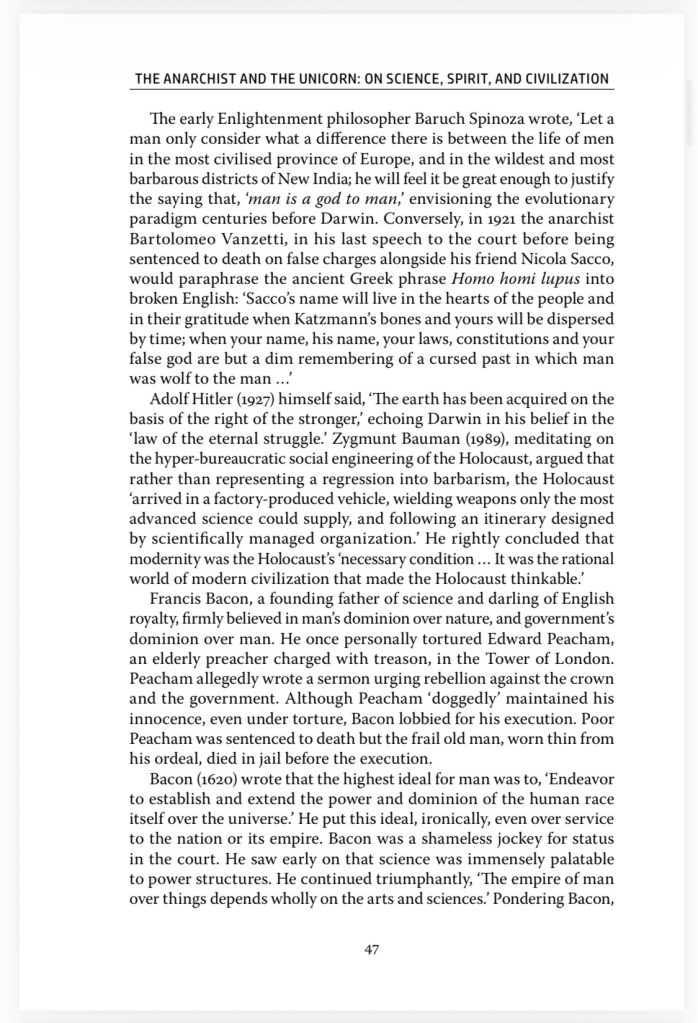
The early Enlightenment philosopher Baruch Spinoza wrote, ‘Let a man only consider what a diff erence there is between the life of men in the most civilised province of Europe, and in the wildest and most barbarous districts of New India; he will feel it be great enough to justify the saying that, ‘man is a god to man,’ envisioning the evolutionary paradigm centuries before Darwin. Conversely, in 1921 the anarchist Bartolomeo Vanzetti, in his last speech to the court before being sentenced to death on false charges alongside his friend Nicola Sacco, would paraphrase the ancient Greek phrase Homo homi lupus into broken English: ‘Sacco’s name will live in the hearts of the people and in their gratitude when Katzmann’s bones and yours will be dispersed by time; when your name, his name, your laws, constitutions and your false god are but a dim remembering of a cursed past in which man was wolf to the man …’
Adolf Hitler (1927) himself said, ‘The earth has been acquired on the basis of the right of the stronger,’ echoing Darwin in his belief in the ‘law of the eternal struggle.’ Zygmunt Bauman (1989), meditating on the hyper-bureaucratic social engineering of the Holocaust, argued that rather than representing a regression into barbarism, the Holocaust ‘arrived in a factory-produced vehicle, wielding weapons only the mostadvanced science could supply, and following an itinerary designed by scientifically managed organization.’ He rightly concluded that modernity was the Holocaust’s ‘necessary condition … It was the rational world of modern civilization that made the Holocaust thinkable.’
Francis Bacon, a founding father of science and darling of English royalty, firmly believed in man’s dominion over nature, and government’s dominion over man. He once personally tortured Edward Peacham, an elderly preacher charged with treason, in the Tower of London. Peacham allegedly wrote a sermon urging rebellion against the crown and the government. Although Peacham ‘doggedly’ maintained his innocence, even under torture, Bacon lobbied for his execution. Poor Peacham was sentenced to death but the frail old man, worn thin from his ordeal, died in jail before the execution.
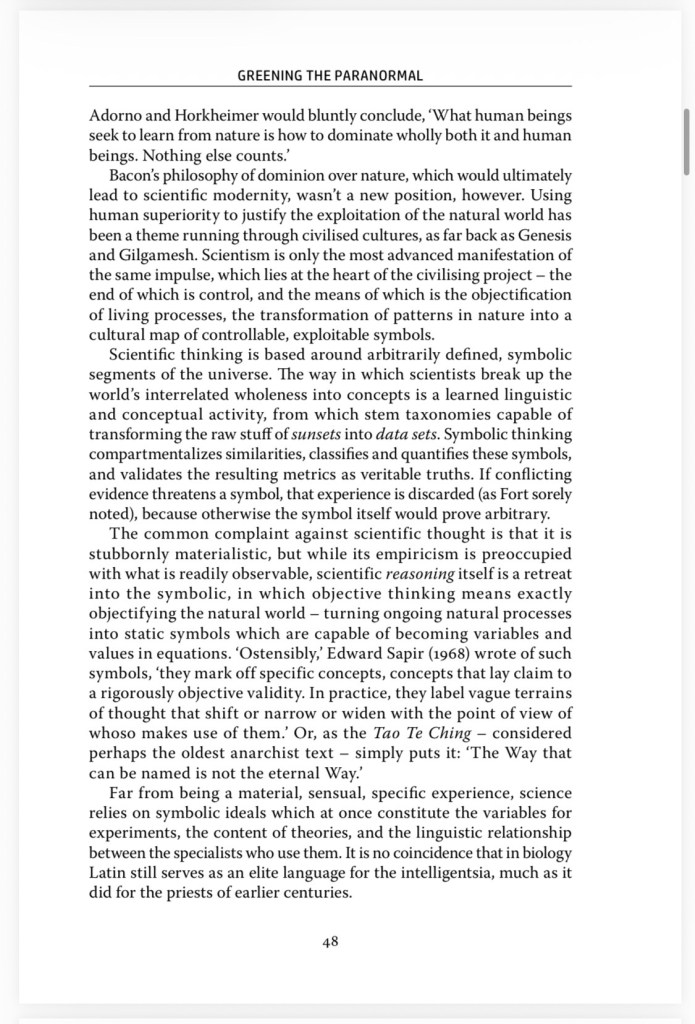
Bacon (1620) wrote that the highest ideal for man was to, ‘Endeavor to establish and extend the power and dominion of the human race itself over the universe.’ He put this ideal, ironically, even over service to the nation or its empire. Bacon was a shameless jockey for status in the court. He saw early on that science was immensely palatable to power structures. He continued triumphantly, ‘The empire of man over things depends wholly on the arts and sciences.’ Pondering Bacon, Adorno and Horkheimer would bluntly conclude, ‘What human beings seek to learn from nature is how to dominate wholly both it and human beings. Nothing else counts.’
Bacon’s philosophy of dominion over nature, which would ultimately lead to scientific modernity, wasn’t a new position, however. Using human superiority to justify the exploitation of the natural world has been a theme running through civilised cultures, as far back as Genesis and Gilgamesh. Scientism is only the most advanced manifestation of the same impulse, which lies at the heart of the civilising project – the end of which is control, and the means of which is the objectification of living processes, the transformation of patterns in nature into a cultural map of controllable, exploitable symbols.
Scientific thinking is based around arbitrarily defined, symbolic segments of the universe. The way in which scientists break up the world’s interrelated wholeness into concepts is a learned linguistic and conceptual activity, from which stem taxonomies and lexicons capable of transforming the raw stuff of sunsets into data sets. Symbolic thinking compartmentalizes similarities, classifi es and quantifi es these symbols, and validates the resulting metrics as veritable truths. If conflicting evidence threatens a symbol, that experience is discarded (as Fort sorely noted), because otherwise the symbol itself would prove arbitrary.
The common complaint against scientific thought is that it isstubbornly materialistic, but while its empiricism is preoccupied with what is readily observable, scientific reasoning itself is a retreat into the symbolic, in which objective thinking means exactly objectifying the natural world – turning ongoing natural processes into static symbols which are capable of becoming variables and values in equations. ‘Ostensibly,’ Edward Sapir (1968) wrote of such symbols, ‘they mark off specific concepts, concepts that lay claim to a rigorously objective validity. In practice, they label vague terrains of thought that shift or narrow or widen with the point of view of whoso makes use of them.’ Or, as the Tao Te Ching – considered perhaps the oldest anarchist text – simply puts it: ‘The Way that can be named is not the eternal Way.’
Far from being a material, sensual, specifi c experience, science relies on symbolic ideals which at once constitute the variables for experiments, the content of theories, and the linguistic relationship between the specialists who use them. It is no coincidence that in biology Latin still serves as an elite language for the intelligentsia, much as it did for the priests of earlier centuries.
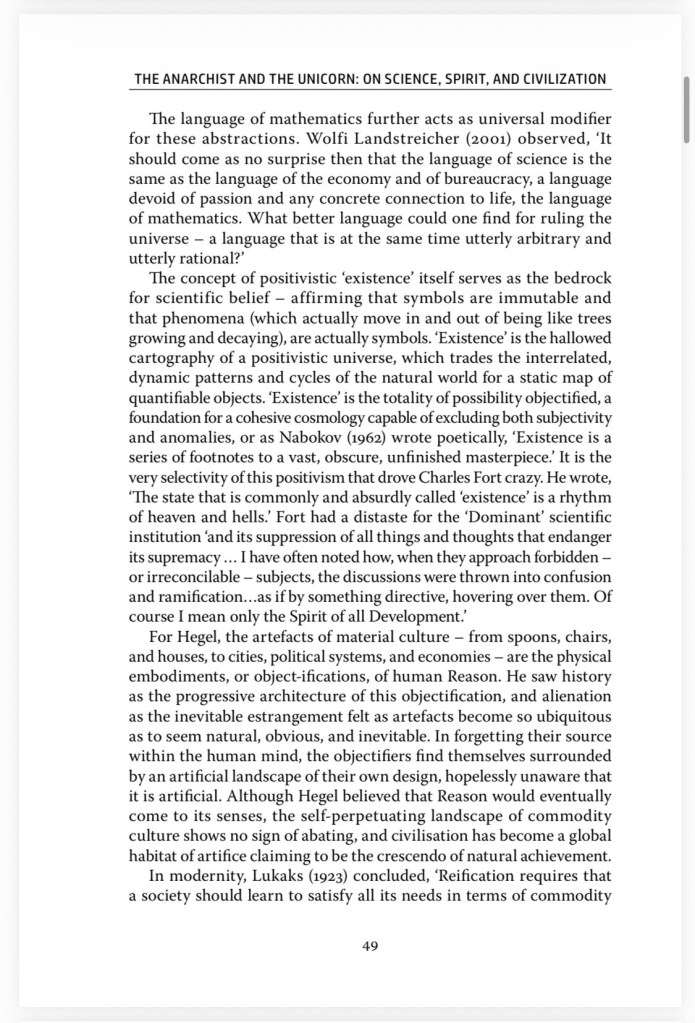
The language of mathematics further acts as universal modifier for these abstractions. Wolfi Landstreicher (2001) observed, ‘It should come as no surprise then that the language of science is the same as the language of the economy and of bureaucracy, a language devoid of passion and any concrete connection to life, the language of mathematics. What better language could one find for ruling the universe – a language that is at the same time utterly arbitrary and utterly rational?’
The concept of positivistic ‘existence’ itself serves as the bedrock for scientific belief – affirming that symbols are immutable and that phenomena (which actually move in and out of being like trees growing and decaying), are actually symbols. ‘Existence’ is the hallowed cartography of a positivistic universe, which trades the interrelated, dynamic patterns and cycles of the natural world for a static map of quantifiable objects. ‘Existence’ is the totality of possibility objectified, a foundation for a cohesive cosmology capable of excluding both subjectivity and anomalies, or as Nabokov (1962) wrote poetically, ‘Existence is a series of footnotes to a vast, obscure, unfinished masterpiece.’ It is the very selectivity of this positivism that drove Charles Fort crazy. He wrote, ‘The state that is commonly and absurdly called ‘existence’ is a rhythm of heaven and hells.’ Fort had a distaste for the ‘Dominant’ scientific institution ‘and its suppression of all things and thoughts that endanger its supremacy … I have often noted how, when they approach forbidden – or irreconcilable – subjects, the discussions were thrown into confusion and ramification…as if by something directive, hovering over them. Of course I mean only the Spirit of all Development.’
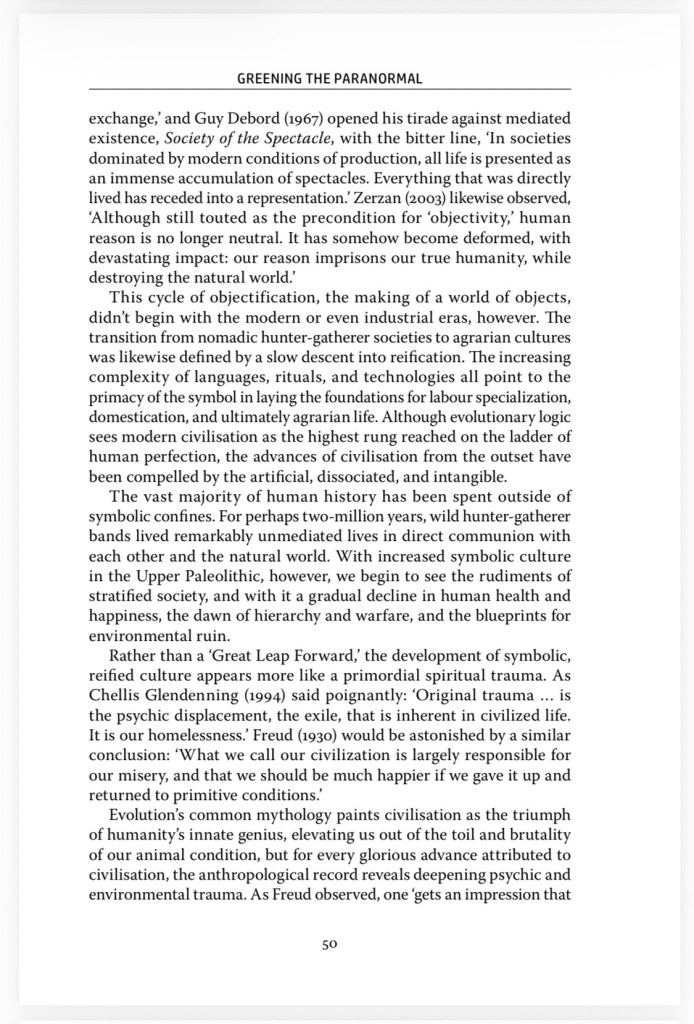
For Hegel, the artefacts of material culture – from spoons, chairs, and houses, to cities, political systems, and economies – are the physical embodiments, or object-ifi cations, of human Reason. He saw history as the progressive architecture of this objectifi cation, and alienation as the inevitable estrangement felt as artefacts become so ubiquitous as to seem natural, obvious, and inevitable. In forgetting their source within the human mind, the objectifi ers fi nd themselves surrounded by an artificial landscape of their own design, hopelessly unaware that it is artifi cial. Although Hegel believed that Reason would eventually come to its senses, the self-perpetuating landscape of commodity culture shows no sign of abating, and civilisation has become a global habitat of artifi ce claiming to be the crescendo of natural achievement. In modernity, Lukaks (1923) concluded, ‘Reifi cation requires that a society should learn to satisfy all its needs in terms of commodity exchange,’ and Guy Debord (1967) opened his tirade against mediated existence, Society of the Spectacle, with the bitter line, ‘In societies dominated by modern conditions of production, all life is presented as an immense accumulation of spectacles. Everything that was directly lived has receded into a representation.’ Zerzan (2003) likewise observed, ‘Although still touted as the precondition for ‘objectivity,’ human reason is no longer neutral. It has somehow become deformed, with devastating impact: our reason imprisons our true humanity, while destroying the natural world.’
This cycle of objectification, the making of a world of objects, didn’t begin with the modern or even industrial eras, however. The transition from nomadic hunter-gatherer societies to agrarian cultures was likewise defi ned by a slow descent into reifi cation. The increasing complexity of languages, rituals, and technologies all point to the primacy of the symbol in laying the foundations for labour specialization, domestication, and ultimately agrarian life. Although evolutionary logic sees modern civilisation as the highest rung reached on the ladder of human perfection, the advances of civilisation from the outset have been compelled by the artificial, dissociated, and intangible.
The vast majority of human history has been spent outside ofsymbolic confines. For perhaps two-million years, wild hunter-gatherer bands lived remarkably unmediated lives in direct communion with each other and the natural world. With increased symbolic culture in the Upper Paleolithic, however, we begin to see the rudiments of stratified society, and with it a gradual decline in human health and happiness, the dawn of hierarchy and warfare, and the blueprints for environmental ruin.
Rather than a ‘Great Leap Forward,’ the development of symbolic, reified culture appears more like a primordial spiritual trauma. As Chellis Glendenning (1994) said poignantly: ‘Original trauma … is the psychic displacement, the exile, that is inherent in civilized life. It is our homelessness.’ Freud (1930) would be astonished by a similar conclusion: ‘What we call our civilization is largely responsible for our misery, and that we should be much happier if we gave it up and returned to primitive conditions.’
Evolution’s common mythology paints civilisation as the triumph of humanity’s innate genius, elevating us out of the toil and brutality of our animal condition, but for every glorious advance attributed to civilisation, the anthropological record reveals deepening psychic and environmental trauma. As Freud observed, one ‘gets an impression that civilization is something which was imposed on a resisting majority by a minority which understood how to obtain possession of the means to power and coercion.’ Civilisation was a bitterly resented and repressive force from its outset.
Far from being ‘nasty brutish and short,’ Marshal Sahlins (1972) dubbed hunter-gatherers the ‘original affl uent society,’ because their material needs were so readily satisfied by the natural world. Th ey were also the original anarchist society. The lack of specialisation made each member of a band an autonomous unit, capable of moving freely to satisfy their needs. Bands were formed by voluntary affi nity, consensus, and mutual aid. Autonomy shaped band society’s ethos of egalitarianism, sharing and cooperation – all words which are synonymous with foragers in the anthropological literature. Sahlins contrasted this to modern civilisation, writing, ‘The present human condition of man slaving to bridge the gap between his unlimited wants and his insuffi cient means is a tragedy of modern times.’
The concept of work as an institution is itself wholly absent in band society, and the myth that agriculture reduced humanity’s workload has been turned upside down by recent studies. Sahlins estimated that extant hunter-gatherers only labour an average of three to fi ve hours a day to meet their needs. Even among Kung Bushmen, in their harsh desert landscape, Richard Lee (1979) estimated twelve to nineteen hours a week satisfi ed their needs. Compared to the labour required to raise crops, it is little wonder that when Lee asked one Bushman why he didn’t adopt planting, he replied, ‘Why should we plant, when there are so many mongongo nuts in the world?’ The often-observed sense of playfulness in foraging bands follows from their freedom from
social obligation, and their pursuit of unmediated fulfi lment of their
immediate needs.
With the dawning of agriculture, symbolic culture and toil became
cemented as means of livelihood. Th e separation and cultivation of
land shows how sharply the agrarian concept of self contrasts with the
far more ancient sense of transcendental fl uency and kinship foragers
enjoyed with the land. Rather than acting as a safeguard against
famine, homogenized, domesticated crops actually proved much more
susceptible to disease and failure than the diverse supply of wild foods
foragers enjoyed. Life expectancy likewise actually declined with the
emergence of agriculture, as did bone density, height, and dental health.
Although it is a common myth that agriculture was an adaptation
to growing population size, the opposite was true – population size
increased only after agriculture developed. All these conundrums turn
the popular myths of the Agricultural Revolution on their heads, and
suggest that rather than the symbolic working to advance human life,
human life became increasingly ritualised in service of the symbolic.
Th e pressures of cultivation, irrigation, and deforestation which
accompany civilisation quickly exhausts land bases, forcing collapses,
expansions, resource wars, or mixtures of these to inevitably follow
domestication. Civilisation builds cities and leaves deserts in its wake.
Th e barren hills of Lebanon – once covered in lush cedar forests –
and the wastes of the once bountiful Tigris-Euphrates valley, where
irrigation with saline river water slowly toxifi ed the topsoil leaving it
unproductive to this day, are famous and enduring examples.
Nietzsche (1885) wrote, ‘Man is the most domesticated animal of all.’
Herre & Rohres (1989) found that ‘mental and behavioral deterioration’
accompanies a decrease in brain weight and cortex volume in captive
(domesticated) animals. They noted: ‘Mammals are capable of
memory and planned actions, and it is entirely justifi ed to describe the
intraspecifi c communication systems of mammals as species-specifi c
‘languages.’ In captivity, intraspecifi c communication is reduced.’
Domestic dogs, for instance, have nowhere near the vocal complexity
of wolves – the result of diminished nervous systems capabilities.
Perhaps the rise of language as a dominant and defi ning cultural force
coinciding with the rise of civilisation should be understood not as an
advancement of our power to communicate but a remnant of a much
fuller capacity for communion – not just among humans, but with the
totality of being.
Freud (1933) suggests that telepathy is ‘the original, archaic method
of communication,’ and Pobers (1956), after observing supernormal
communications during natural disasters, suggested that for so-
called ‘primitive’ people, telepathy ‘remains an archaic means of
communication in critical and confl ictual situations.’ He worried that
‘the penetration of technological progress is faster than we think. In a
few years’ time there may be very little left of the phenomena.’
Pobers heard of a woman who asked a cotton tree to psychically
contact her children – apparently the children responded in kind.
When questioned, she replied, ‘Rich people have telephones. I am poor.
I have no telephone. I have to try it that way.’ Laurens van der Post
(1958) also observed telepathy among the Kalahari Kung, and when he
inquired how this was possible a Bushman tapped his chest and said,
‘We Bushmen have a wire here … it brings us news.’
Th e telephone metaphors are telling. Who hasn’t had a distant friend
wander into their thoughts just before they call? Th is intuition may
be just a shadow of its former potential. As Marshall McLuhan (1964)
wrote, ‘With the arrival of electric technology, man has extended, or
set outside himself, a live model of the central nervous system itself. To
the degree that this is so, it is a development that suggests a desperate
suicidal autoamputation, as if the central nervous system could no
longer depend on the physical organs to be protective buff ers against
the slings and arrows of outrageous mechanism.’
Technology, from the earliest stages of the division of labour, has
always resulted in atrophy. Any specialisation naturally fragments
wholesome autonomy, and creates inherent social imbalances around
the division of labour. Shamans are considered the original specialists
– in fact the fi rst cultural practitioners at all – and their appearance
in the archaeological record is the fi rst clear seed of socio-economic
stratifi cation.
Along with the advent of shamanism – which suggests by nature that
the trauma at the centre of the shift to advanced symbolism was a deeply
spiritual one – also came the fi rst rumblings of ritual and ideology –
the seeds of cultural obligation, myth, and hierarchy. Chiefdoms soon
follow, structuralizing and perpetuating wealth imbalances, and even
in early chiefdoms anthropologists identify a bureaucratic class.
Another symbolic relic from the transition to agrarian life is the
number. Th e need to quantify developed only with specialized trades,
which required a way to standardize commodity exchange – a problem
which had been absent in the hunter-gatherer gift economy. As Zerzan
(1988) explains in Number: Its Origin and Evolution, ‘Where articles
are made, animals killed or plants collected for domestic use and
not for exchange, there is no demand for standardized numbers or
measurements. Measuring and weighing possessions develops later,
along with the measurement and defi nition of property rights and
duties to authority.’
Some of the earliest cave paintings – created by shamans –
were stunningly fluid and expressive, but these impressionistic
representations gradually formalized into simpler systems devoid of that
earlier vitality, showing the tendency of symbols to lose their emotive
power as they reach cultural stasis. Likewise, the earliest languages
are rich in verbs but give way to nouns during agrarian settlement,
where their prevalence suggests a worldview of fi xed objectivity and
domination long before modernity. Th e advent of writing later cemented
the quasi-realities of language, time and number. From there they take
their places in administrating wealth and debt – the cornerstones of
complex material culture.
From the point where a quantifi ed economy is the central axis
which civilized life revolves around, it is an inevitable progression
to the numerical cosmology of Descartes (1659), where, ‘everything
happens in nature in a mathematical way, and there is no quantity that
is not divisible into an infi nity of parts,’ and the body is ‘just a statue
or a machine made of earth.’ Our inheritance of this lineage – of the
symbolic subsuming all nature under its authority – leaves little wonder
as to the impoverishment and despair of the modern world.
Modern cosmology declares life is the product of chemical chance
in a mechanical universe – a fl uke on a meaningless planet which
is inevitably dissipating into the black vacuum of entropy anyhow.
As Deloria (2002) lamented, ‘Science is our religion today. Because
it offi cially produces no concept of divinity, it is regarded as neutral
on the question of origins. But science is fi rmly grounded in a crude
materialism that precludes the possibility of divinity, indeed even
rejects any hint of teleology – the sense of purpose and meaning – in
its explanation of the world we live in.’ It is no wonder that postmodern
culture is rife with nihilism, narcissism, irony, and depression – the
authenticity and meaningfulness inherent in nature are buried under
the wasteland of artifi ce. Horkheimer (1947) summarized, ‘On the one
hand, nature has been stripped of all intrinsic value or meaning. On the
other, man has been stripped of all aims except self-preservation. He
tries to transform everything within reach into a means to that end.’
Presently, the evolutionary myth is striving towards literal alienation
– proclaiming that the ultimate destiny of civilization is to (somehow)
colonize space. Th e fact that this ideal came from cultural osmosis of
UFO lore (Vallee, 1969) is an irony worth pondering, and off ers troubling
revelations about both the myths of civilization and the ambitions of
otherworldly visitors, but even on a mundane level, the myth that space
colonization is the destiny of humanity’s evolution is the epitome of
shameless alienation, showing a naive and dangerous antipathy towards
the earth and laying bare global civilization’s omnicidal indiff erence
towards life’s inherent value.
Yet of course hope remains in the margins. As Fort proved by so joyously
fl aunting the ‘damned’ in the face of science’s pretensions, the symbolic can
never fully encompass a universe which defi es parameters. Landstreicher
(ibid) said it well, ‘Th e scientifi c accountants with their calculations, graphs,
charts and ledgers are perpetually confronted with a recalcitrant reality
comprised of entities that don’t conform to numbers or measurements,
of individuals who resist interchangeability, of phenomena that cannot
be repeated – in other words, of things that incessantly unbalance the
accounts. Scientists may attempt to retreat to the laboratory, to the thought
experiment, to virtual reality, but beyond the door, beyond their minds,
beyond the realm of cyberspace, the unaccountable still waits.’
Instead of trying to corral anomalies into the packing plant of
scientifi c consensus, perhaps it is better to directly seek the wondrous,
untamable wisdom which anomalies and wildlings alike assert must
await beyond the fences of objective control – to immerse ourselves in
the ‘rhythm of heavens and hells,’ to rediscover our interconnectedness
and the unfolding of eternity in each moment. As Yeats (1893) wrote,
‘How do we not know but that our own unreason may be better than
another’s truth? for it has been warmed in our hearths and in our souls,
and is ready for the wild bees of truth to hive in it, and make their sweet
honey. Come into this world again, wild bees, wild bees!’
Or in Job: 39, where the whirlwind taunts Job with the unbridled
strength of the wild and mystical: ‘Canst thou bind the unicorn with
his band in the furrow? or will he harrow the valleys after thee? Wilt
thou trust him, because his strength is great? or wilt thou leave thy
labour to him? Wilt thou believe him, that he will bring home thy seed,
and gather it into thy barn?’ Like Chang Tzu’s gnarled, crooked tree
which is blessed because no carpenter can square its strange wood, the
anomalous defi es objectifi cation.
Mystical and mythical traditions off er a breadcrumb trail of de-
civilizing reverse psychology. Th at love is often prescribed by mystics
as an antidote to the trauma of ego separation – the reifi cation of the
self – is more than a banal moralism. ‘Against all the evidence of his
senses, a man who is in love declares that ‘I’ and ‘you’ are one, and is
prepared to behave as if it were a fact,’ wrote Freud in Civilization and
its Discontents. Zerzan (1988) found, ‘Th ere is a profound truth to the
notion that ‘lovers need no words.’ Th e point is that we must have a
world of lovers, a world of the face-to-face, in which even names can
be forgotten, a world which knows that enchantment is the opposite of
ignorance.’ Love in the mystical sense is neither a pacifying platitude
nor a warm cocoon against the cold of sorrow. It is the intimacy that
comes with the limitlessness of the self, and the sensuality of subjectivity.
It is a living way to embrace, transcend, and travel among the stars –because we already do.