The Self, Poetry, and the Psychology of Existentialism (2008) : How linguistic synaesthesia liberates authentic self-expression by resolving dissonance in relation to ego-dystonic sociolinguistic recruitment (alienation).
These are some of my first rumblings of an “Archeology of the Self” in psychology, biology, philosophy, and culture—an interdisciplinary approach to language, epistemics, and the anthropology of religion and human nature.
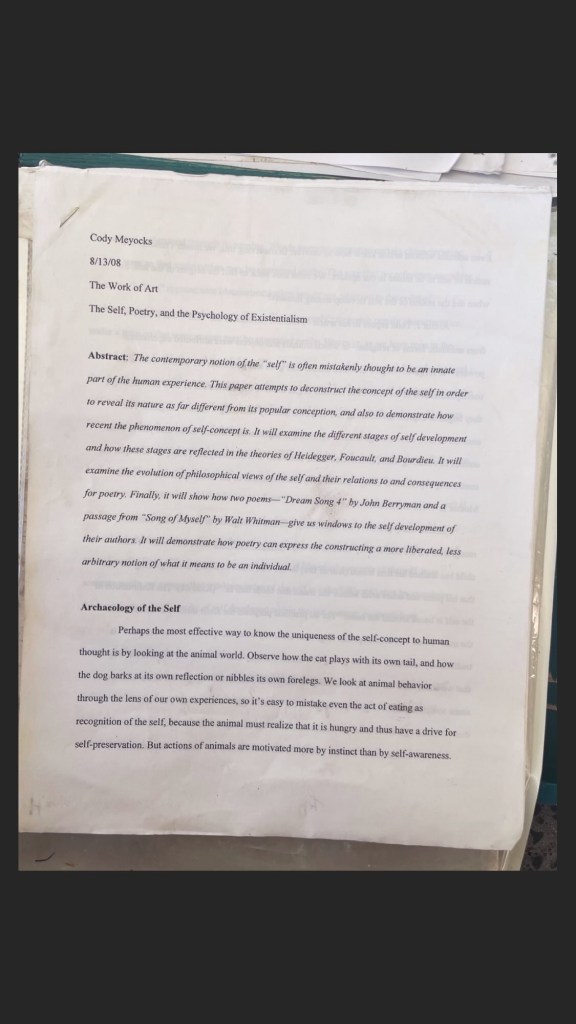
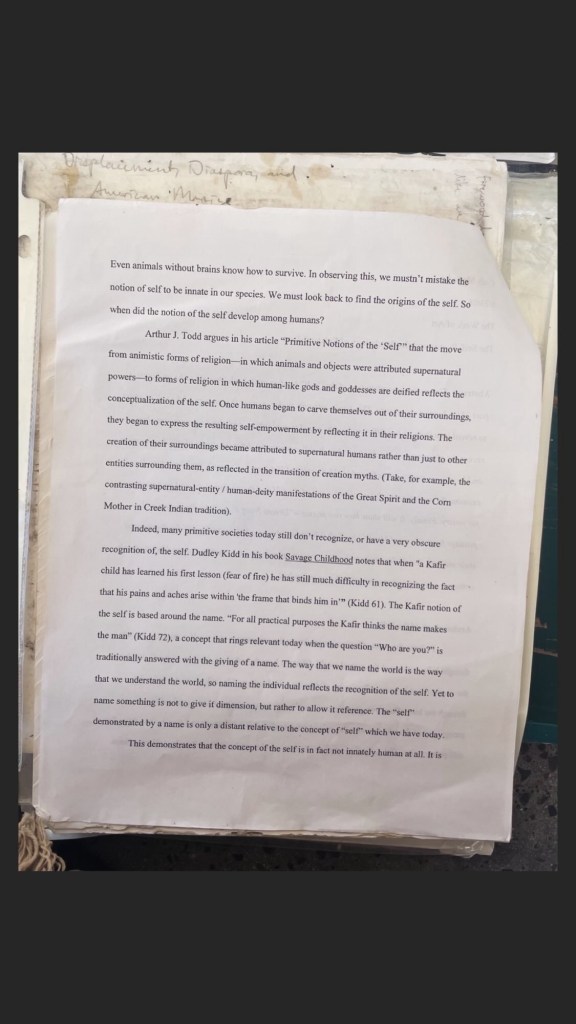
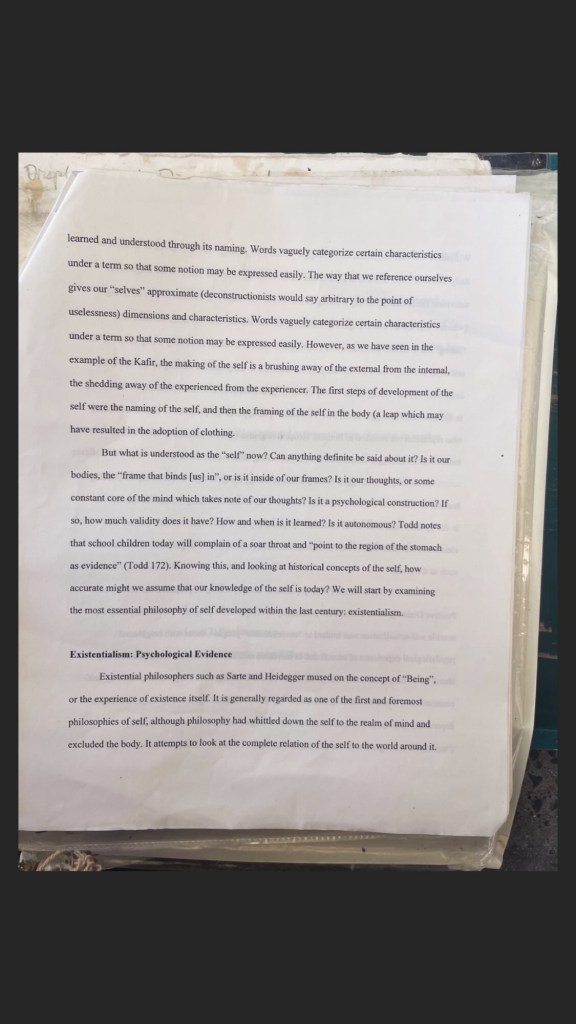
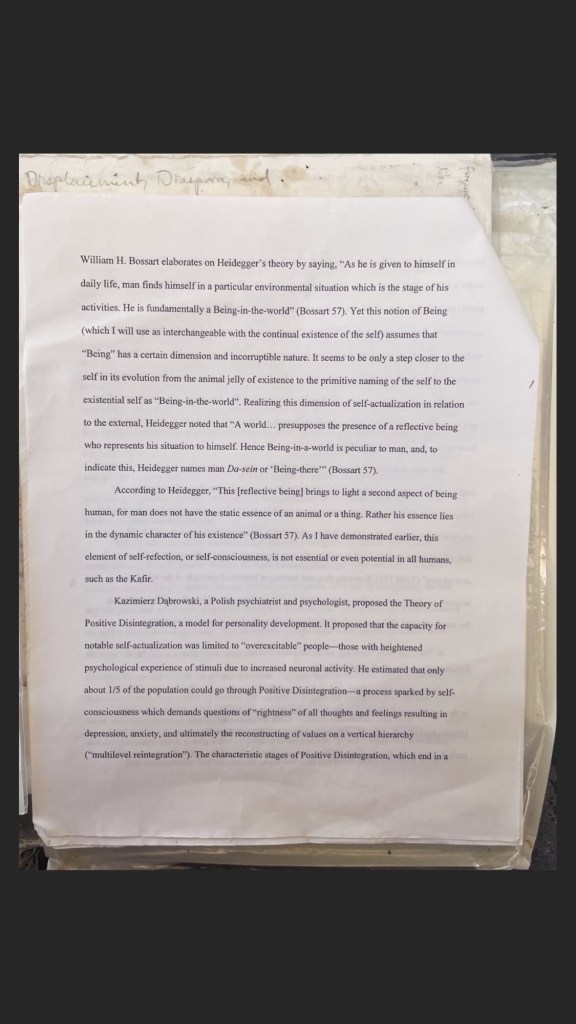
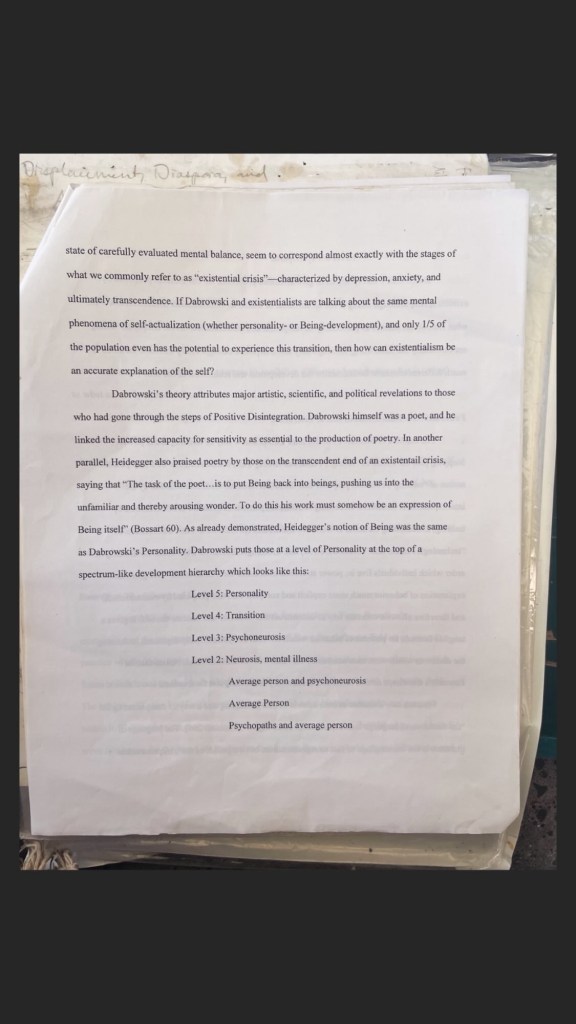
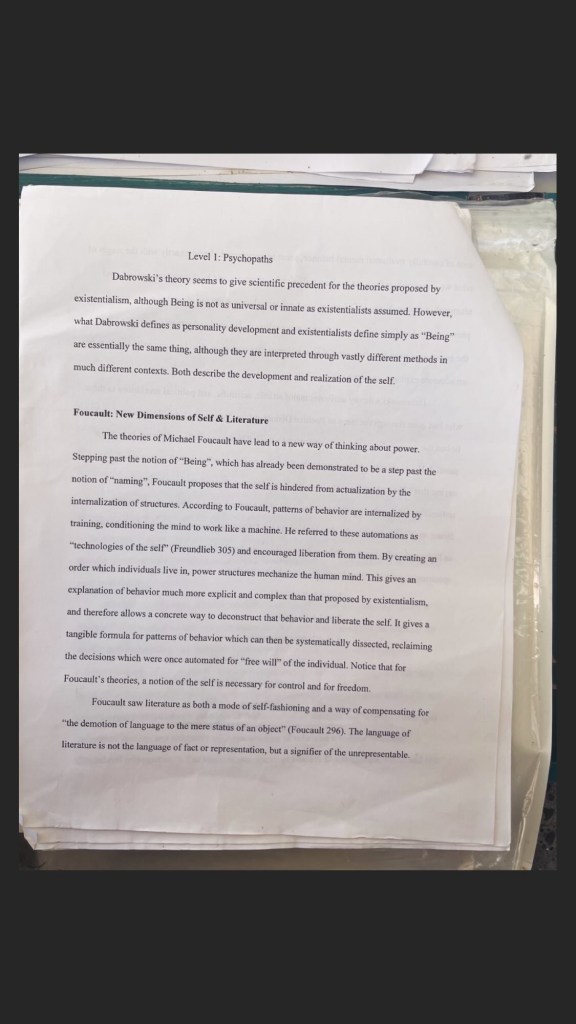
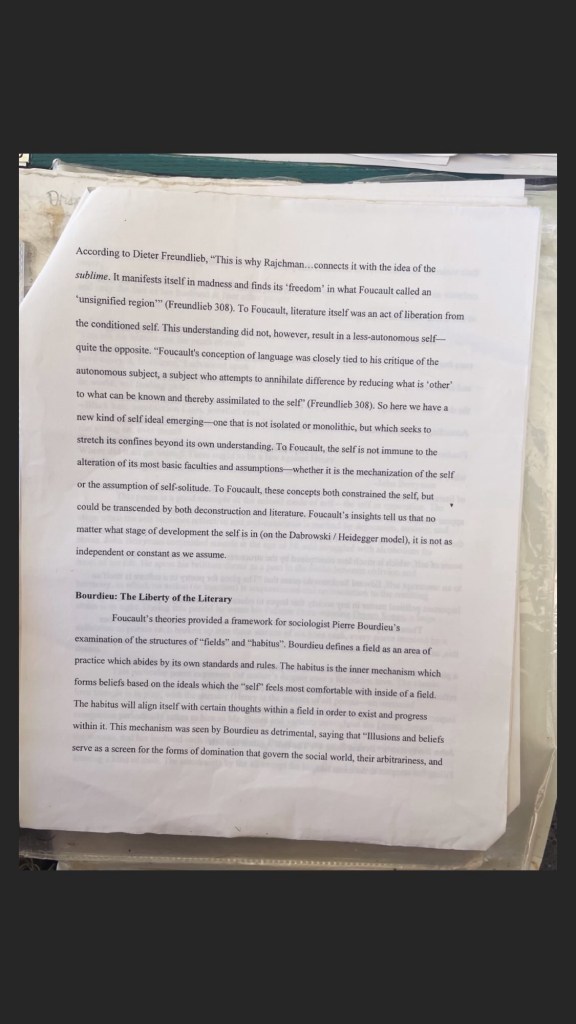
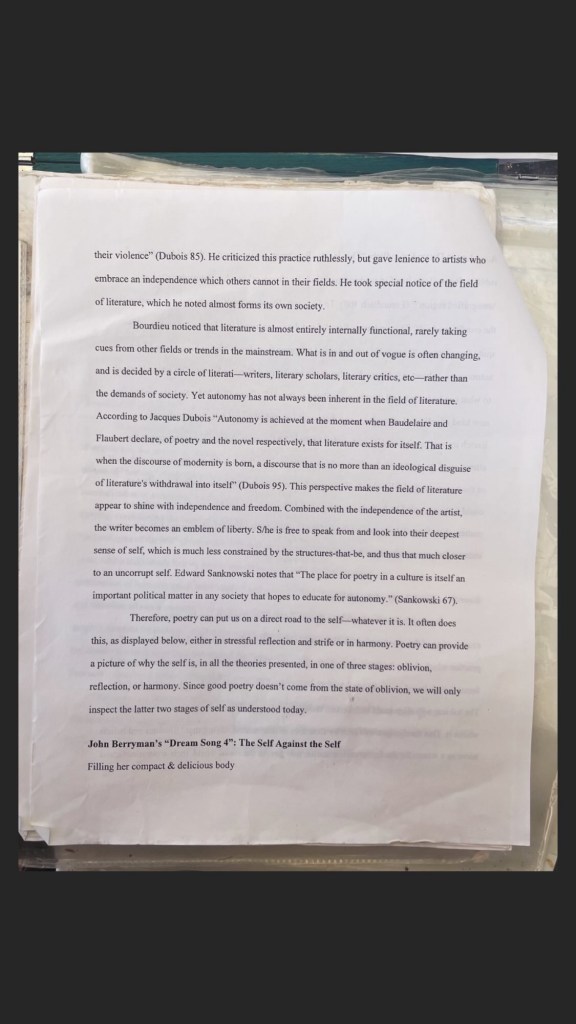
Here is a paper from 2008 that has amazingly survived my travels all these years, that I wrote for a course at PSU. It shows some of my early attempts to decipher the common undercurrents between disciplines (primarily psychology, language theory/cultural anthropology, and poetry) in what I term the “Archeology of the Self”-assuming as I was at the time that culturally-constructed identity and sociolinguistic recruitment may play some fundamental role in psychological alienation and the modern existential crisis (which I find naive but the awkward formation of a good intention in retrospect).
I discuss linguistic synasthesia in poetry as a form of psychological expression of free will and authentic individuality in relation to existentialism, Dabrowskian personality / moral value development, and individuation that conflicts with psychological dissonance in personality cohesion more generally (as in, at times where external forms of domination are held as one’s personal liability in ways that conflict with our guiding internal value structures-ie. Foucault’s panopticon, even if that is not explicitly stated here— and alienation more generally).
The most fundamental flaw I make is referencing Dabrowski’s quite non-medical theories on developmental “moral hierarchy” based on his concept of nervous system over-excitability (OE)— which is an interesting fringe lead that ultimately reproduces extremely flawed prejudices by replicating the language of hierarchy in an almost imperative or biologically essentialist (Darwinian-feeling) way, and does not describe his intention but certainly destroyed his theory’s effect.
I take this as fatal quackery in retrospect, especially in the ways I presented it here. I have a thing with medical beneficence, and I don’t know that Dabrowskian personality structuring is a useful rubric for public consumption whatsoever.
Also I hate Walt Witman now, unfortunately.
Other than that, this is the basic rubric for my later investigations into the philosophy of language, culture, human biology, and ultimately epistemics.
I hope that showing my work and reflecting on my flaws-where they came from and how I overcame them by relying on the integrity of other academics and scholars held to more rigorous standards, as well as public educational access (in particular PubMed, libraries, self-published zines, and the Internet Archive have been indespensible resources)-helps others understand me and my work in more overarching context.
Ultimately, this is a young formulation of themes I have come to address in my later life and work that lie at the core of human philosophy across cultures:
What is the relationship between individual and group morality? Who am I? How do thoughts, language structures, and cultural institutions like religion effect alienation, and our core responsibility to ourselves and others? What is this question’s bearing on psychology? What drives authenticity when it is repressed in the environment?
What is knowledge? What is real? What is worthy? What is true? What is the good life and how do we acheive it?
Keep in mind that I was an English major, so poetry is my bridge.
Ultimately these themes are crucial and I’m proposing much more than something superficial and commercial like “self- actualization through artistic expression”—which I find hopelessly belittling and further complicating the argument against cultural essentialism in relation to human value.
If we are driven to resolve internal, individual conflicts that bring us into disagreement with prevailing attitudes and institutions of our culture-ultimately this is dialectic, potentially political, and undiscernable from religion and metacognitive medicine as they have functioned throughout history.
What I am clearly missing here is training in psychoanalysis and the foundations of modern psychology-in particular the contributions of Klein, Winnicott, and Joseph Campbell as they bleed into the understanding of religion as a distinct current in human life (showing both biological and psychological necessity that does contrast with cultural uniformity by nature).
Sometimes one does find oneself alone and preserving something true and righteous in the midst of storms and darknesses of prevailing popular opinion.
In the current era, this automatically makes me think of the misuse of public knowledge-the architecture of public literacy -to develop Al models that are designed as impliments of social/industrial-scale technological abuse and deprivation of liberty, which betrays their founding mediums of aggregated human endeavor and labor embedded the written word and its free access in digital form.
But there is something more crucial at stake in truly creating maps around the tolerances of non-conformity, imposed self- negation (as in the case of severe psychological or domestic abuse), and its universal relationship to cultural cohesion, freedom, and relationship to all life and the universe at large (our own-not another’s).
I know that my work is about individual freedom in a healthy, holistic way that simply validates our common understanding of what it means to be born and seek harmony in our own lives as human beings.
The fact that articulating these landscapes has come at a personal cost to me of my efforts being viewed as an affront to the pathological entitlements of certain authorities, seems only to vindicate how crucial it is to design functional concepts of healthy individuality and existential meaning that do not rely on the permission or encroachment of others. This is an old endeavor, ultimately, and hardly frivolous.
Perhaps we are born free as a natural law that is insurmountable-perhaps we must become free through self- actualization that tests the wisdom imbued in us through cultural recruitment-by way of relating, feeling, speaking, searching, and ultimately by way of faith.
Ultimately, freedom is a misnomer because we are bound to relating in ways that defy any escape from biology.
That means, in a sense, that liberating each other is also a necessary endeavor for our own good and wellbeing. A gentle, earstwhile responsibility-one can hope and imagine.